Secrets Management FAQs: How to Secure Credentials Properly
Hardcoding secrets in code is the most common error, but even encrypted files fail if the decryption key is stored in the same repository.

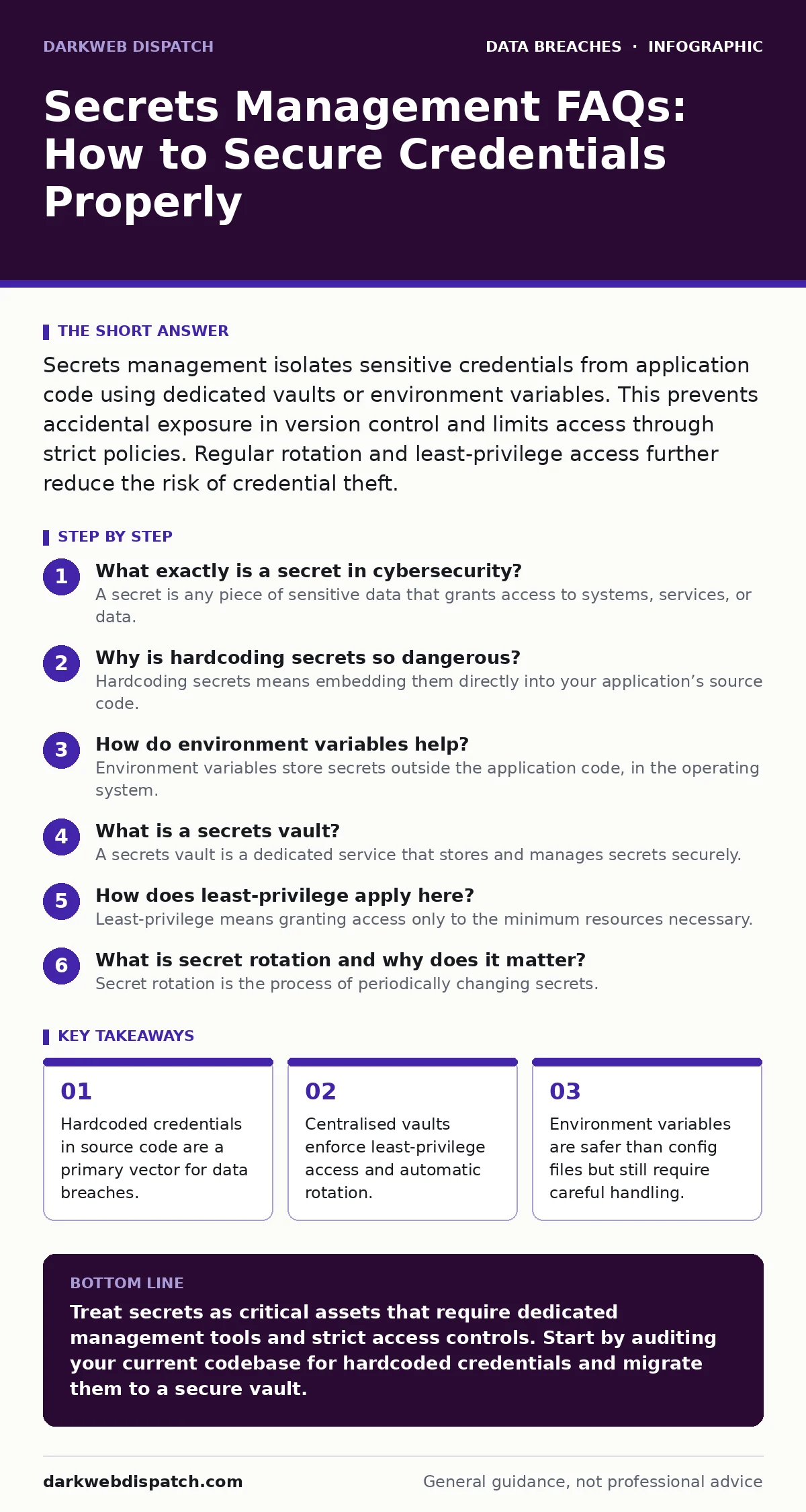
Secrets management isolates sensitive credentials from application code using dedicated vaults or environment variables. This prevents accidental exposure in version control and limits access through strict policies. Regular rotation and least-privilege access further reduce the risk of credential theft.
What exactly is a secret in cybersecurity?
A secret is any piece of sensitive data that grants access to systems, services, or data. This includes passwords, API keys, private cryptographic keys, and tokens. Unlike user passwords, these secrets often have broader permissions and longer lifespans. They are the keys to the kingdom for your infrastructure.
If a secret is compromised, an attacker can impersonate your application or service. This allows them to access databases, cloud storage, or external APIs. The damage can be immediate and extensive. Understanding what constitutes a secret is the first step in protecting it.
Why is hardcoding secrets so dangerous?
Hardcoding secrets means embedding them directly into your application’s source code. This is dangerous because code is often shared, version-controlled, and sometimes publicly visible. If a secret is in the code, it is in the repository history. Deleting it later does not remove it from past commits.
Imagine an open-source project where a developer accidentally commits an API key. Scanners detect it within minutes. Attackers scrape these repositories for valid credentials. This exposure can lead to account takeover or data theft. The cost of remediation is high, requiring key rotation and access audits.
How do environment variables help?
Environment variables store secrets outside the application code, in the operating system. When the application runs, it reads these variables from the system environment. This separates the secret from the source code, reducing the risk of accidental exposure in version control.
However, environment variables are not a complete solution. They can still be leaked through logs, error messages, or debugging tools. If an attacker gains access to the server, they can often read these variables. They provide a layer of separation but not strong protection on their own.
What is a secrets vault?
A secrets vault is a dedicated service that stores and manages secrets securely. It encrypts secrets at rest and in transit, controlling access through strict policies. Applications request secrets from the vault at runtime, rather than storing them locally. This centralises management and auditing.
Vaults often support automatic rotation, changing secrets regularly without manual intervention. This limits the window of opportunity for an attacker who steals a secret. They also provide detailed logs of who accessed which secret and when. This visibility is critical for detecting suspicious activity.
How does least-privilege apply here?
Least-privilege means granting access only to the minimum resources necessary. In secrets management, this means an application should only access the secrets it needs to function. It should not have access to database passwords if it only needs an API key.
Implementing this requires careful mapping of application dependencies. It often involves creating specific service accounts with narrow permissions. This limits the blast radius if a secret is compromised. An attacker with a low-privilege secret cannot pivot to more critical systems.
What is secret rotation and why does it matter?
Secret rotation is the process of periodically changing secrets. This reduces the risk of long-term compromise. If a secret is stolen, its usefulness is limited to the period before it is rotated. Automatic rotation ensures this happens consistently, without relying on human memory.
Many vaults support dynamic secrets, generating a new credential for each request. These secrets often have very short lifespans, sometimes just minutes. This makes stealing and using them extremely difficult. It adds a layer of temporal security to your infrastructure.
| Method | Security Level | Management Overhead | Best For |
|---|---|---|---|
| Hardcoded | Very Low | Very Low | Testing only |
| Env Variables | Medium | Low | Simple apps |
| Config Files | Medium | Medium | Legacy systems |
| Secrets Vault | High | High | Production |
Can I manage secrets in cloud platforms?
Most cloud providers offer native secrets management services. These integrate directly with other cloud resources, simplifying access control. They often provide encryption and auditing features out of the box. Using native services can reduce complexity and cost.
However, relying solely on cloud services can create vendor lock-in. If you move to a different provider, migrating secrets can be challenging. Consider using a provider-agnostic vault if you have a multi-cloud strategy. This ensures consistency and portability across environments.
How do I protect against insider threats?
Insider threats can be malicious or accidental. Employees with access to secrets may misuse them or expose them through negligence. Strict access controls and monitoring are essential. Regular audits ensure that permissions are still appropriate.
Segregation of duties ensures that no single person has complete control over critical secrets. This requires approval workflows for sensitive operations. Training employees on the importance of secrets management is also vital. Human error is often the weakest link in the chain.
What about secrets in containerised environments?
Containers often bundle applications and their dependencies. If secrets are baked into the container image, they are exposed to anyone with access to the image. Instead, inject secrets at runtime using environment variables or mounted volumes. This keeps the image generic and secure.
Orchestration platforms like Kubernetes have their own secrets management features. However, these are not always encrypted by default. Ensure that your platform encrypts secrets at rest. Regularly scan container images for hardcoded secrets before deployment.
Key takeaways
- Hardcoded credentials in source code are a primary vector for data breaches.
- Centralised vaults enforce least-privilege access and automatic rotation.
- Environment variables are safer than config files but still require careful handling.
- Human error remains the largest threat to secret integrity.
Treat secrets as critical assets that require dedicated management tools and strict access controls. Start by auditing your current codebase for hardcoded credentials and migrate them to a secure vault.
Frequently asked questions
Is encrypting a config file enough?
No, because the decryption key must be stored somewhere, often alongside the file, creating a single point of failure.
How often should I rotate secrets?
Ideally, use dynamic secrets that rotate with every session, or rotate static secrets regularly based on risk assessment.
Can I use the same secret for multiple environments?
No, this violates least-privilege and increases the blast radius if one environment is compromised.
What if I lose access to my vault?
Ensure you have a secure, offline backup of the vault's root keys or recovery codes, stored physically separate from the infrastructure.
How this guide was produced: written by the DarkWeb Dispatch editorial team with AI assistance, checked against the public references listed below, and reviewed when the facts change. See our editorial policy or report an error.