How the HIPAA Security Rule Shapes Technical Decisions
The HIPAA Security Rule forces teams to document risk decisions, turning vague security hopes into auditable engineering choices that survive leadership changes.

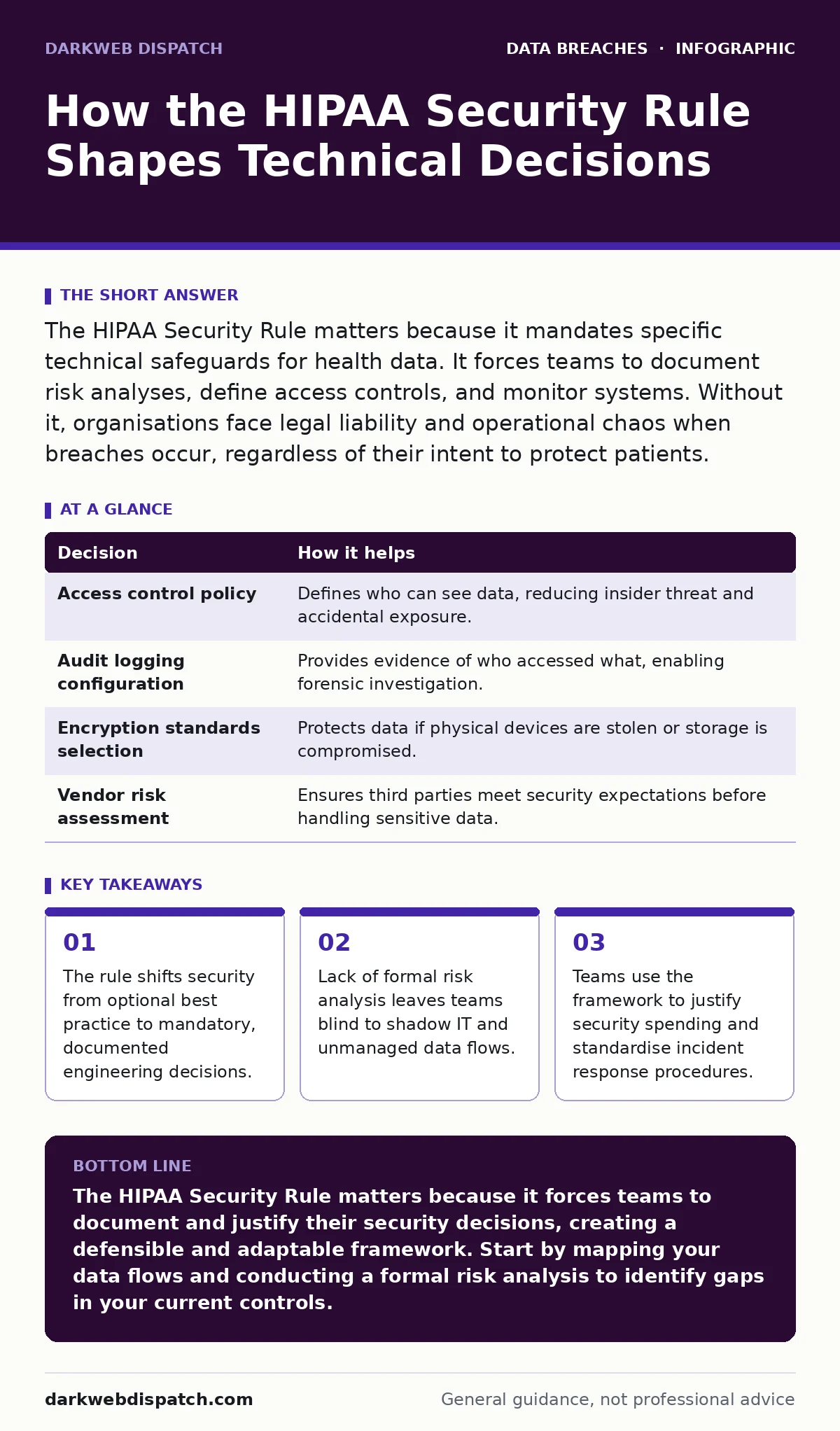
The HIPAA Security Rule matters because it mandates specific technical safeguards for health data. It forces teams to document risk analyses, define access controls, and monitor systems. Without it, organisations face legal liability and operational chaos when breaches occur, regardless of their intent to protect patients.
The Architecture of Mandatory Choice
Most technology teams view compliance as a burden. They see checklists and paperwork that distract from building features. The HIPAA Security Rule operates differently. It does not prescribe specific tools or software. Instead, it mandates a process for making decisions about risk. This distinction changes how engineers design systems.
You cannot claim you protected data if you did not document why you chose your controls. The rule requires a risk analysis. This is a formal assessment of how likely threats are and how severe the impact would be. You must record these findings. You must then select safeguards that address those specific risks. This creates a paper trail that survives staff turnover.
Decisions Driven by Documentation
Security decisions often rely on intuition or budget constraints. Under this framework, every decision must link back to the risk analysis. If you choose not to encrypt a specific database, you must explain why the risk is acceptable. You cannot simply ignore it. This forces teams to confront trade-offs they usually avoid.
Consider encryption at rest. It adds computational overhead. It complicates backup processes. A team might delay implementing it to save time. The rule requires you to weigh this convenience against the risk of data exposure. You must document that trade-off. This documentation becomes the basis for future audits and internal reviews.
| Decision | How it helps |
|---|---|
| Access control policy | Defines who can see data, reducing insider threat and accidental exposure. |
| Audit logging configuration | Provides evidence of who accessed what, enabling forensic investigation. |
| Encryption standards selection | Protects data if physical devices are stolen or storage is compromised. |
| Vendor risk assessment | Ensures third parties meet security expectations before handling sensitive data. |
The Cost of Unstructured Security
Imagine a healthcare provider that ignores formal risk analysis. They assume their firewall is enough. They do not track who accesses patient records after hours. They do not review third-party contracts for security clauses. This approach feels efficient until a breach occurs.
Without documented decisions, the team cannot prove they acted reasonably. They cannot show they considered specific threats. This leaves them vulnerable to legal consequences. More importantly, they lack a baseline for improvement. They do not know which controls are working and which are failing. Security becomes a series of reactive patches rather than a coherent strategy.
How Teams Implement the Framework
Teams use the rule to structure their security programmes. They start by mapping data flows. They identify where protected health information enters, moves through, and leaves their systems. This map reveals hidden risks. It shows where data sits in unmonitored storage or moves through unsecured channels.
Next, they define access policies. They determine who needs access to perform their jobs. They implement role-based access control. This limits exposure to only those who require it. They then configure logging to record access events. This creates an audit trail. Teams review these logs regularly to detect anomalies.
Integrating with Broader Security Efforts
This rule does not exist in isolation. It intersects with other security challenges. For example, shadow IT data exposure often occurs when staff use unapproved applications to handle patient data. The rule’s requirement for risk analysis helps teams identify these rogue applications. It forces them to account for all data handling, not just official systems.
Similarly, email account compromise can lead to mass data exfiltration. The rule’s emphasis on access control and audit logging helps teams detect and respond to these incidents. By monitoring access patterns, teams can spot unusual login locations or times. This early detection limits the damage.
The Role of Technical Safeguards
The rule specifies four types of technical safeguards. These are the concrete measures teams must implement. Access control ensures only authorised users can view data. Audit controls record and examine activity in information systems. Integrity controls prevent improper modification or destruction of data. Transmission security protects data moving across networks.
Each safeguard requires specific configuration. For access control, you must define roles and permissions. For audit controls, you must ensure logs are tamper-proof and retained for a set period. For integrity, you must use checksums or digital signatures. For transmission, you must use encryption protocols. These are not suggestions. They are required components of a compliant system.
Managing Third-Party Risks
Healthcare organisations rarely operate alone. They use cloud providers, billing services, and analytics platforms. These third parties often process protected health information. The rule requires you to assess their security practices. You cannot outsource your responsibility.
You must review their contracts. You must ensure they agree to implement appropriate safeguards. You must monitor their compliance. This adds complexity to vendor management. It requires legal and security teams to work together. Failure to assess third-party risk can lead to breaches that are technically your fault, even if the vendor made the mistake.
Sustaining Compliance Over Time
Compliance is not a one-time project. It is an ongoing process. Systems change. New threats emerge. Staff roles evolve. Your risk analysis must reflect these changes. Teams must update their documentation regularly. They must re-evaluate controls when technology shifts.
This continuous improvement cycle builds resilience. It ensures your security posture adapts to new realities. It also prepares you for audits. Auditors look for evidence of ongoing management. They want to see that you review logs, update policies, and train staff. This discipline turns security from a cost centre into a strategic asset.
Key takeaways
- The rule shifts security from optional best practice to mandatory, documented engineering decisions.
- Lack of formal risk analysis leaves teams blind to shadow IT and unmanaged data flows.
- Teams use the framework to justify security spending and standardise incident response procedures.
The HIPAA Security Rule matters because it forces teams to document and justify their security decisions, creating a defensible and adaptable framework. Start by mapping your data flows and conducting a formal risk analysis to identify gaps in your current controls.
Frequently asked questions
Does the HIPAA Security Rule require specific software tools?
No, the rule is technology-neutral. It mandates outcomes and processes, not specific products or vendors. You choose the tools that best meet the required safeguards.
Who is responsible for implementing the Security Rule?
Covered entities and their business associates are responsible. This includes healthcare providers, insurers, and any third party that handles protected health information on their behalf.
How often must risk analyses be performed?
Risk analyses must be conducted regularly. The frequency depends on the organisation’s size, complexity, and changes in technology or threats. Annual reviews are common practice.
What happens if a team fails to comply?
Non-compliance can result in significant fines and legal action. It also increases the risk of data breaches, which can damage reputation and lead to loss of patient trust.
How this guide was produced: written by the DarkWeb Dispatch editorial team with AI assistance, checked against the public references listed below, and reviewed when the facts change. See our editorial policy or report an error.