Third Party Risk Assessment Questionnaire: What to Ask and Why
Your vendor questionnaire reveals their security posture but hides the true risk of shared credentials and outdated sub-contractor policies.

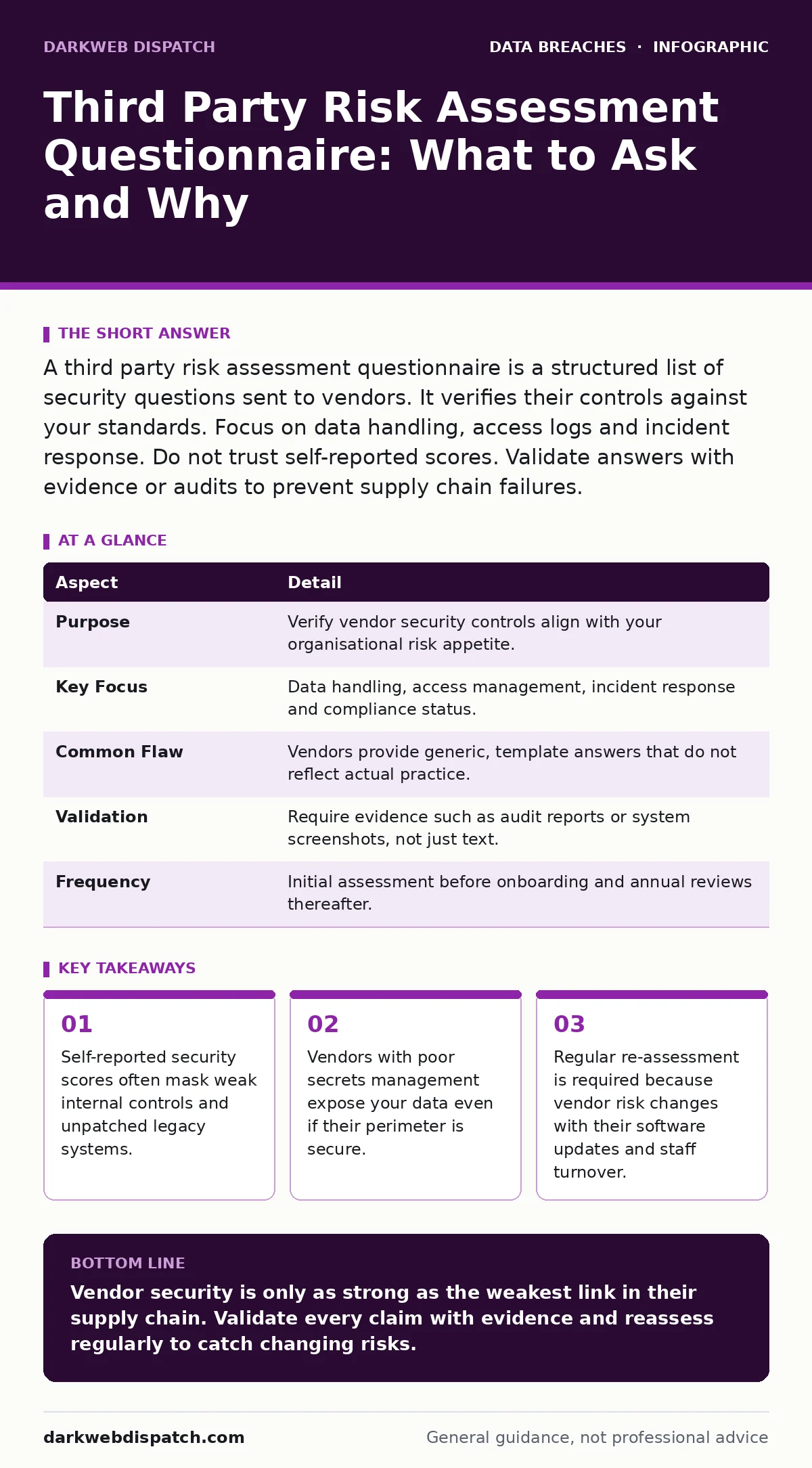
A third party risk assessment questionnaire is a structured list of security questions sent to vendors. It verifies their controls against your standards. Focus on data handling, access logs and incident response. Do not trust self-reported scores. Validate answers with evidence or audits to prevent supply chain failures.
The Library Analogy for Vendor Trust
Imagine you hire a locksmith to install a new safe in your office. You check their certificate and insurance. You assume the job is secure. Now imagine the locksmith shares the master key code with their apprentice. That apprentice writes the code on a sticky note and leaves it on a café table. Your safe is breached, not because you chose poorly, but because you did not assess the locksmith’s internal habits.
A third party risk assessment questionnaire operates on the same principle. It is a documented set of questions designed to evaluate the security practices of an external vendor. The goal is to ensure their controls match your requirements. This process extends your security boundary to include any party that touches your data or systems.
At a Glance: Assessment Basics
| Aspect | Detail |
|---|---|
| Purpose | Verify vendor security controls align with your organisational risk appetite. |
| Key Focus | Data handling, access management, incident response and compliance status. |
| Common Flaw | Vendors provide generic, template answers that do not reflect actual practice. |
| Validation | Require evidence such as audit reports or system screenshots, not just text. |
| Frequency | Initial assessment before onboarding and annual reviews thereafter. |
How the Third Party Risk Assessment Questionnaire Works
The process begins with classification. You categorise vendors based on the sensitivity of the data they access. A marketing agency that only sees public logos requires less scrutiny than a cloud provider hosting customer payment details. This tiered approach saves time and focuses resources where the risk is highest.
You then distribute the third party risk assessment questionnaire. This document asks specific technical and procedural questions. Does the vendor encrypt data at rest? How do they handle employee termination? Do they maintain a data breach response plans for their own incidents? The answers provide a baseline picture of their maturity.
The final step is validation. A vendor might claim they use role-based access control to limit data visibility. You must verify this by asking for a sample policy or an excerpt from their access review logs. Without evidence, the questionnaire is merely a formality. It provides no real protection against supply chain attacks.
Who Is Affected by Third-Party Risks
Every organisation that uses external services faces third-party risk. This includes software vendors, cloud infrastructure providers, managed service providers and even freelance consultants. The risk is not limited to large enterprises. Small businesses often rely on single vendors for critical operations, making them disproportionately vulnerable to a single point of failure.
Vendors themselves are affected. They must invest time in completing assessments and maintaining compliance. This creates a hidden cost. Smaller vendors may lack the resources to answer detailed technical questions accurately. They might also resist sharing sensitive security details, fearing competitive disadvantage or exposure of their own weaknesses.
End users are the ultimate victims of failure. When a vendor suffers a data leak, the primary organisation faces reputational damage and regulatory scrutiny. Users lose trust in the brand they interact with, even if that brand did not directly cause the breach. The responsibility for vendor security ultimately rests with the organisation that hired them.
What People Usually Get Wrong
Many organisations treat the questionnaire as a one-time checkbox exercise. They send it out, receive a completed PDF and file it away. This is a critical error. Vendor security postures change rapidly. A vendor that was secure last year may have suffered a data scraping attack this year. They may have changed their hosting provider or altered their data retention policies. Static assessments become obsolete quickly.
Another common mistake is relying on self-certification. Vendors have an incentive to present themselves in the best possible light. They may claim compliance with standards like PCI DSS without having undergone a formal audit. They might state they have strong secrets management practices while developers still hard-code API keys in public repositories. Trusting these claims without verification leaves significant gaps in your defence.
Organisations also often ignore the sub-contractor chain. A vendor may have excellent security but outsource their database management to a third party. That sub-contractor may have lax controls. Your questionnaire must ask about sub-processing and require the vendor to disclose all downstream partners. You are responsible for the entire chain of custody for your data, not just the immediate vendor.
Deepening the Assessment: Beyond the Basics
A basic third party risk assessment questionnaire covers standard controls. To gain true insight, you must ask about edge cases and failure modes. Ask how the vendor detects and responds to synthetic identity fraud if they handle onboarding. Ask about their backup restoration procedures and how often they test them. Ask about their physical security for on-premise servers if they are not fully cloud-based.
Consider the vendor’s financial health. A struggling vendor may cut corners on security maintenance to save costs. They may delay patching vulnerabilities or reduce staff training. Financial instability is a leading indicator of future security failures. Include questions about their business continuity and disaster recovery funding in your assessment.
Also evaluate the vendor’s transparency. Do they share incident details openly? Do they provide regular security reports? A vendor that hides minor incidents is likely hiding major ones. Transparency builds trust and allows you to adjust your own controls in real time. If a vendor refuses to share basic security metrics, treat this as a high-risk signal.
Implementing Effective Vendor Management
Start by defining your minimum security requirements. Document these clearly in your vendor onboarding policy. Make the third party risk assessment questionnaire a mandatory step before any contract is signed. Integrate this process into your procurement workflow. Procurement teams should not approve vendors without security clearance.
Use automated tools where possible. Many platforms allow vendors to self-assess and upload evidence digitally. This reduces manual effort and provides a central repository for all vendor security data. Set up alerts for expired certifications or missing evidence. Regularly review your vendor list and remove unused services. Reducing your attack surface by eliminating unnecessary vendors is a powerful risk mitigation strategy.
Finally, maintain a data breach response plans that includes third-party incidents. Define clear communication channels with your vendors. Ensure you know who to contact in an emergency. Conduct tabletop exercises that simulate a vendor breach. This prepares your team to act quickly and coordinate effectively with external partners when a real incident occurs.
Key takeaways
- Self-reported security scores often mask weak internal controls and unpatched legacy systems.
- Vendors with poor secrets management expose your data even if their perimeter is secure.
- Regular re-assessment is required because vendor risk changes with their software updates and staff turnover.
Vendor security is only as strong as the weakest link in their supply chain. Validate every claim with evidence and reassess regularly to catch changing risks.
Frequently asked questions
How often should I send a third party risk assessment questionnaire?
Send it initially before onboarding and then annually. Increase frequency to quarterly for high-risk vendors or those handling sensitive data like payments or health records.
What if a vendor refuses to answer security questions?
Treat this as a high-risk signal. Refusal to disclose security practices suggests hidden vulnerabilities. Consider finding an alternative vendor that is transparent about their security posture.
Do I need a questionnaire for small freelance contractors?
Yes, if they access your systems or data. Even individual contractors can introduce risk through poor device security or weak secrets management. Use a simplified version for low-risk engagements.
Can I use a standard template for all vendors?
Use a tiered approach. A basic template for low-risk vendors and a detailed technical questionnaire for high-risk vendors. This balances thoroughness with efficiency and avoids vendor fatigue.
How this guide was produced: written by the DarkWeb Dispatch editorial team with AI assistance, checked against the public references listed below, and reviewed when the facts change. See our editorial policy or report an error.