DNS Amplification Mistakes That Leave Your Network Exposed
Open recursive resolvers and weak source validation allow attackers to turn small queries into massive traffic floods that overwhelm your bandwidth.

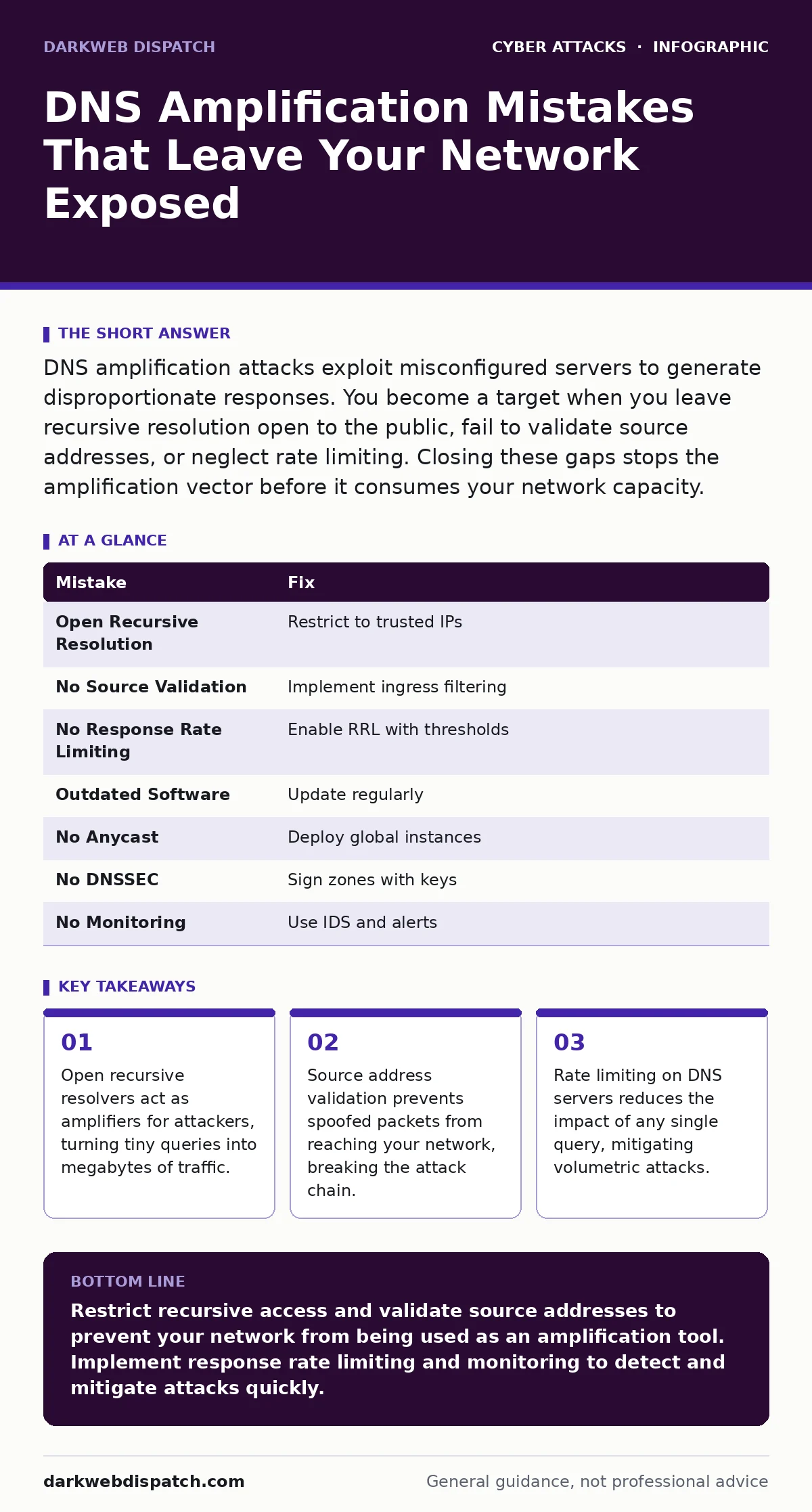
DNS amplification attacks exploit misconfigured servers to generate disproportionate responses. You become a target when you leave recursive resolution open to the public, fail to validate source addresses, or neglect rate limiting. Closing these gaps stops the amplification vector before it consumes your network capacity.
Mistake 1: Leaving Recursive Resolution Open to the Internet
Recursive resolution allows a server to look up domain names on behalf of clients. When this service is accessible to any IP address, it becomes a public tool for attackers. They send small queries with spoofed source addresses, causing your server to send large responses to the victim. This exposes your infrastructure to legal scrutiny and consumes your bandwidth. You must restrict recursive queries to trusted internal networks only.
Why it hurts: Your server processes queries from anywhere, amplifying traffic directed at third parties. This waste of resources draws attention and may lead to your IP being blacklisted by upstream providers. The attack vector remains open as long as public access persists.
The fix: Configure your DNS server to allow recursion only for specific IP ranges. Use access control lists to deny queries from unknown sources. Verify the configuration by testing resolution from an external network. This ensures only authorised clients benefit from your lookup service.
Mistake 2: Failing to Validate Source Addresses
Source address validation ensures that incoming packets originate from the claimed IP. Without this check, attackers can spoof the source address to match your network. Your server then sends large DNS responses to the spoofed victim, using your identity as the return path. This makes your network appear to be the attacker, complicating incident response and reputation management.
Why it hurts: Spoofed traffic bypasses basic filtering, allowing attackers to hide their origin. Your network becomes a conduit for reflected attacks, consuming outbound bandwidth. You lose visibility into the true source of the traffic, hindering mitigation efforts and forensic analysis.
The fix: Implement ingress filtering on your network edge routers. Use Border Gateway Protocol community tags or Access Control Lists to drop packets with invalid source addresses. This prevents spoofed queries from entering your network, ensuring all traffic has a verifiable origin.
Mistake 3: Ignoring Response Rate Limiting
Response Rate Limiting (RRL) caps the number of responses a DNS server sends to a single IP address within a time window. Without RRL, a single attacker can trigger thousands of large responses per second. This overwhelms the target’s connection, causing service disruption. RRL adds a layer of protection by throttling excessive query volumes.
Why it hurts: Unrestricted response rates allow attackers to maximise amplification factors. Your server becomes a high-throughput weapon, sending more data than the attacker requests. This strains your hardware and network links, potentially causing collateral damage to legitimate users.
The fix: Enable RRL on your DNS software. Set thresholds that balance security with legitimate high-volume clients. Monitor logs to adjust limits dynamically. This reduces the effectiveness of amplification attempts while maintaining service for normal traffic patterns.
Mistake 4: Using Outdated DNS Software
Legacy DNS software often lacks modern security features like RRL and strict access controls. It may also contain known vulnerabilities that attackers exploit to bypass restrictions. Running outdated versions leaves your server exposed to older attack techniques. Regular updates patch these holes and introduce new defensive mechanisms.
Why it hurts: Old software cannot enforce modern security policies, leaving gaps in your defence. Attackers exploit known bugs to gain control or bypass filters. This increases the risk of successful amplification attacks and other exploits.
The fix: Maintain a strict update schedule for your DNS software. Test updates in a staging environment before production deployment. This ensures you benefit from the latest security patches and features without disrupting service.
Mistake 5: Neglecting Anycast Deployment
Anycast routing directs traffic to the nearest server instance, distributing load across multiple locations. Without anycast, a single server bears the full brunt of an attack. This creates a bottleneck that is easy to overwhelm. Anycast helps absorb traffic spikes by spreading them across a global network.
Why it hurts: A single point of failure makes your DNS service vulnerable to concentrated attacks. Attackers focus their efforts on one location, saturating its bandwidth. This leads to prolonged outages and reduced reliability for all users.
The fix: Deploy DNS services using anycast routing. Distribute server instances across multiple geographic locations. This ensures traffic is routed to the closest available node, mitigating the impact of localised attacks.
See also: Secure Email Gateways Explained: How the Post Office Analogy Works
Mistake 6: Overlooking DNSSEC Implementation
DNS Security Extensions (DNSSEC) add cryptographic signatures to DNS records, preventing spoofing and cache poisoning. While DNSSEC does not directly stop amplification, it ensures the integrity of responses. Attackers cannot inject false records to redirect traffic. This reduces the effectiveness of certain amplification variants that rely on data manipulation.
Why it hurts: Without DNSSEC, attackers can manipulate DNS responses to redirect users to malicious sites. This undermines trust in your domain and exposes users to further attacks. It also complicates the verification of legitimate traffic.
The fix: Sign your DNS zones with DNSSEC keys. Distribute keys securely and rotate them regularly. This ensures the authenticity of DNS data, protecting against spoofing and manipulation.
Mistake 7: Disabling Monitoring and Alerting
Without monitoring, you may not detect an amplification attack until it causes significant damage. Early detection allows for rapid mitigation, such as blackholing traffic or contacting upstream providers. Monitoring tools provide visibility into traffic patterns and anomalies. This enables proactive defence rather than reactive cleanup.
Why it hurts: Delayed detection prolongs the attack, increasing resource consumption and service disruption. You lose the ability to respond effectively, allowing attackers to maximise their impact. This erodes user trust and damages your reputation.
The fix: Deploy intrusion detection systems to monitor DNS traffic for unusual patterns. Set up alerts for sudden spikes in query volumes or response sizes. This ensures you are aware of attacks as they begin, allowing for timely intervention.
| Mistake | Fix |
|---|---|
| Open Recursive Resolution | Restrict to trusted IPs |
| No Source Validation | Implement ingress filtering |
| No Response Rate Limiting | Enable RRL with thresholds |
| Outdated Software | Update regularly |
| No Anycast | Deploy global instances |
| No DNSSEC | Sign zones with keys |
| No Monitoring | Use IDS and alerts |
Key takeaways
- Open recursive resolvers act as amplifiers for attackers, turning tiny queries into megabytes of traffic.
- Source address validation prevents spoofed packets from reaching your network, breaking the attack chain.
- Rate limiting on DNS servers reduces the impact of any single query, mitigating volumetric attacks.
Restrict recursive access and validate source addresses to prevent your network from being used as an amplification tool. Implement response rate limiting and monitoring to detect and mitigate attacks quickly.
Frequently asked questions
How do I know if I am under a DNS amplification attack?
Look for sudden spikes in inbound traffic from DNS ports, particularly with large response sizes. Monitor for unusual query patterns and high bandwidth usage.
Can a firewall stop DNS amplification attacks?
Standard firewalls may block some traffic but cannot easily distinguish between legitimate and malicious DNS queries. You need application-layer filtering and rate limiting.
Is DNS amplification the same as a SYN flood attack?
No. SYN floods exploit the TCP handshake, while DNS amplification exploits UDP and DNS server misconfigurations. Both are volumetric but use different mechanisms.
Do I need a secure email gateway to protect against DNS attacks?
Secure email gateways protect against email-based threats like spear phishing, not network-level DNS attacks. They serve different security purposes.
How this guide was produced: written by the DarkWeb Dispatch editorial team with AI assistance, checked against the public references listed below, and reviewed when the facts change. See our editorial policy or report an error.