DNS Tunneling Explained: How Attackers Hide Data in Plain Sight
DNS tunneling hides stolen data inside standard domain lookups, allowing exfiltration to bypass firewalls that treat DNS traffic as safe and unavoidable.

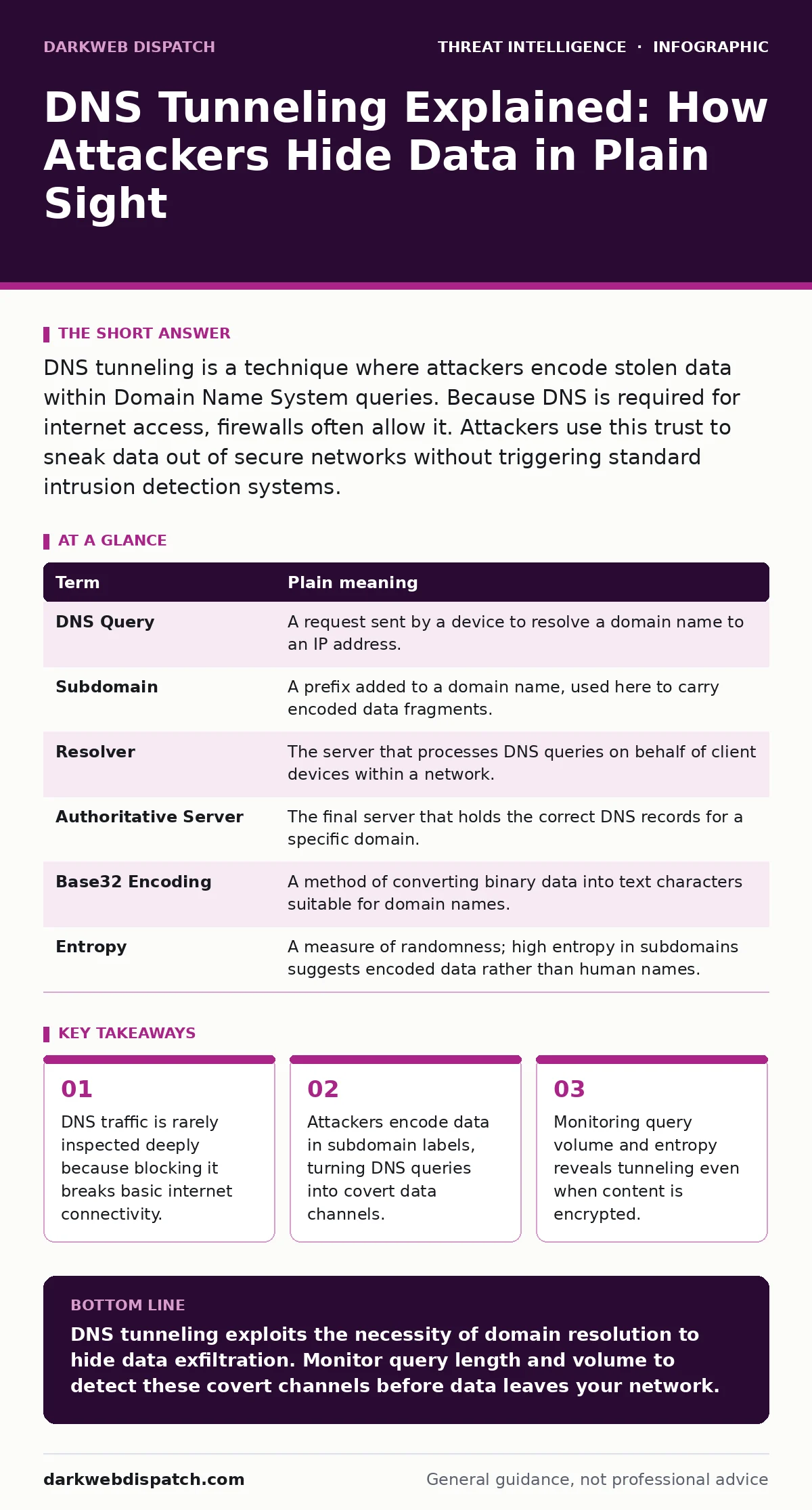
DNS tunneling is a technique where attackers encode stolen data within Domain Name System queries. Because DNS is required for internet access, firewalls often allow it. Attackers use this trust to sneak data out of secure networks without triggering standard intrusion detection systems.
What is DNS tunneling explained simply
Imagine you want to smuggle a secret letter out of a heavily guarded castle. You cannot walk through the main gate with it, as guards inspect every package. Instead, you write the message on the back of a standard delivery receipt. The guards allow receipts to pass because the castle needs supplies. The recipient reads the hidden message on the receipt. DNS tunneling works exactly like this. The castle is your network. The receipt is a DNS query. The secret letter is your stolen data.
The Domain Name System translates human-readable names into machine-readable IP addresses. Every time you visit a website, your device sends a DNS query. Networks must allow these queries to function. Attackers exploit this necessity. They encode stolen files into the structure of these queries. The data leaves the network disguised as normal address lookups. This method bypasses firewalls that block unusual ports or protocols.
The mechanics of covert channels
To understand how this works, you must look at the structure of a DNS request. A standard query asks for the IP address of a specific domain. It contains a domain name, a query type, and a transaction ID. Attackers manipulate the domain name part. They break stolen data into small chunks. They convert these chunks into valid characters for domain labels. They then append these labels to a domain they control.
The victim’s device sends these modified queries to its DNS resolver. The resolver forwards them to the authoritative server. The attacker’s server receives the encoded data. It decodes the labels to reconstruct the stolen file. The resolver receives a standard response. The firewall sees only DNS traffic. It does not inspect the payload of the query closely. This creates a blind spot in most security perimeters.
Key terms for DNS tunneling
Understanding the components helps you spot anomalies. These terms define the technical reality of the attack vector.
| Term | Plain meaning |
|---|---|
| DNS Query | A request sent by a device to resolve a domain name to an IP address. |
| Subdomain | A prefix added to a domain name, used here to carry encoded data fragments. |
| Resolver | The server that processes DNS queries on behalf of client devices within a network. |
| Authoritative Server | The final server that holds the correct DNS records for a specific domain. |
| Base32 Encoding | A method of converting binary data into text characters suitable for domain names. |
| Entropy | A measure of randomness; high entropy in subdomains suggests encoded data rather than human names. |
Why standard defenses often fail
Most organizations configure their firewalls to allow outbound DNS traffic on port 53. They assume this traffic is harmless metadata. Inspecting every DNS packet deeply is computationally expensive. It slows down network performance significantly. Therefore, many security teams leave DNS traffic unencrypted or lightly inspected. Attackers know this. They rely on the assumption that defenders will not parse the content of every query.
Standard intrusion detection systems look for known malware signatures. DNS tunneling does not use known signatures. It uses standard protocols in an unusual way. The traffic looks like legitimate browsing activity. The volume might be high, but individual queries are small. This makes statistical analysis more effective than signature matching. You must look for patterns, not specific threats.
Detecting the hidden traffic
You can detect DNS tunneling by monitoring for anomalies. Look for unusually long subdomain labels. Human-typed domain names are short and memorable. Encoded data produces long, random-looking strings. Check for high query volumes to a single domain. A user might send hundreds of queries to one server in minutes. This is abnormal for normal browsing.
Monitor the entropy of the subdomains. High entropy indicates randomness. Randomness suggests encoded data rather than natural language. Compare these metrics against a baseline of normal network activity. Deviations from the baseline are your primary indicator. You do not need to decode the data to suspect a breach. The structure of the traffic itself reveals the intent.
See also: Double Extortion Ransomware: Response and Recovery Steps · Tor browser privacy risks and small firm protection
A first practical step: Try this now
You can improve your visibility immediately. Follow these three steps to tighten your DNS posture.
- Implement internal DNS sinkholing. Configure your internal DNS server to intercept queries for known malicious domains. Return a safe IP address instead of resolving to the attacker’s server. This stops the communication channel.
- Log all DNS queries. Ensure your firewall or DNS server records the full query name, source IP, and timestamp. Store these logs securely. You cannot analyze what you do not record.
- Analyze query length distributions. Use simple scripts to flag queries with subdomains longer than twenty characters. Review these flags manually. This catches the most obvious tunneling attempts without complex tools.
Beyond basic detection
Advanced attackers use encryption to hide the data further. They might use DNS over HTTPS or DNS over TLS. These protocols encrypt the DNS payload. Your firewall cannot see the query content. It only sees the destination IP. You must rely on metadata analysis in this case. Monitor connection frequency and duration.
This technique intersects with other advanced threats. Understanding the cyber kill chain helps you place DNS tunneling in context. It is often an exfiltration step. It follows initial access and lateral movement. Recognising this phase allows you to respond appropriately. You might also consider threat intelligence reports to identify known command and control domains.
Sharing indicators with ISACs improves collective defence. While deception technology can distract attackers, it does not stop data exfiltration. Purple teaming exercises can test your detection capabilities. Golden ticket attacks and pass-the-hash attacks are different vectors but often precede data theft. STIX and TAXII standards help share these indicators securely.
Key takeaways
- DNS traffic is rarely inspected deeply because blocking it breaks basic internet connectivity.
- Attackers encode data in subdomain labels, turning DNS queries into covert data channels.
- Monitoring query volume and entropy reveals tunneling even when content is encrypted.
DNS tunneling exploits the necessity of domain resolution to hide data exfiltration. Monitor query length and volume to detect these covert channels before data leaves your network.
Frequently asked questions
Does DNS over HTTPS stop DNS tunneling?
No, it encrypts the traffic, making content inspection harder. You must rely on metadata analysis and trusted resolver usage instead.
Can I block DNS tunneling completely?
No, because DNS is essential for internet access. You can mitigate risk by restricting resolvers and monitoring for anomalies.
What is the difference between DNS tunneling and DNS cache poisoning?
Tunneling exfiltrates data by encoding it in queries. Cache poisoning manipulates responses to redirect users to malicious sites.
How do I know if my DNS server is compromised?
Check for unexpected changes in configuration, unknown domains in logs, and high outbound traffic to unusual destinations.
How this guide was produced: written by the DarkWeb Dispatch editorial team with AI assistance, checked against the public references listed below, and reviewed when the facts change. See our editorial policy or report an error.