Bulletproof Hosting Mistakes: 7 Errors That Expose Your Network
Misconfigured DNS and weak vendor checks let bulletproof hosts absorb your traffic, creating a persistent backdoor that bypasses perimeter security controls.

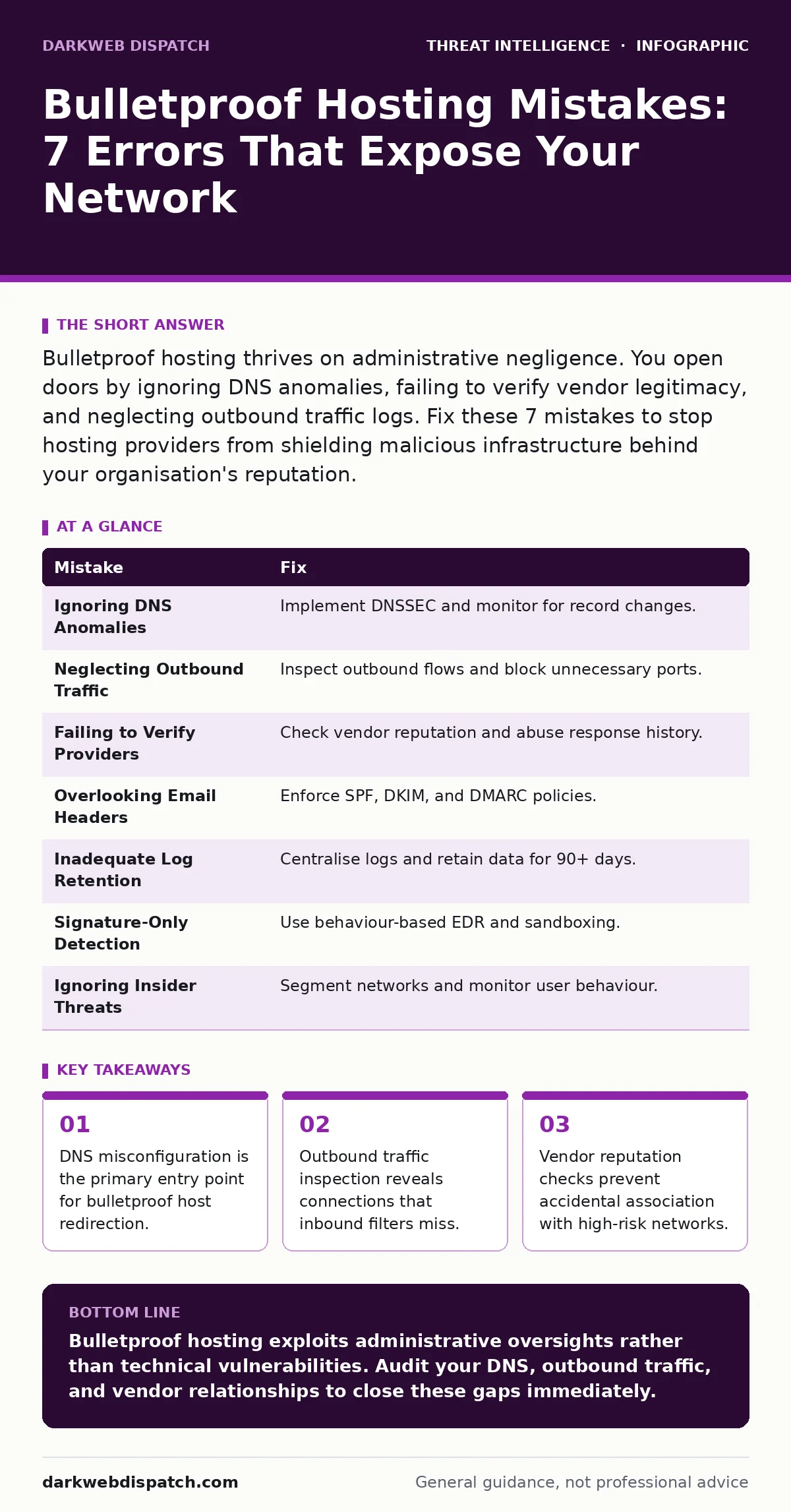
Bulletproof hosting thrives on administrative negligence. You open doors by ignoring DNS anomalies, failing to verify vendor legitimacy, and neglecting outbound traffic logs. Fix these 7 mistakes to stop hosting providers from shielding malicious infrastructure behind your organisation's reputation.
Mistake 1: Ignoring DNS Anomalies
Why it hurts:
Domain Name System (DNS) records translate human-readable names into IP addresses. Bulletproof hosts often use dynamic DNS or frequently changing IP ranges to evade blacklists. If your systems trust cached DNS records without validation, they may resolve to a newly assigned malicious address. This creates a persistent channel for data exfiltration or command-and-control communication that appears legitimate in standard logs.
The fix:
Implement DNSSEC (Domain Name System Security Extensions) to cryptographically verify DNS responses. Configure your resolver to validate signatures and reject unsigned or mismatched data. Monitor for sudden changes in IP associations for critical domains. Use DNS monitoring tools to alert on unexpected record modifications. This prevents attackers from hijacking your resolution process to redirect traffic to hostile infrastructure.
Mistake 2: Neglecting Outbound Traffic Inspection
Why it hurts:
Most security teams focus heavily on inbound traffic, assuming the threat originates outside. Bulletproof hosts often operate by allowing inbound connections to their servers while the victim organisation initiates outbound connections to them. If you do not inspect outbound traffic, you miss the initial handshake. This allows malware to phone home for instructions or send stolen data without triggering perimeter alerts. The connection appears as standard HTTPS or DNS traffic.
The fix:
Deploy an outbound proxy or firewall rule that inspects all external connections. Block ports that should not have external access, such as database ports or remote administration protocols. Implement application-layer filtering to inspect the content of outbound HTTPS requests. Monitor for large data transfers to unknown destinations. Reviewing outbound flows helps identify compromised internal systems communicating with bulletproof infrastructure before significant damage occurs.
Mistake 3: Failing to Verify Hosting Provider Reputation
Why it hurts:
Not all hosting providers are equal in terms of security hygiene. Bulletproof hosts explicitly advertise their tolerance for illegal content or lack of cooperation with law enforcement. Using sub-services or APIs hosted on such platforms creates a direct link to hostile infrastructure. This association can tarnish your organisation's reputation and make you a target for retaliatory attacks. It also exposes you to the collateral damage of takedowns or network disruptions affecting the entire host.
The fix:
Conduct due diligence on any third-party provider before integration. Check their history of responding to abuse reports and cooperating with legal requests. Avoid providers with a known history of hosting malware distribution networks or phishing campaigns. Use threat intelligence feeds to cross-reference provider IP ranges against known malicious indicators. Choosing reputable partners reduces the risk of accidental association with hostile networks and ensures a faster response to security incidents.
Mistake 4: Overlooking Email Header Analysis
Why it hurts:
Email remains a primary vector for initial access. Bulletproof hosts often allow open relays or weak authentication to facilitate spam and phishing campaigns. If your email gateway does not perform deep header analysis, it may accept messages from servers with forged or suspicious origins. This leads to successful phishing attempts that bypass standard spam filters. The headers reveal the true path the message took, including intermediate servers that may be hosted on bulletproof infrastructure.
The fix:
Enable and enforce SPF (Sender Policy Framework), DKIM (DomainKeys Identified Mail), and DMARC (Domain-based Message Authentication, Reporting, and Conformance) policies. Configure your mail server to reject or quarantine emails that fail these checks. Inspect email headers for anomalies such as missing return paths or unexpected relay servers. Train your staff to recognise phishing indicators, but rely on technical controls for consistent filtering. This reduces the likelihood of successful social engineering attacks originating from hostile hosts.
Mistake 5: Inadequate Log Retention and Analysis
Why it hurts:
Bulletproof hosts are designed to operate for extended periods before detection. If your log retention policy is too short, you lose the historical context needed to identify slow-moving threats. Attackers may use low-and-slow techniques to avoid triggering real-time alerts. Without sufficient log data, you cannot correlate events across different timeframes or identify patterns of compromise. This blindness allows malicious activity to persist undetected, increasing the potential impact of the breach.
The fix:
Implement a centralized logging solution that retains data for a minimum of 90 days, preferably longer for compliance reasons. Ensure logs include detailed connection metadata, such as source and destination IPs, ports, and timestamps. Use automated tools to correlate events and identify anomalies. Regularly review logs for signs of persistent connections to known malicious ranges. Adequate log retention provides the visibility needed to detect and respond to slow-moving threats that evade real-time detection.
See also: How Autonomous System Numbers Work in Threat Intelligence · ISACs: The Real Value and Hidden Costs of Sector Sharing
Mistake 6: Relying Solely on Signature-Based Detection
Why it hurts:
Signature-based security tools identify threats based on known patterns of malware or attack behaviour. Bulletproof hosts often use custom or obfuscated malware that does not match existing signatures. This allows novel threats to bypass perimeter defenses. Additionally, attackers frequently modify their payloads to avoid detection, rendering static signatures ineffective. Relying solely on signatures creates a false sense of security and leaves gaps in your defence against evolving threats hosted on resilient infrastructure.
The fix:
Complement signature-based tools with behaviour-based detection methods. Use endpoint detection and response (EDR) solutions to monitor for suspicious process activity, such as unexpected memory injection or privilege escalation. Implement sandboxing to analyse unknown files in a controlled environment before execution. Deploy network intrusion detection systems that look for anomalies in traffic patterns. This multi-layered approach improves your ability to detect and respond to novel threats that evade traditional signature-based controls.
Mistake 7: Ignoring Insider Threat Indicators
Why it hurts:
Insiders, whether malicious or compromised, can inadvertently facilitate connections to bulletproof hosts. An employee may download malware from a phishing email or use a personal device with weak security. If internal network segmentation is poor, this initial compromise can spread to critical systems. Bulletproof hosts may then be used to exfiltrate data or launch further attacks within your network. Neglecting insider threat indicators allows this lateral movement to occur unchecked, expanding the scope of the breach.
The fix:
Implement strict network segmentation to limit lateral movement. Use role-based access control to ensure users have only the permissions necessary for their jobs. Monitor user behaviour for anomalies, such as accessing unusual resources or transferring large amounts of data. Conduct regular security awareness training to educate staff on recognising phishing and social engineering attempts. Addressing insider risks reduces the attack surface and limits the potential impact of initial compromises.
| Mistake | Fix |
|---|---|
| Ignoring DNS Anomalies | Implement DNSSEC and monitor for record changes. |
| Neglecting Outbound Traffic | Inspect outbound flows and block unnecessary ports. |
| Failing to Verify Providers | Check vendor reputation and abuse response history. |
| Overlooking Email Headers | Enforce SPF, DKIM, and DMARC policies. |
| Inadequate Log Retention | Centralise logs and retain data for 90+ days. |
| Signature-Only Detection | Use behaviour-based EDR and sandboxing. |
| Ignoring Insider Threats | Segment networks and monitor user behaviour. |
Key takeaways
- DNS misconfiguration is the primary entry point for bulletproof host redirection.
- Outbound traffic inspection reveals connections that inbound filters miss.
- Vendor reputation checks prevent accidental association with high-risk networks.
Bulletproof hosting exploits administrative oversights rather than technical vulnerabilities. Audit your DNS, outbound traffic, and vendor relationships to close these gaps immediately.
Frequently asked questions
How do I know if a hosting provider is bulletproof?
Look for providers that explicitly advertise non-cooperation with law enforcement or tolerance for illegal content. Check independent reviews and threat intelligence feeds for reports of abuse.
Can bulletproof hosts bypass firewall rules?
They do not bypass rules but exploit misconfigurations or allowed outbound traffic. Firewalls block known bad IPs, but bulletproof hosts frequently change addresses, requiring dynamic updates and behaviour-based detection.
What is the difference between bulletproof and standard hosting?
Standard hosts adhere to laws and cooperate with abuse reports. Bulletproof hosts prioritise uptime and privacy for their clients, often ignoring illegal activity and resisting takedown requests.
How often should I review my DNS settings?
Review DNS settings quarterly or after any significant infrastructure change. Implement continuous monitoring to detect unauthorized changes in real-time and ensure alignment with security policies.
How this guide was produced: written by the DarkWeb Dispatch editorial team with AI assistance, checked against the public references listed below, and reviewed when the facts change. See our editorial policy or report an error.