Bot Management FAQs: Distinguishing Humans from Automated Traffic
Effective bot management relies on behavioural analysis rather than simple signature matching, ensuring legitimate automation is not blocked while malicious scripts are denied access.

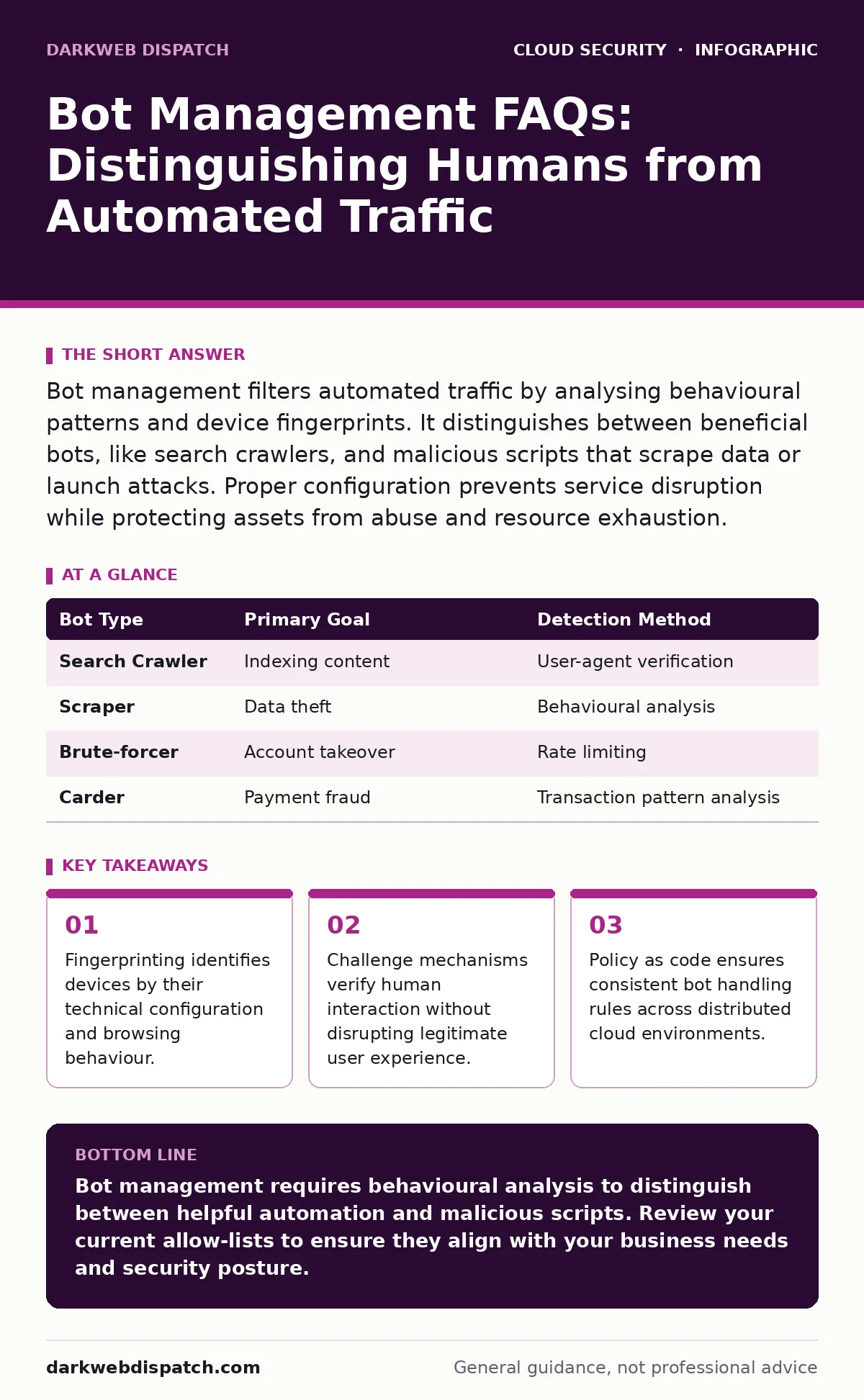
Bot management filters automated traffic by analysing behavioural patterns and device fingerprints. It distinguishes between beneficial bots, like search crawlers, and malicious scripts that scrape data or launch attacks. Proper configuration prevents service disruption while protecting assets from abuse and resource exhaustion.
What defines a bot in cloud security?
A bot is any automated software application that performs repetitive tasks on a web server or API. These programs range from search engine crawlers that index content to malicious scripts that scrape pricing data or launch brute-force attacks. Understanding this distinction is the foundation of effective traffic filtering. You must identify which automated agents provide value and which consume resources or steal intellectual property.
How does bot management differ from a firewall?
Firewalls filter traffic based on IP addresses, ports, and protocol headers. Bot management analyses the behaviour and identity of the request source after it passes the network perimeter. While a firewall blocks known bad IPs, bot management detects sophisticated scripts that originate from clean residential proxies or compromised devices. It looks at how the request is made, not just where it comes from.
What is device fingerprinting and why does it matter?
Device fingerprinting creates a unique identifier for a visitor by analysing their browser configuration, screen resolution, installed fonts, and hardware capabilities. This technique allows you to track entities that change their IP address frequently. It prevents attackers from bypassing simple IP-based blocks by rotating through proxy networks. The fingerprint remains consistent even when the network connection changes, providing a stable basis for reputation scoring.
How do challenge mechanisms verify human users?
Challenge mechanisms present tasks that are easy for humans but difficult for automated scripts. These include invisible verification steps that analyse cursor movement and typing rhythms, or visible puzzles that require cognitive processing. The goal is to confirm human presence without creating friction for legitimate visitors. Poorly configured challenges can block automated tools that businesses rely on, such as monitoring services or integration scripts.
Why is blocking all bots a bad strategy?
Blocking all automated traffic disrupts legitimate services and search engine visibility. Search engines use bots to index your content, and blocking them hides your site from potential customers. Many businesses rely on automated integration partners and monitoring tools that operate via scripts. A blanket block policy creates operational blind spots and reduces the utility of your digital assets. You must allow beneficial automation while filtering malicious activity.
See also: Policy as Code: Definition, Purpose and Practical Cloud Security · Segmentation vs Microsegmentation: What Is the Real Difference
How do bots exploit cloud metadata services?
Malicious bots often scan for exposed cloud metadata endpoints to steal credentials. These endpoints provide temporary access keys for running instances. If a bot discovers an unsecured metadata service, it can escalate privileges and access other resources. This vector is particularly dangerous in containerised environments where network policies might be misconfigured. Securing metadata access prevents bots from gaining footholds within your infrastructure.
| Bot Type | Primary Goal | Detection Method |
|---|---|---|
| Search Crawler | Indexing content | User-agent verification |
| Scraper | Data theft | Behavioural analysis |
| Brute-forcer | Account takeover | Rate limiting |
| Carder | Payment fraud | Transaction pattern analysis |
What is the role of policy as code in bot management?
Policy as code allows you to define and enforce bot handling rules programmatically. This approach ensures consistency across multiple cloud regions and environments. You can version-control your security policies and test changes before deployment. It reduces human error and ensures that new bot threats are addressed with predefined, tested responses. This method integrates seamlessly with modern DevSecOps workflows and infrastructure automation.
How does OAuth token abuse relate to bot activity?
Bots often exploit stolen or misconfigured OAuth tokens to bypass authentication. These tokens grant access to user accounts without requiring passwords. Attackers use automation to test token validity at scale, accessing sensitive data or performing actions on behalf of victims. Understanding this threat requires you to monitor for anomalous token usage patterns. Implementing short-lived tokens and strict scope restrictions mitigates this risk.
How do you balance security with user experience?
Aggressive bot management can introduce latency and false positives that frustrate legitimate users. The key is to apply verification only when risk indicators are present. Low-risk traffic should pass through with minimal friction, while high-risk requests undergo deeper inspection. This tiered approach maintains performance for most visitors while protecting against abuse. Continuous tuning based on feedback loops helps refine this balance over time.
What hidden costs does poor bot management incur?
Ineffective bot management leads to wasted compute resources and increased cloud bills. Malicious bots consume bandwidth, CPU, and database queries without generating revenue. This waste inflates operational costs and can trigger auto-scaling events that further increase expenditure. Additionally, data scraping can erode competitive advantage by exposing pricing strategies or inventory levels. The financial impact extends beyond direct security incidents to ongoing operational inefficiency.
Key takeaways
- Fingerprinting identifies devices by their technical configuration and browsing behaviour.
- Challenge mechanisms verify human interaction without disrupting legitimate user experience.
- Policy as code ensures consistent bot handling rules across distributed cloud environments.
Bot management requires behavioural analysis to distinguish between helpful automation and malicious scripts. Review your current allow-lists to ensure they align with your business needs and security posture.
Frequently asked questions
Does bot management protect against DDoS attacks?
Bot management can mitigate application-layer DDoS attacks by identifying and blocking malicious automated traffic, but it does not replace network-layer DDoS protection services.
How often should bot management rules be updated?
Rules should be reviewed regularly, ideally after any significant change to your application or infrastructure, to ensure they remain effective and do not block legitimate traffic.
Can bot management be implemented on-premises?
Yes, bot management solutions can be deployed on-premises, in hybrid environments, or purely in the cloud, depending on your infrastructure and compliance requirements.
What is the impact of bot management on SEO?
Properly configured bot management allows search engine crawlers to index your content while blocking malicious bots, thereby protecting your SEO efforts from negative impacts.
How this guide was produced: written by the DarkWeb Dispatch editorial team with AI assistance, checked against the public references listed below, and reviewed when the facts change. See our editorial policy or report an error.