Policy as Code: Definition, Purpose and Practical Cloud Security
Policy as code shifts security checks from human review to automated machine validation, catching configuration errors before they reach production environments.

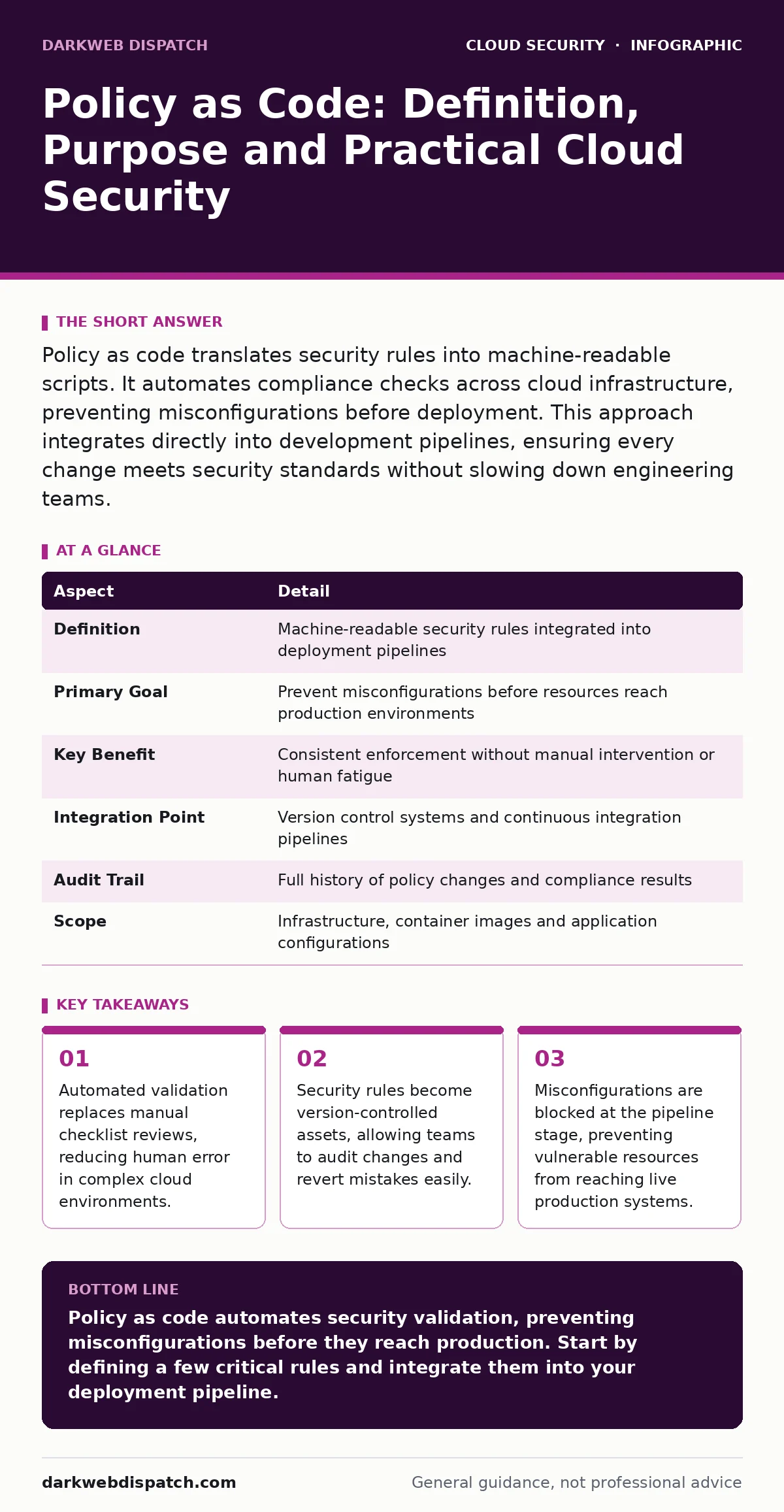
Policy as code translates security rules into machine-readable scripts. It automates compliance checks across cloud infrastructure, preventing misconfigurations before deployment. This approach integrates directly into development pipelines, ensuring every change meets security standards without slowing down engineering teams.
The Library Analogy for Automated Rules
Imagine a library where every book must be stamped before leaving. Relying on staff to remember this rule leads to lost books and inconsistent enforcement. Policy as code acts as an automated gate. The gate scans every book against a database of rules. If a book lacks the required stamp, the gate stays closed. This mechanical certainty removes the variability of human memory. Security teams define the rules once. The system applies them consistently to every action. This shift transforms security from a periodic audit into a continuous control.
| Aspect | Detail |
|---|---|
| Definition | Machine-readable security rules integrated into deployment pipelines |
| Primary Goal | Prevent misconfigurations before resources reach production environments |
| Key Benefit | Consistent enforcement without manual intervention or human fatigue |
| Integration Point | Version control systems and continuous integration pipelines |
| Audit Trail | Full history of policy changes and compliance results |
| Scope | Infrastructure, container images and application configurations |
The Problem Manual Checks Cannot Solve
Cloud infrastructure changes rapidly. Engineers provision servers, databases and storage buckets multiple times daily. Manual security reviews cannot keep pace with this velocity. Human reviewers miss subtle misconfigurations under pressure. A single unchecked permission allows unrestricted access to sensitive data. Policy as code solves this speed mismatch. It embeds security checks into the creation process. The system validates every change against defined standards automatically. This approach ensures that security scales with infrastructure growth. You no longer wait for quarterly audits to discover gaps. The system flags issues immediately when they occur.
Core Components of the Framework
Policy as code relies on three distinct elements. The first is the policy definition. This is a machine-readable file describing allowed and forbidden configurations. It uses standard languages like YAML or JSON for clarity. The second element is the evaluation engine. This software interprets the policy and checks live resources against it.
It determines whether a configuration complies with the rule. The third component is the enforcement mechanism. This blocks or alerts based on the evaluation result. Integration with version control ensures policies evolve alongside code. Teams can review policy changes using standard pull requests. This transparency builds trust between security and development teams.
Integration with Development Workflows
Policy as code fits naturally into continuous integration pipelines. Developers push code changes to a repository. Automated tools trigger before the code reaches production. These tools evaluate the infrastructure definitions against security policies. If violations exist, the build fails. This shift-left approach catches errors early. Fixing a mistake in code is cheaper than patching a live server. Security becomes a collaborative feature rather than a bottleneck. Engineers learn to write compliant configurations by default. The feedback loop reinforces good habits. This integration reduces the friction between speed and safety.
Where It Fits in Defence Layers
Policy as code is not a standalone shield. It works alongside other security controls. For instance, it complements the shared responsibility model by clarifying customer obligations. It prevents the misconfigurations that often lead to cloud metadata service attacks. While it handles infrastructure, it does not replace identity management. You still need strong authentication mechanisms. Single sign-on provides secure access to the tools that manage these policies. Policy as code ensures the environment is secure. Identity management ensures only authorised people change the environment. Both layers are required for effective protection.
See also: Bot Management FAQs: Distinguishing Humans from Automated Traffic · Segmentation vs Microsegmentation: What Is the Real Difference
Common Misconceptions About Implementation
Many teams treat policy as code as a one-time setup. This view ignores the evolving nature of threats. Policies must be updated regularly to reflect new risks. Another mistake is writing overly restrictive rules. If policies block legitimate work, engineers will seek workarounds. This creates shadow IT and reduces visibility. Balance is necessary. Policies should enforce minimum security standards without stifling innovation. Some teams also forget to test policies themselves. Broken policies cause false positives or negatives. Regular testing ensures the rules work as intended. Treat policies like software. They require maintenance, testing and version control.
The Hidden Cost of Complexity
Policy as code introduces its own maintenance burden. As rules grow, so does complexity. Conflicting policies can cause unexpected failures. A rule for one service might break another. Teams must carefully scope each policy. Documentation becomes critical. New engineers must understand why certain rules exist. Without clear context, they may disable protections to unblock work. This drift erodes security posture over time. Regular reviews help identify redundant or conflicting rules. Simplify where possible. Clear, focused policies are easier to maintain and enforce. Complexity is the enemy of reliable security automation.
Synergy With Access Controls
Policy as code secures the infrastructure. It does not manage who accesses it. You must combine it with rigorous access controls. Secrets in source code remain a risk even with strict infrastructure policies. Engineers might accidentally commit credentials. Policy as code can scan for these leaks. It blocks commits containing sensitive data. This integration prevents credential exposure. It also supports SaaS access reviews by ensuring cloud resources match expected configurations. Regular reviews verify that permissions align with business needs. Policy as code provides the structural guardrails. Access controls manage the human element. Together, they create a resilient security posture.
Key takeaways
- Automated validation replaces manual checklist reviews, reducing human error in complex cloud environments.
- Security rules become version-controlled assets, allowing teams to audit changes and revert mistakes easily.
- Misconfigurations are blocked at the pipeline stage, preventing vulnerable resources from reaching live production systems.
Policy as code automates security validation, preventing misconfigurations before they reach production. Start by defining a few critical rules and integrate them into your deployment pipeline.
Frequently asked questions
Does policy as code replace security audits?
No, it complements them by providing continuous validation. Audits still verify overall compliance and policy effectiveness.
Can developers write their own policies?
Yes, but security teams should review them. Collaborative development ensures rules are practical and secure.
What happens if a policy is wrong?
It may block legitimate deployments. Teams should use version control to revert incorrect policies quickly.
Is policy as code only for cloud environments?
It works in any automated infrastructure, including on-premises and hybrid setups.
How this guide was produced: written by the DarkWeb Dispatch editorial team with AI assistance, checked against the public references listed below, and reviewed when the facts change. See our editorial policy or report an error.