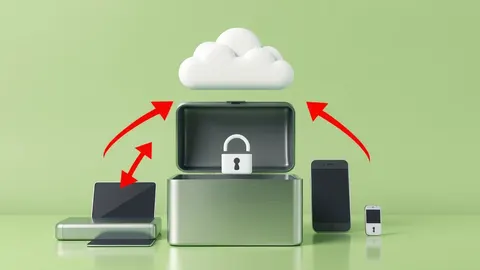
Segmentation vs Microsegmentation: What Is the Real Difference
Microsegmentation isolates individual workloads using software-defined policies, whereas traditional segmentation relies on network zones and perimeter firewalls to control traffic flow.

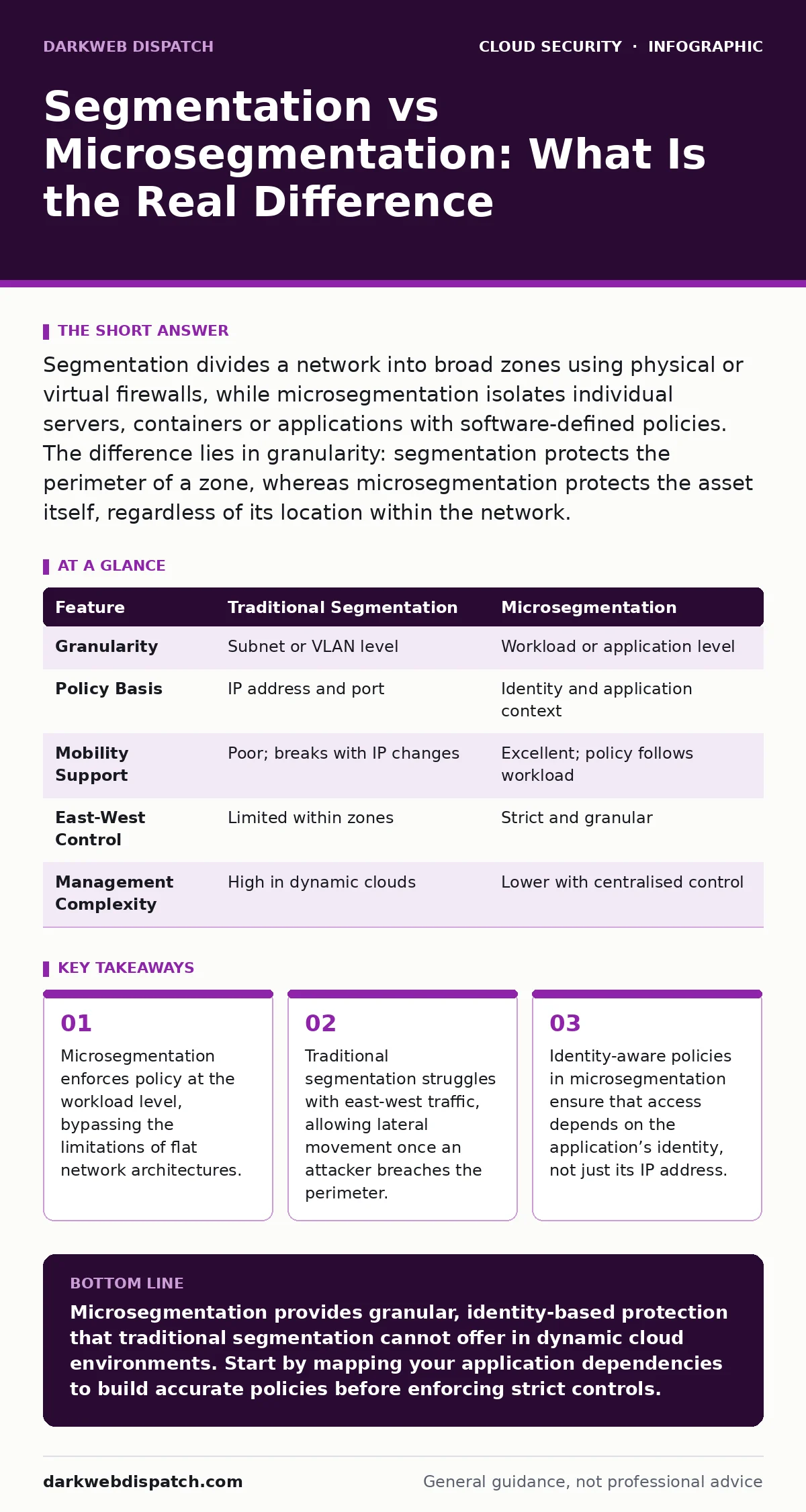
Segmentation divides a network into broad zones using physical or virtual firewalls, while microsegmentation isolates individual servers, containers or applications with software-defined policies. The difference lies in granularity: segmentation protects the perimeter of a zone, whereas microsegmentation protects the asset itself, regardless of its location within the network.
What is the difference between segmentation and microsegmentation?
Segmentation creates broad network zones, while microsegmentation isolates individual workloads with granular, identity-based policies. Traditional segmentation relies on subnets and firewalls to separate departments or functions, such as finance from engineering. This approach assumes that traffic between these zones is controlled and monitored. Microsegmentation goes deeper by applying security controls directly to the operating system or hypervisor level. It treats every server, container or virtual machine as its own security zone. This distinction matters because flat networks in cloud environments make traditional zone boundaries obsolete.
How does traditional network segmentation work?
Traditional segmentation uses IP addresses and port numbers to define security boundaries. Network administrators configure firewalls to allow or deny traffic between subnets. For example, a database server might only accept connections from application servers within a specific subnet. This method works well in static, on-premises environments where hardware and locations are fixed.
The limitation appears when workloads move. Virtual machines migrate across physical hosts, and containers spin up and down rapidly. Static IP-based rules become unmanageable in dynamic environments. The security posture degrades because administrators cannot update firewall rules fast enough to match the changing infrastructure.
Why does microsegmentation focus on the workload?
Microsegmentation attaches security policies to the workload itself, independent of its network location. The policy travels with the server or container as it moves across the infrastructure. This approach uses identity labels rather than IP addresses. An application might be tagged as "payment-processing" and allowed to communicate only with services tagged "database-write".
This method eliminates the need to track IP changes. It also prevents lateral movement. If an attacker compromises one server, they cannot easily jump to another because the policy denies unknown traffic. The control plane manages these policies centrally, ensuring consistency across hybrid and multi-cloud environments.
What are the limitations of perimeter-based security?
Perimeter-based security assumes that threats originate from outside the network. This model fails when attackers breach the outer firewall. Inside the network, traditional segmentation often allows free flow of traffic between servers in the same zone. This is known as east-west traffic. Attackers exploit this freedom to move laterally, seeking sensitive data or higher privileges. Microsegmentation addresses this by restricting east-west traffic. It ensures that even within the same subnet, servers can only talk to each other if explicitly permitted. This reduces the attack surface significantly. It also limits the blast radius of a compromise, containing the damage to a single workload.
| Feature | Traditional Segmentation | Microsegmentation |
|---|---|---|
| Granularity | Subnet or VLAN level | Workload or application level |
| Policy Basis | IP address and port | Identity and application context |
| Mobility Support | Poor; breaks with IP changes | Excellent; policy follows workload |
| East-West Control | Limited within zones | Strict and granular |
| Management Complexity | High in dynamic clouds | Lower with centralised control |
How does identity-aware policy improve security?
Identity-aware policies use attributes of the application or user to make access decisions. Instead of asking "where is this traffic coming from", the system asks "who is sending this traffic". This requires a central directory or tag management system. The policy engine checks these attributes against the access rules.
This method is crucial for cloud environments where IP addresses are ephemeral. It also supports zero trust principles. Zero trust assumes no user or device is trusted by default, even inside the network. By verifying identity for every connection, you reduce the risk of unauthorised access. This approach complements single sign-on systems by extending trust verification to server-to-server communications.
See also: Stop Cloud Storage Leaks: 7 Misconfiguration Mistakes · Policy as Code: Definition, Purpose and Practical Cloud Security
What are the operational challenges of microsegmentation?
Implementing microsegmentation requires detailed knowledge of application dependencies. You must map how every service communicates with others. This discovery process can be time-consuming and error-prone. Incorrect policies may block legitimate traffic, causing outages. Administrators must balance security with operational continuity.
The control plane must be highly available to avoid policy enforcement failures. Monitoring and logging are also more complex. You need to track millions of micro-policy decisions in real time. This generates significant data volume. Without proper tooling, troubleshooting connectivity issues becomes difficult. It is essential to start with a discovery phase before enforcing strict policies.
When should you use traditional segmentation?
Traditional segmentation remains useful for broad network isolation. It is cost-effective for static environments with minimal change. Small organisations with simple infrastructure may not need the complexity of microsegmentation. It also serves as a first line of defence. Combining both approaches provides defence in depth.
Traditional segmentation can handle large-scale traffic filtering, while microsegmentation protects critical assets. This hybrid model balances security and performance. It also simplifies management for less critical workloads. However, as you adopt cloud services and containers, traditional methods become less effective. The shift towards dynamic infrastructure makes microsegmentation increasingly necessary.
How does microsegmentation protect against cloud threats?
Cloud environments introduce unique risks, such as cloud metadata service attacks. Attackers often target metadata endpoints to steal credentials. Microsegmentation restricts access to these endpoints to only authorised management agents. It also mitigates container escape risks. If an attacker escapes a container, microsegmentation policies limit their ability to communicate with other hosts.
This containment is vital for containerised applications. Additionally, microsegmentation helps prevent cloud privilege escalation. By limiting lateral movement, attackers cannot easily gain higher privileges. This protection works alongside cloud backup strategies to ensure data integrity and availability.
What is the future of network segmentation?
The trend is moving towards software-defined perimeters. These perimeters are decoupled from the underlying network infrastructure. They rely on identity and context for access decisions. This evolution aligns with zero trust architectures. As organisations adopt more cloud services, the need for granular control increases.
Microsegmentation will likely become the default for cloud-native applications. Traditional segmentation will persist for legacy systems and broad network isolation. The integration of artificial intelligence may automate policy creation and anomaly detection. This will reduce the manual effort required for dependency mapping. Security teams must adapt to this shift to maintain robust protection.
Key takeaways
- Microsegmentation enforces policy at the workload level, bypassing the limitations of flat network architectures.
- Traditional segmentation struggles with east-west traffic, allowing lateral movement once an attacker breaches the perimeter.
- Identity-aware policies in microsegmentation ensure that access depends on the application’s identity, not just its IP address.
Microsegmentation provides granular, identity-based protection that traditional segmentation cannot offer in dynamic cloud environments. Start by mapping your application dependencies to build accurate policies before enforcing strict controls.
Frequently asked questions
Can microsegmentation replace firewalls?
No, microsegmentation complements firewalls. Firewalls handle perimeter traffic and large-scale filtering, while microsegmentation manages internal, workload-level access.
Is microsegmentation only for cloud environments?
No, it works in on-premises and hybrid environments. However, its benefits are most pronounced in dynamic cloud and containerised infrastructures.
How do I discover application dependencies?
Use passive monitoring tools to observe traffic patterns over time. This helps you understand how services communicate without disrupting operations.
Does microsegmentation impact performance?
Properly implemented microsegmentation has minimal performance impact. The policy enforcement happens at the hypervisor or host level, which is efficient.
How this guide was produced: written by the DarkWeb Dispatch editorial team with AI assistance, checked against the public references listed below, and reviewed when the facts change. See our editorial policy or report an error.