SYN Flood Attacks: How They Work and How to Stop Them
A SYN flood exhausts server resources by opening half-finished connections, leaving no room for legitimate users to connect.

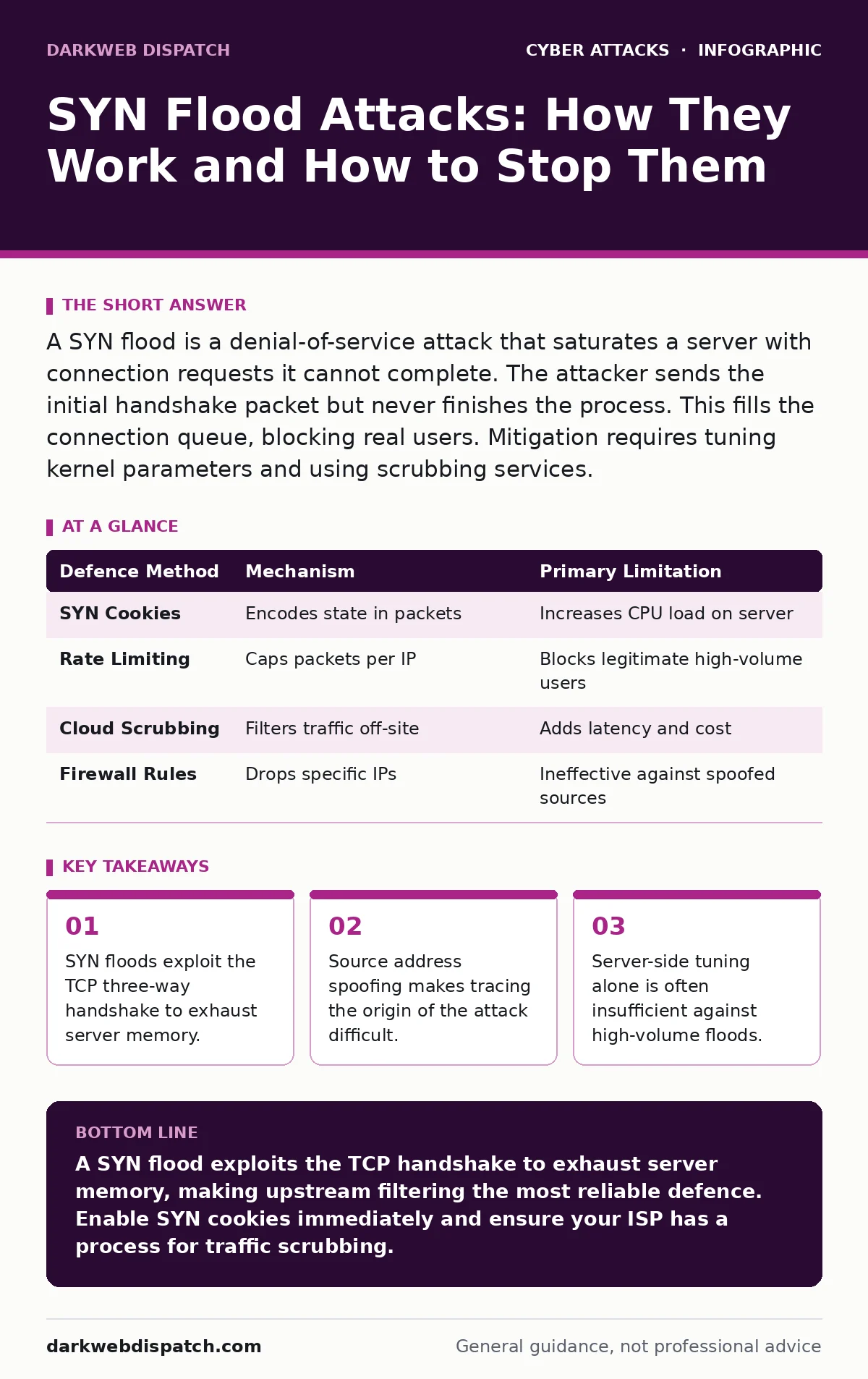
A SYN flood is a denial-of-service attack that saturates a server with connection requests it cannot complete. The attacker sends the initial handshake packet but never finishes the process. This fills the connection queue, blocking real users. Mitigation requires tuning kernel parameters and using scrubbing services.
What is a SYN flood attack?
A SYN flood is a type of denial-of-service attack that targets the TCP three-way handshake. The attacker sends many SYN packets, which signal a request to start a connection. The server responds with a SYN-ACK packet and waits for the final ACK packet to complete the handshake. The attacker never sends this final packet, leaving the connection half-open. The server reserves memory for these incomplete connections until a timeout occurs.
Why does this attack cause a server to crash?
Servers have a limited buffer for pending connections, known as the SYN backlog. When this queue fills with half-open connections, the server cannot accept new legitimate requests. It effectively stops responding to users, appearing offline. This is not a bug in the software but a consequence of limited system resources. The server is waiting for packets that will never arrive, wasting CPU and memory.
How do attackers hide their identity?
Attackers typically use source address spoofing to mask their true location. They fake the IP address in the header of each SYN packet. The server sends its response to the forged address, which is often non-existent or belongs to an innocent third party. This prevents the server from completing the handshake and hides the attacker’s origin. It also makes traditional IP-based blocking ineffective.
Can a single computer generate a large flood?
A single machine has bandwidth and processing limits that cap its output. To overwhelm a modern server, attackers usually use a botnet. A botnet is a network of compromised devices controlled remotely. Each device sends a small number of SYN packets. Collectively, they generate enough traffic to saturate the target. This distributed nature makes the attack harder to block at a single point.
How do intrusion detection systems help?
Intrusion detection systems monitor network traffic for abnormal patterns. They can flag a sudden spike in SYN packets from diverse sources. Some systems can automatically block traffic from suspicious IP ranges. However, if the attack uses spoofed addresses, the IDS may block innocent users. It is a detection tool, not a complete mitigation solution. You need additional measures to absorb the traffic volume.
What is SYN cookie protection?
SYN cookies are a server-side defence mechanism that changes how connections are tracked. Instead of storing state for each half-open connection, the server encodes connection details in the sequence number of the SYN-ACK packet. It does not allocate memory until the final ACK packet arrives. This prevents the backlog from filling up. The trade-off is increased CPU usage to encode and decode these cookies.
Does network segmentation stop a SYN flood?
Network segmentation divides your infrastructure into smaller, isolated zones. If one segment is overwhelmed, the attack does not necessarily spread to others. It limits the impact but does not stop the attack at the edge. You still need perimeter defences to filter malicious traffic. Segmentation ensures that critical services remain available even if public-facing servers are down. It is a containment strategy, not a prevention method.
| Defence Method | Mechanism | Primary Limitation |
|---|---|---|
| SYN Cookies | Encodes state in packets | Increases CPU load on server |
| Rate Limiting | Caps packets per IP | Blocks legitimate high-volume users |
| Cloud Scrubbing | Filters traffic off-site | Adds latency and cost |
| Firewall Rules | Drops specific IPs | Ineffective against spoofed sources |
What is the hidden cost of rate limiting?
Rate limiting restricts the number of connections from a single IP address. It is simple to implement and effective against small attacks. However, it creates a false sense of security. Legitimate users behind a NAT (Network Address Translation) gateway share a single public IP. If many users connect simultaneously, they may hit the limit. You risk blocking your own customers to stop an attacker. This trade-off is often overlooked in basic cyber hygiene plans.
How do secure email gateways relate?
Secure email gateways filter malicious content before it reaches your inbox. They do not protect against network-layer attacks like SYN floods. However, they reduce the load on your mail servers. Less load means more resources available for legitimate traffic. It is part of a layered defence strategy. You must protect different layers of your stack with appropriate tools.
What should you do during an active attack?
First, contact your internet service provider. They can filter traffic upstream, before it reaches your network. This is often the most effective immediate step. Second, enable SYN cookies if not already active. Third, consider redirecting traffic to a cloud-based scrubbing service. These services absorb the flood and forward only clean traffic. Do not try to block individual IPs manually; it is too slow and ineffective.
Key takeaways
- SYN floods exploit the TCP three-way handshake to exhaust server memory.
- Source address spoofing makes tracing the origin of the attack difficult.
- Server-side tuning alone is often insufficient against high-volume floods.
- Network segmentation limits the blast radius of a successful attack.
A SYN flood exploits the TCP handshake to exhaust server memory, making upstream filtering the most reliable defence. Enable SYN cookies immediately and ensure your ISP has a process for traffic scrubbing.
Frequently asked questions
Can a personal firewall stop a SYN flood?
A personal firewall protects your local device from incoming connections. It does not protect a server you are trying to access. The attack targets the server’s resources, not your client machine.
Is a SYN flood different from a DDoS?
A SYN flood is a specific type of DDoS attack. DDoS is the broad category of distributed denial-of-service attacks. SYN floods specifically target the TCP handshake process.
Do password managers help with SYN floods?
Password managers secure your credentials and prevent account takeover. They do not protect against network-layer attacks like SYN floods. They are irrelevant to this specific threat vector.
Can login alerts detect a SYN flood?
Login alerts notify you of authentication attempts. A SYN flood does not involve logging in. It operates at the network connection layer, below the authentication stage.
How this guide was produced: written by the DarkWeb Dispatch editorial team with AI assistance, checked against the public references listed below, and reviewed when the facts change. See our editorial policy or report an error.