Cyber Hygiene: The Hidden Logic Behind Secure Systems
Routine maintenance prevents systemic failure by reducing the attack surface available to automated threats before human intervention is required.

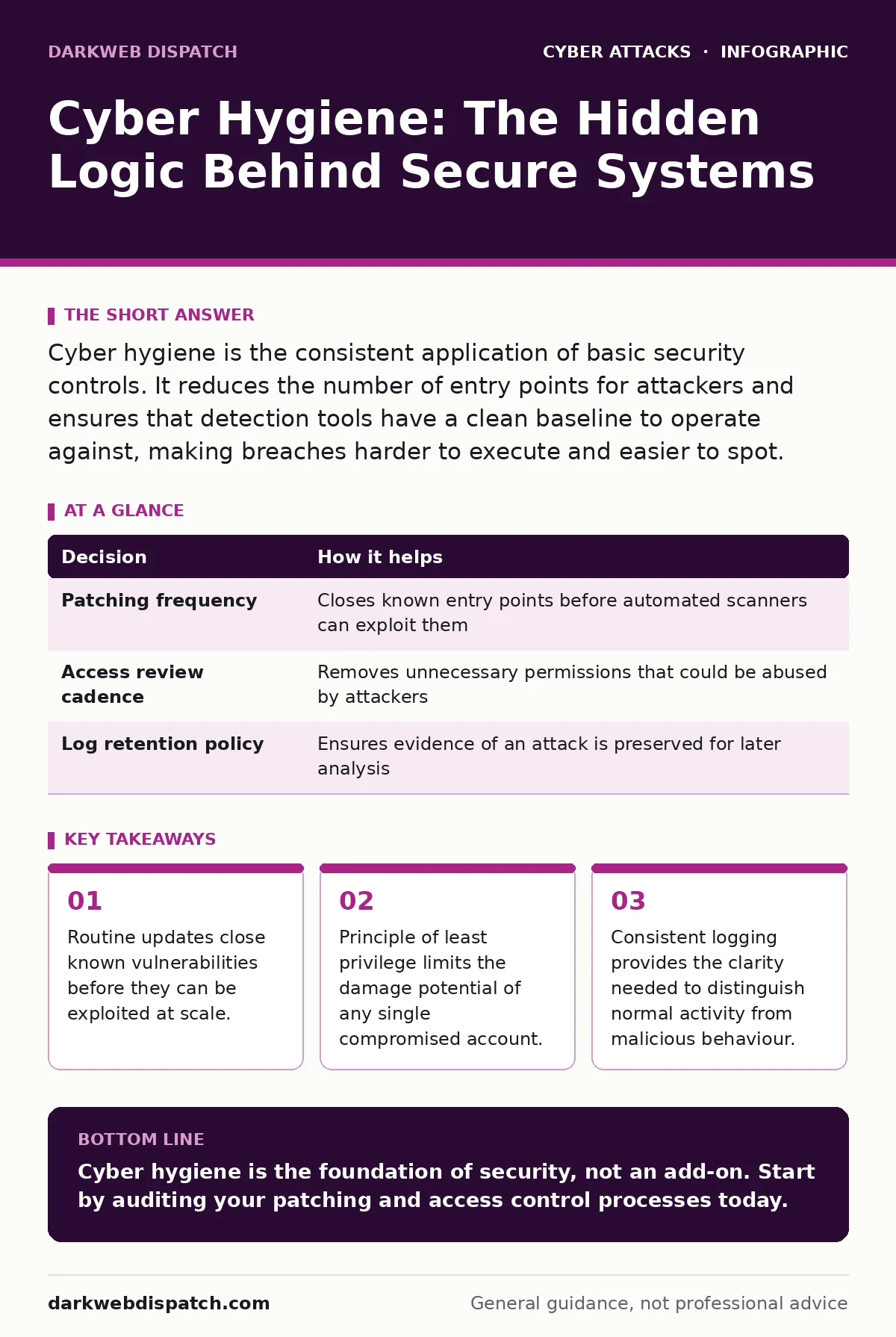
Cyber hygiene is the consistent application of basic security controls. It reduces the number of entry points for attackers and ensures that detection tools have a clean baseline to operate against, making breaches harder to execute and easier to spot.
The Baseline of Trust
Cyber hygiene is not a product you install. It is a discipline of maintenance. It involves keeping systems updated, managing access rights strictly, and ensuring that data flows only where it needs to go. Without this baseline, advanced security tools become noise generators rather than protectors.
Imagine a house with many doors. You can install the best alarm system in the world, but if you leave every window open, the alarm will trigger constantly. You will eventually ignore it. This is known as alert fatigue. Hygiene closes the windows so the alarm only rings when someone actually breaks in.
What Goes Wrong Without It
Neglecting basic maintenance creates a fragile environment. When software is outdated, known vulnerabilities remain open. Attackers use automated tools to scan for these specific weaknesses. They do not need creativity; they need volume.
Suppose a team ignores patching for a web server. An automated script finds the unpatched flaw. It gains access. Because access controls were never reviewed, that script can now move laterally to other systems. The breach expands before anyone notices. This is the hidden cost of neglect: it turns a minor issue into a systemic collapse.
The Decisions It Informs
Hygiene dictates where you spend your time and budget. It tells you which controls are foundational and which are optional. Without a hygiene framework, you might spend resources on complex encryption while leaving default passwords active on administrative accounts.
Every decision about security should start with the question: is the basic state of this system secure? If the answer is no, adding layers of defence is inefficient. You are building a castle on sand. The foundation must be solid before you consider the turret.
| Decision | How it helps |
|---|---|
| Patching frequency | Closes known entry points before automated scanners can exploit them |
| Access review cadence | Removes unnecessary permissions that could be abused by attackers |
| Log retention policy | Ensures evidence of an attack is preserved for later analysis |
How Teams Use It
Teams treat hygiene as a continuous process, not a one-time project. They automate updates where possible. They schedule regular reviews of user permissions. They define what "normal" traffic looks so that anomalies stand out.
This approach reduces the cognitive load on security staff. Instead of chasing every alert, they focus on the ones that break the pattern. This is where intrusion detection systems become effective. They need a clean baseline to function correctly. If the baseline is messy, the system cannot distinguish between a user making a mistake and an attacker executing a exploit.
The Non-Obvious Trade-Offs
There is a tension between convenience and security. Strict hygiene can slow down operations. Forcing users to change passwords frequently can lead to weaker choices, such as using predictable sequences. This is why password managers are recommended. They handle the complexity, allowing users to maintain strong, unique credentials without memorising them.
Another trade-off is visibility versus privacy. To detect intrusions, you need logs. But collecting too much data can raise privacy concerns. You must decide what data is necessary for security and what is not. This balance is delicate. Too little data and you miss attacks. Too much and you drown in noise.
See also: Password Managers Explained: How Vault Encryption Protects You · Unified Kill Chain: Why Fragmented Threat Models Fail Your Defences
Edge Cases and Failures
Standard advice fails when assumptions are wrong. For instance, relying solely on email spoofing detection tools is insufficient if users are not trained to recognise social engineering. An attacker can craft a message that bypasses technical filters by using a legitimate sender’s domain in a subtle way.
Similarly, network segmentation is useless if administrative credentials are shared across segments. If an attacker breaches one segment, shared credentials allow them to move to others. Hygiene requires that access controls are as segmented as the network itself. This is a common oversight. Teams segment the network but forget to segment the identities.
Sustaining the Discipline
Maintaining hygiene requires automation and culture. Manual processes are prone to error and fatigue. Automate updates, access provisioning, and log collection. Culture ensures that every team member understands their role in security.
This is not about achieving perfection. It is about reducing risk to a manageable level. It is about making the attacker’s job harder and your job easier. By maintaining a clean baseline, you ensure that your security investments yield results. You spend time responding to real threats, not fixing preventable mistakes.
Key takeaways
- Routine updates close known vulnerabilities before they can be exploited at scale.
- Principle of least privilege limits the damage potential of any single compromised account.
- Consistent logging provides the clarity needed to distinguish normal activity from malicious behaviour.
Cyber hygiene is the foundation of security, not an add-on. Start by auditing your patching and access control processes today.
Frequently asked questions
How often should I review user permissions?
Review permissions at least quarterly. Remove access for employees who have changed roles or left the organisation immediately.
Does cyber hygiene replace the need for advanced security tools?
No. Hygiene ensures that advanced tools, such as intrusion detection systems, have a clean baseline to operate against. Without it, these tools generate too many false positives.
What is the first step in improving cyber hygiene?
Identify all administrative accounts and ensure they use strong, unique passwords. Enable multi-factor authentication for these accounts if it is not already active.
Can automation handle all aspects of cyber hygiene?
Automation can handle updates, log collection, and password resets. However, decisions about access rights and policy changes require human judgment and regular review.
How this guide was produced: written by the DarkWeb Dispatch editorial team with AI assistance, checked against the public references listed below, and reviewed when the facts change. See our editorial policy or report an error.