How ReDoS Works: Step-by-Step Attack Mechanics
Regular expression denial of service exploits catastrophic backtracking in pattern matching engines to freeze application threads indefinitely.

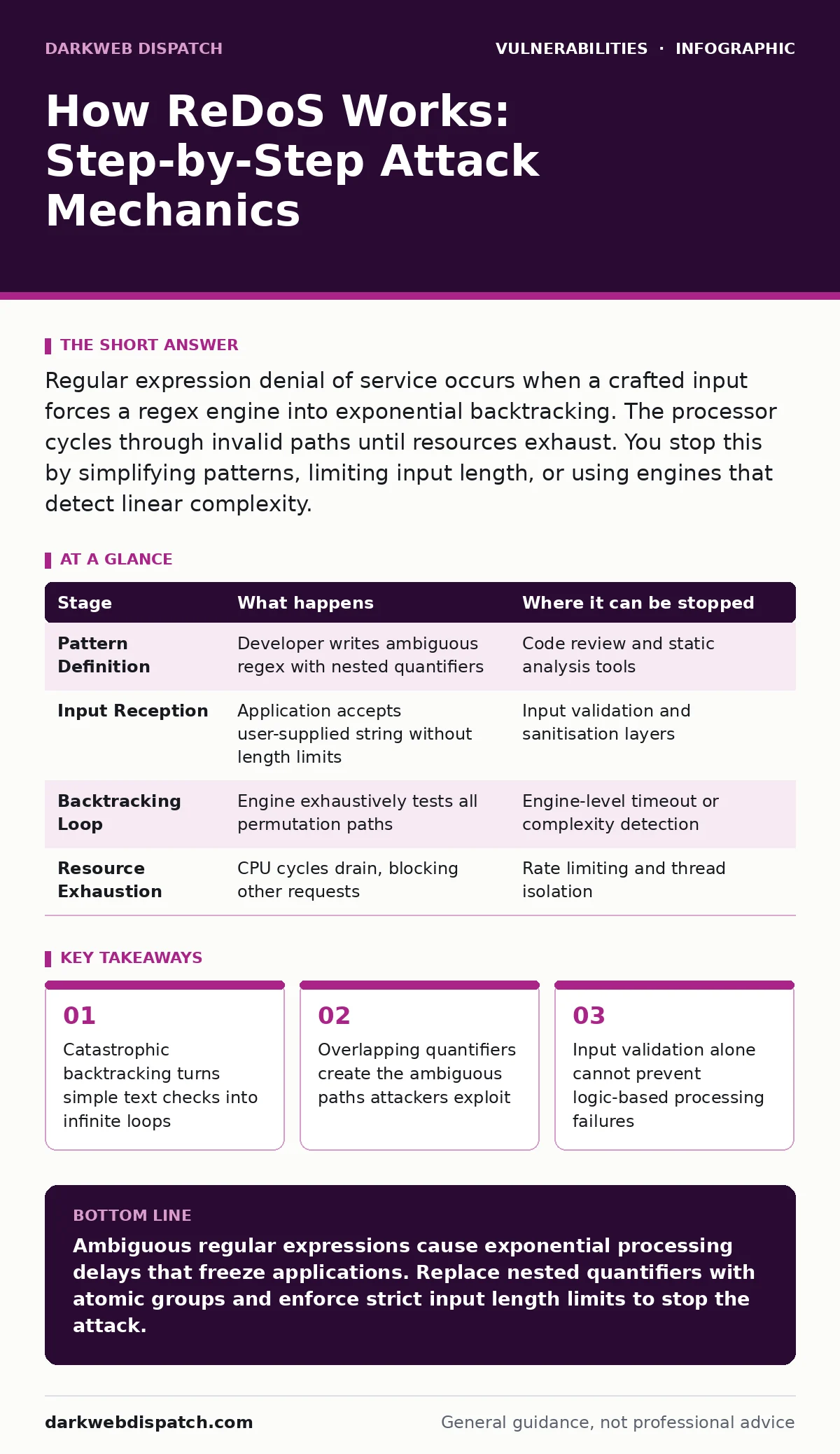
Regular expression denial of service occurs when a crafted input forces a regex engine into exponential backtracking. The processor cycles through invalid paths until resources exhaust. You stop this by simplifying patterns, limiting input length, or using engines that detect linear complexity.
The Mechanics of Pattern Ambiguity
Regular expression denial of service exploits a fundamental weakness in how most software interprets pattern matching rules. When a regular expression contains overlapping quantifiers, the engine cannot determine which path leads to a match. It tries every possible combination. This process creates an exponential explosion of steps. The application hangs while the processor cycles through these invalid paths. The flaw relies on the engine’s attempt to be thorough rather than efficient.
Imagine a pattern that requires a sequence of characters followed by optional repetitions. If the input partially matches but fails at the end, the engine retreats. It adjusts the repetition count and tries again. This backtracking repeats millions of times for short inputs. The result is a complete freeze of the processing thread.
| Stage | What happens | Where it can be stopped |
|---|---|---|
| Pattern Definition | Developer writes ambiguous regex with nested quantifiers | Code review and static analysis tools |
| Input Reception | Application accepts user-supplied string without length limits | Input validation and sanitisation layers |
| Backtracking Loop | Engine exhaustively tests all permutation paths | Engine-level timeout or complexity detection |
| Resource Exhaustion | CPU cycles drain, blocking other requests | Rate limiting and thread isolation |
Stage 1: The Vulnerable Pattern Definition
The attack begins long before any data arrives. It starts when a developer writes a regular expression that is logically ambiguous. A common mistake involves using quantifiers that can match the same characters in different ways. For example, a pattern might specify one or more alphanumeric characters followed by zero or more alphanumeric characters. The engine sees two valid ways to parse the same string segment.
This ambiguity is invisible during normal operation. Standard inputs match quickly because the engine finds a valid path on the first try. The vulnerability lies in the error handling path. When the input does not fully match, the engine must prove it is not a match. This proof requires exploring every dead end. The pattern itself is the root cause.
Stage 2: The Crafted Input Injection
The attacker does not need to break the pattern. They only need to make the engine work harder. A successful payload consists of a string that matches most of the pattern but fails at the very end. This partial match triggers the backtracking mechanism. The attacker calculates the exact length and character composition that maximises the number of permutations.
The input is often short. A few dozen characters can generate billions of processing steps. The attacker sends this string through any input field that uses the vulnerable regular expression. This could be a search box, a username field, or an API parameter. The goal is not to inject code, but to waste time.
You can interrupt this stage by enforcing strict length limits on all inputs. Shorter inputs reduce the maximum depth of the backtracking tree. While this does not fix the underlying logic error, it raises the cost for the attacker. It makes the attack less practical in real-time scenarios.
Stage 3: The Catastrophic Backtracking Loop
Once the engine receives the crafted input, it begins the matching process. Then it tries the second quantifier. When it reaches the end of the string, it finds no match. The engine backtracks. It reduces the count of the first quantifier and increases the second.
This cycle repeats exponentially. For every additional character in the input, the number of steps doubles or more. The processor enters a tight loop, consuming cycles without making progress. The application thread is blocked. It cannot serve other requests. It cannot release memory. It simply waits for the pattern match to finish.
This stage is where the damage occurs. The application appears to be running, but it is unresponsive. Other users experience timeouts. The server may crash if the thread pool exhausts. The backtracking loop is the core of the denial of service effect.
Stage 4: Resource Exhaustion and Impact
The final stage is the consequence of the infinite loop. The thread handling the request remains occupied. If the application uses a thread-per-request model, other users are denied service. The server becomes unavailable.
In some cases, the operating system kills the process. This is a fail-safe, but it causes data loss or session termination. The attacker achieves denial of service without crashing the system directly. They simply force the system to waste its own resources. The impact is proportional to the number of threads blocked.
You can mitigate this by isolating regex operations. Run pattern matching in separate worker processes. If a worker hangs, you can terminate it without affecting the main application. This containment strategy limits the blast radius of the attack.
See also: Server-Side Template Injection Explained: How Code Becomes Dangerous · Input Validation Mistakes That Break Your Security Controls
Breaking the Chain: Prevention Strategies
Preventing regular expression denial of service requires a multi-layered approach. First, review all regular expressions for ambiguous quantifiers. Replace nested quantifiers with atomic groups or possessive quantifiers where supported. These features prevent backtracking by committing to a match once found.
Second, implement strict input validation. Reject inputs that exceed reasonable length limits. Use allowlists for expected character sets. This reduces the attack surface before the data reaches the regex engine.
Third, use engines that detect catastrophic backtracking. Some modern libraries can identify patterns that will cause exponential complexity. They throw an error instead of hanging. This shifts the failure mode from a hang to a controlled exception.
The Hidden Cost of Convenience
Developers often write complex regular expressions to save time. A single line of code can replace pages of logic. This convenience comes with hidden costs. Ambiguous patterns are hard to spot in code reviews. They behave correctly in testing because test cases are usually valid.
The flaw only appears with malicious or edge-case inputs. This makes it similar to other logic bugs. It requires specific conditions to trigger. The cost of fixing it after deployment is high. It often requires emergency patching.
You can reduce this cost by integrating static analysis into your build pipeline. Tools can flag risky patterns before they reach production. This proactive approach is more effective than reactive mitigation. It addresses the root cause rather than the symptoms.
Beyond the Regex Engine
Regular expression denial of service is not just a regex problem. It is a symptom of trusting user input. Any code that processes untrusted data can fail. The same principles apply to other vulnerabilities. For instance, server-side template injection also relies on ambiguous parsing.
Understanding how parsers work helps you spot similar issues. Look for places where the application splits or interprets text. These are high-risk areas. Apply the same caution here as you do with regular expressions.
Consider how input validation fits into your broader security model. It is not a silver bullet, but it is a necessary layer. Combine it with other controls. Use web cache poisoning protections to limit exposure. Address browser extension vulnerabilities to reduce client-side risks.
The Reality of Mitigation
No single measure provides complete protection. Regular expression denial of service exploits logic, not memory. You cannot patch it with a simple update. You must change the code. This requires effort and testing.
The most effective defence is awareness. Train developers to recognise ambiguous patterns. Encourage the use of simpler matching logic. Avoid nested quantifiers unless absolutely necessary.
Regular monitoring helps detect anomalies. Sudden spikes in CPU usage or response times can indicate an attack. Set up alerts for these metrics. Respond quickly to minimise impact.
Remember that security is a process. It requires continuous improvement. Stay informed about new techniques. Adapt your defences accordingly. The goal is not perfection, but resilience.
Key takeaways
- Catastrophic backtracking turns simple text checks into infinite loops
- Overlapping quantifiers create the ambiguous paths attackers exploit
- Input validation alone cannot prevent logic-based processing failures
Ambiguous regular expressions cause exponential processing delays that freeze applications. Replace nested quantifiers with atomic groups and enforce strict input length limits to stop the attack.
Frequently asked questions
Can I fix ReDoS by increasing server resources?
No, adding more CPU or memory does not solve the logic error. The exponential growth will eventually exceed any resource limit. You must fix the regular expression pattern itself.
Is input validation enough to prevent this attack?
Input validation reduces the risk by limiting input size, but it does not eliminate the vulnerability. A short, crafted input can still trigger catastrophic backtracking if the pattern is ambiguous.
How do I know if my regex is vulnerable?
Look for nested quantifiers like `(a+)+` or overlapping ranges. Test your patterns with tools that detect catastrophic backtracking. Static analysis plugins can flag risky patterns during development.
Does this affect all programming languages?
Most languages use similar regex engines that support backtracking. Python, Java, JavaScript, and C# are all susceptible. The vulnerability is in the algorithm, not the language syntax.
How this guide was produced: written by the DarkWeb Dispatch editorial team with AI assistance, checked against the public references listed below, and reviewed when the facts change. See our editorial policy or report an error.