Data Breach Costs Explained: Why the Hidden Bills Outstrip the Headlines
The true cost of a data breach includes months of hidden labour and legal fees that dwarf the initial ransom or fine, creating a long-tail financial drain.

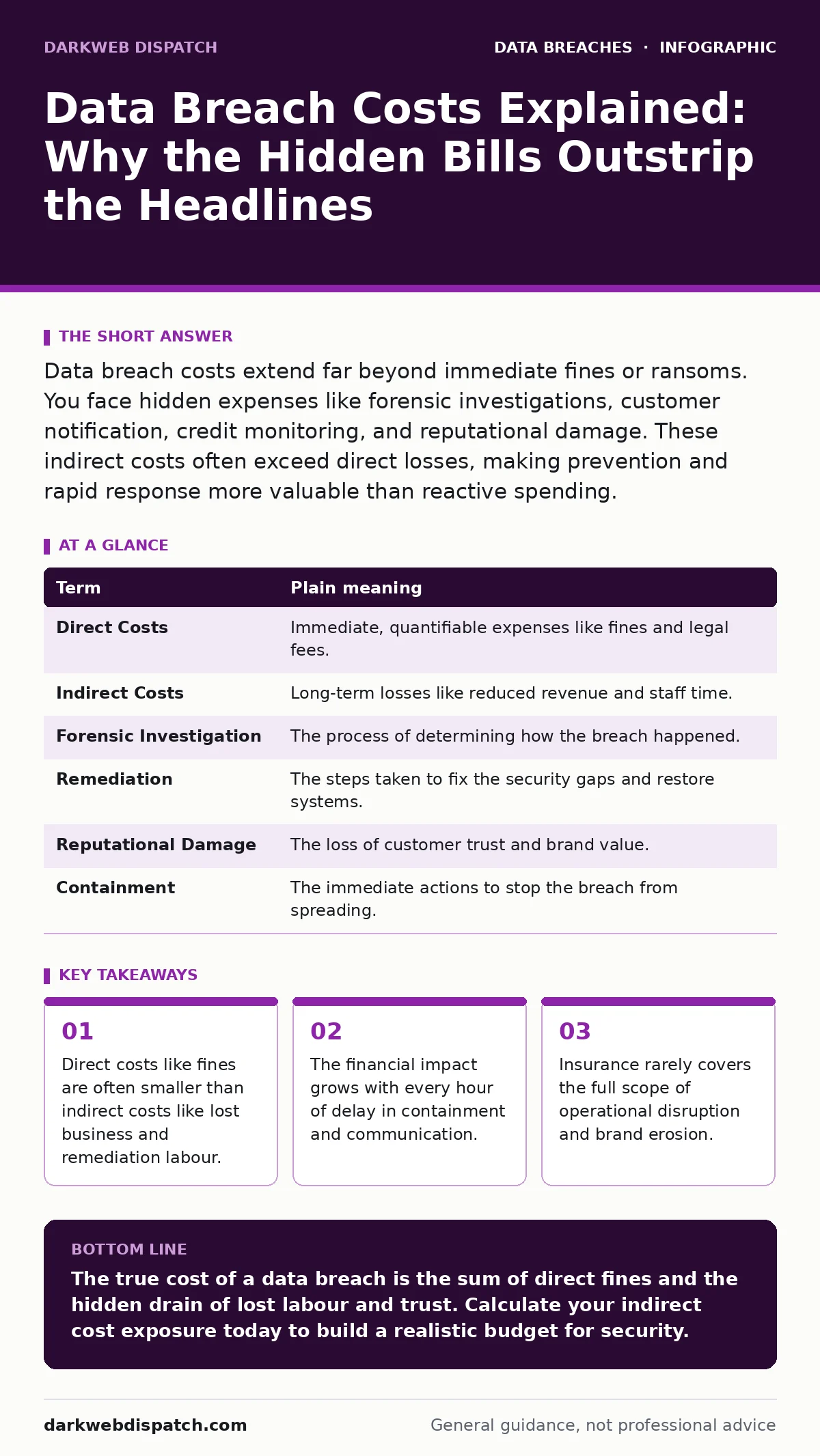
Data breach costs extend far beyond immediate fines or ransoms. You face hidden expenses like forensic investigations, customer notification, credit monitoring, and reputational damage. These indirect costs often exceed direct losses, making prevention and rapid response more valuable than reactive spending.
The Leaking Tank Analogy
Imagine your business is a water tank. A data breach is not just a single hole in the side. It is a crack that widens over time, letting water escape slowly. You might see the puddle forming (the initial breach), but you do not immediately notice the foundation eroding (the long-term costs). Patching the hole is cheap. Rebuilding the foundation is expensive. Most organisations focus on the patch and ignore the erosion. This analogy helps you visualise why the initial incident cost is only a fraction of the total damage. The water loss represents customer trust and operational stability. Once it is gone, it is hard to refill.
Direct vs Indirect Financial Impact
Direct costs are the bills you can itemise. These include regulatory fines, legal fees, and the immediate cost of forensic investigators. Indirect costs are the silent drains. They include the salary of staff diverted from productive work to handle the crisis. They include the marketing budget needed to win back lost customers. Indirect costs are harder to track because they do not appear as a single invoice. They appear as lower revenue over months or years. This distinction matters because insurance policies often cover direct costs but exclude indirect losses. You must budget for the latter separately.
| Term | Plain meaning |
|---|---|
| Direct Costs | Immediate, quantifiable expenses like fines and legal fees. |
| Indirect Costs | Long-term losses like reduced revenue and staff time. |
| Forensic Investigation | The process of determining how the breach happened. |
| Remediation | The steps taken to fix the security gaps and restore systems. |
| Reputational Damage | The loss of customer trust and brand value. |
| Containment | The immediate actions to stop the breach from spreading. |
The Hidden Cost of Labour
When a breach occurs, your security team stops their normal work. They spend weeks investigating, containing, and reporting. This is labour cost. You are paying high salaries for staff who are not generating new value. Suppose your lead engineer spends a month on breach recovery. That is a month of zero development or improvement. This opportunity cost is rarely calculated in post-incident reports. It is a hidden tax on your productivity. The longer the breach remains undetected, the more labour hours are consumed. Detection time is therefore a financial metric, not just a security one.
Legal and Regulatory Fines
Regulatory fines are the most visible cost. They vary by jurisdiction and the type of data exposed. If you hold financial data, you may face stricter penalties under standards like PCI DSS. If you handle health records, the HIPAA Security Rule imposes specific requirements. These frameworks exist to protect data, but they also define the financial consequences of failure. Fines are not just a penalty; they are a signal of systemic failure. You may also face class-action lawsuits from affected individuals. These legal battles can last years, draining resources further. Compliance is not a one-time check; it is an ongoing cost of doing business.
Customer Notification and Support
You must notify affected customers. This involves mailing letters, sending emails, and setting up call centres. The cost of postage and printing is small. The cost of staff answering angry calls is large. Each call takes time. Each call requires empathy and accuracy. Poor handling increases reputational damage. You may also offer credit monitoring services to victims. This is a standard practice but adds to the bill. The duration of support matters. Some customers need help for months. This is a long-tail cost that stretches your budget.
See also: synthetic identity fraud detection: how to spot fake profiles · ISO 27001 for Small Teams: Practical Steps and Hidden Costs
Reputational Erosion and Trust
Trust is hard to build and easy to lose. When customers learn their data is exposed, they may leave. They take their spending with them. This loss of revenue is difficult to quantify precisely. It depends on your industry and customer loyalty. A breach in a highly competitive market leads to faster churn. You may need to spend heavily on marketing to regain trust. This is not just about money; it is about survival. Your brand value is an asset. A breach devalues that asset. The market may react by lowering your stock price or increasing your borrowing costs.
Preventing the Cost Spiral
You cannot prevent all breaches. You can prevent the cost spiral. Fast detection reduces labour costs. Fast containment limits data loss. Good secrets management prevents attackers from moving laterally. Regular third-party risk assessments ensure your vendors are not the weak link. Understanding shadow IT data exposure helps you find unmanaged data stores. These measures reduce the likelihood and impact of a breach. They are investments, not expenses. The return is measured in avoided costs.
Try This Now
- Map your critical data assets and identify who has access to them.
- Calculate the potential labour cost of a one-week incident response diversion.
- Review your insurance policy to see what indirect costs are excluded.
Key takeaways
- Direct costs like fines are often smaller than indirect costs like lost business and remediation labour.
- The financial impact grows with every hour of delay in containment and communication.
- Insurance rarely covers the full scope of operational disruption and brand erosion.
The true cost of a data breach is the sum of direct fines and the hidden drain of lost labour and trust. Calculate your indirect cost exposure today to build a realistic budget for security.
Frequently asked questions
Does cyber insurance cover all breach costs?
No. Most policies cover direct costs like legal fees and ransoms but exclude indirect costs like lost revenue and reputational damage.
How long does it take to recover financially from a breach?
Financial recovery can take months or years, depending on the severity of reputational damage and customer churn.
Are fines the biggest cost of a breach?
Usually not. Indirect costs like labour, lost business, and remediation often exceed regulatory fines.
Can small businesses afford breach response costs?
Small businesses are often more vulnerable because they lack the reserves to absorb indirect costs, making prevention critical.
How this guide was produced: written by the DarkWeb Dispatch editorial team with AI assistance, checked against the public references listed below, and reviewed when the facts change. See our editorial policy or report an error.