synthetic identity fraud detection: how to spot fake profiles
Synthetic identity fraud creates entirely new people using real data fragments, bypassing traditional checks that rely on matching a name to an existing history.

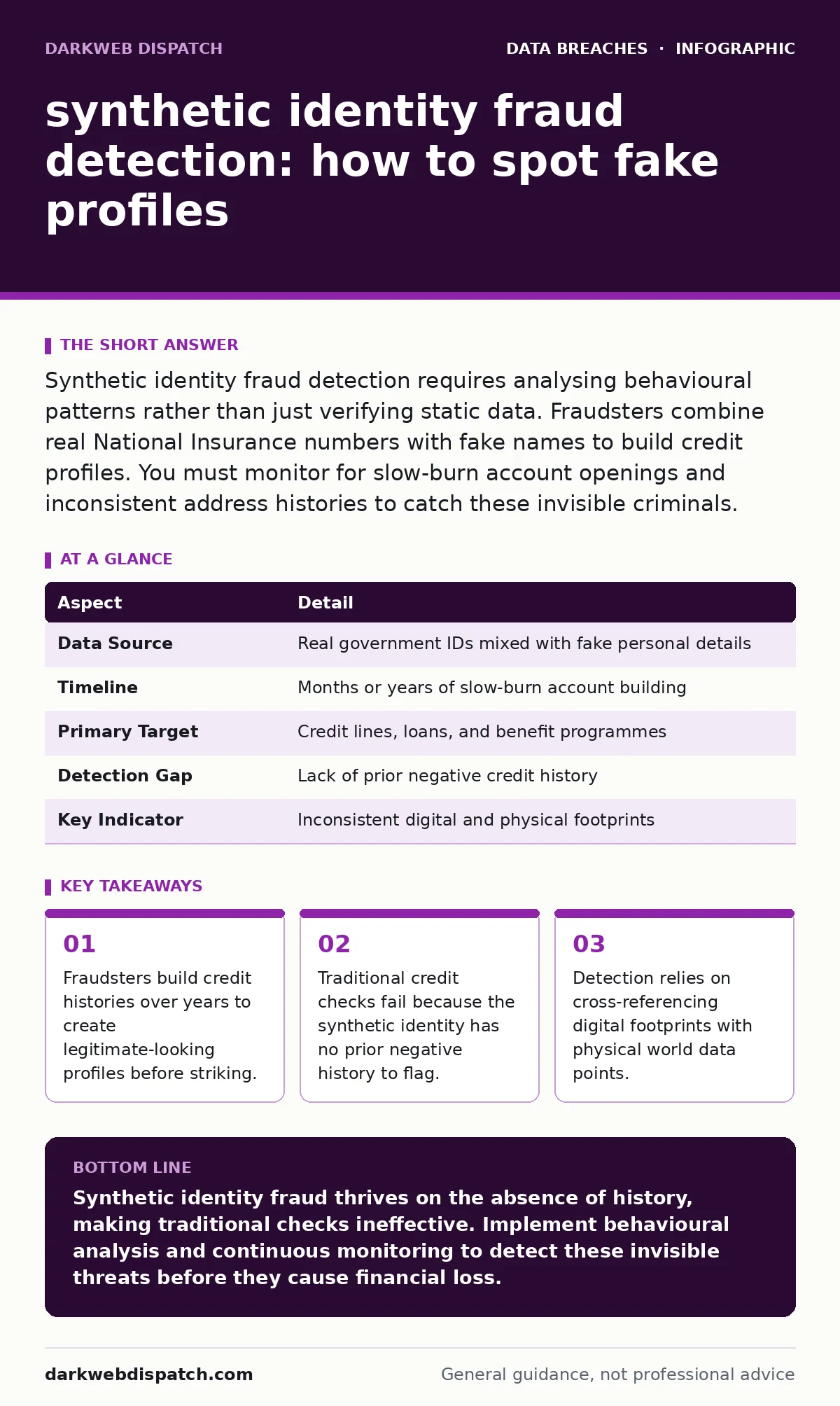
Synthetic identity fraud detection requires analysing behavioural patterns rather than just verifying static data. Fraudsters combine real National Insurance numbers with fake names to build credit profiles. You must monitor for slow-burn account openings and inconsistent address histories to catch these invisible criminals.
Why standard identity checks fail
Imagine a chef creating a new dish by combining real ingredients from different sources. The final meal is not on any existing menu, yet every component is genuine. Synthetic identity fraud operates on this principle. Criminals stitch together real data points, such as a valid tax identification number, with fabricated details like a false name or address. The result is a persona that does not exist in the physical world but appears valid in digital records.
Traditional verification systems look for matches. They check if a name corresponds to a known address or if a phone number has a history. These systems assume the person being verified has an established footprint. Synthetic identities have no prior history. They are blank slates. This absence of negative data makes them invisible to standard fraud filters. A new customer with no credit history is often seen as low risk, not high risk. This assumption is the primary vulnerability.
| Aspect | Detail |
|---|---|
| Data Source | Real government IDs mixed with fake personal details |
| Timeline | Months or years of slow-burn account building |
| Primary Target | Credit lines, loans, and benefit programmes |
| Detection Gap | Lack of prior negative credit history |
| Key Indicator | Inconsistent digital and physical footprints |
How the fraud mechanism works
The process begins with data acquisition. Fraudsters obtain real identifying information, often through data leaks or credential leaks. They need a valid government-issued number to anchor the identity. This number proves something exists. They then invent the surrounding details. They create a name, a date of birth, and an address. They may use a real address that belongs to an unwitting victim, a practice known as address piggybacking.
Once the profile is assembled, the fraudster begins to build credibility. They open prepaid phone accounts or utility services. They make small payments on time. They let the accounts age. This slow-burn phase is critical. It establishes a track record of reliability. Credit bureaus begin to recognise the synthetic identity as a legitimate entity. The profile gains a credit score. It becomes eligible for larger financial products. The fraudster waits until the profile looks strong enough to withstand scrutiny.
Who suffers the consequences
The immediate victim is the financial institution. Banks and lenders lose money when the synthetic identity defaults on a large loan. However, the impact ripples outward. The real person whose tax number was used may face complications. They might be denied credit because the synthetic identity has defaulted on accounts linked to their number. They may receive bills for services they never requested.
Government agencies also bear the cost. Benefit programmes can be drained by synthetic claimants. Regulatory bodies impose fines on institutions that fail to detect these patterns. The broader economy suffers from increased fraud costs, which are passed on to consumers in the form of higher fees and interest rates. The real individual whose data was harvested may need to spend considerable time clearing their name. This administrative burden is often underestimated.
What people usually get wrong
Many organisations believe that checking a government ID is sufficient. This is a fundamental error. A government ID only proves the document is real, not that the person holding it is who they claim to be. Synthetic fraudsters often use genuine documents or high-quality forgeries. They pass the initial visual inspection. The fraud lies in the combination of data, not the individual pieces.
Another common misconception is that new customers are the main risk. While new accounts are scrutinised, synthetic identities often operate for years before committing fraud. They look like loyal, long-term customers. They have a history of positive interactions. This longevity masks the fraudulent nature of the relationship. Assuming that age equals safety allows these identities to mature undetected. The fraud happens at the end of the lifecycle, not the beginning.
Effective synthetic identity fraud detection
Detecting these fake profiles requires a shift from static verification to dynamic analysis. You must look for inconsistencies in the behaviour and data patterns. Synthetic identities often lack the subtle noise of real human behaviour. Real people have irregularities. They move houses, change phone numbers, and have gaps in employment. Synthetic profiles are often too perfect or too uniform.
One effective method is device fingerprinting. This technique analyses the hardware and software configuration of the device used to apply. Synthetic fraudsters often use multiple identities from the same device or network. Linking these accounts reveals the pattern. Another method is cross-referencing data sources. Does the email address domain match the age of the user? Is the phone number assigned to a region that matches the stated address? Mismatches indicate fabrication.
| Detection Method | How It Works | Limitation |
|---|---|---|
| Device Fingerprinting | Links accounts to hardware IDs | Privacy concerns and spoofing tools |
| Behavioural Biometrics | Analyses typing speed and mouse movement | Can be mimicked by sophisticated bots |
| Network Analysis | Maps relationships between accounts | Requires large datasets for accuracy |
| Data Freshness | Checks when data first appeared | May flag legitimate new citizens |
See also: ISO 27001 for Small Teams: Practical Steps and Hidden Costs
The hidden cost of false positives
Aggressive detection systems often block legitimate users. This is a significant trade-off. If your system flags too many synthetic identities, it will also flag new customers who simply lack a digital footprint. These include young adults, recent immigrants, or people with poor internet access. Blocking them damages customer acquisition and reputation.
Balancing security and usability is difficult. Tightening rules reduces fraud but increases friction for real users. Loosening rules improves experience but allows more fraud through. You must find the optimal point. This requires continuous tuning of the detection algorithms. It is not a one-time setup. The fraudsters adapt their methods, so your defences must adapt too. Regular review of blocked transactions helps refine the criteria.
Integrating detection into workflows
Detection cannot be an isolated step. It must be integrated into the broader identity management process. When a user applies for an account, multiple checks should run simultaneously. These include document verification, data cross-referencing, and behavioural analysis. The results are combined into a risk score. High-risk applications are routed for manual review. Low-risk applications are approved automatically.
This approach requires coordination between different teams. The security team manages the detection rules. The operations team handles the manual reviews. The product team ensures the user experience remains smooth. Silos between these groups create gaps. Fraudsters exploit these gaps. A unified strategy ensures that all touchpoints contribute to the overall security posture.
Building a resilient defence
No single tool stops synthetic identity fraud. A layered defence is required. This includes strong identity verification at onboarding, continuous monitoring during the account lifecycle, and rapid response when anomalies are detected. You should also consider third-party risk assessments to ensure your vendors are not introducing vulnerabilities.
Education plays a role too. Staff members who handle manual reviews need training to recognise subtle signs of fraud. They should know what to look for in address histories and employment details. They should understand the tactics fraudsters use. This human element adds a layer of judgement that algorithms cannot replicate.
Final considerations for security teams
The battle against synthetic identity fraud is ongoing. Fraudsters constantly refine their techniques. They use artificial intelligence to generate more realistic data. They use virtual phone numbers and digital mailboxes to create plausible addresses. Your detection methods must evolve to keep pace.
Regularly update your data sources. Ensure your cross-referencing tools have access to the latest information. Test your systems with synthetic data to see if they catch known patterns. Engage with industry groups to share threat intelligence. Collaboration helps identify emerging trends before they become widespread problems.
Key takeaways
- Fraudsters build credit histories over years to create legitimate-looking profiles before striking.
- Traditional credit checks fail because the synthetic identity has no prior negative history to flag.
- Detection relies on cross-referencing digital footprints with physical world data points.
Synthetic identity fraud thrives on the absence of history, making traditional checks ineffective. Implement behavioural analysis and continuous monitoring to detect these invisible threats before they cause financial loss.
Frequently asked questions
Can a synthetic identity be caught by a credit check?
Standard credit checks often fail because the identity has no negative history. Specialised fraud screening tools are needed to detect the inconsistencies in the data pattern.
How long does it take to build a synthetic identity?
It can take months or years. Fraudsters need time to establish a credit history and build trust with financial institutions before attempting a large fraud.
Is synthetic identity fraud limited to credit cards?
No. It affects loans, mortgages, government benefits, and even employment. Any system that relies on identity verification is a potential target.
What is the difference between identity theft and synthetic fraud?
Identity theft involves using someone else's real identity. Synthetic fraud creates a new, fake identity using a mix of real and fabricated data.
How this guide was produced: written by the DarkWeb Dispatch editorial team with AI assistance, checked against the public references listed below, and reviewed when the facts change. See our editorial policy or report an error.