ISO 27001 for Small Teams: Practical Steps and Hidden Costs
Formal certification often costs more than the data it protects, but the internal discipline it forces stops misconfigured cloud storage leaks before they start.

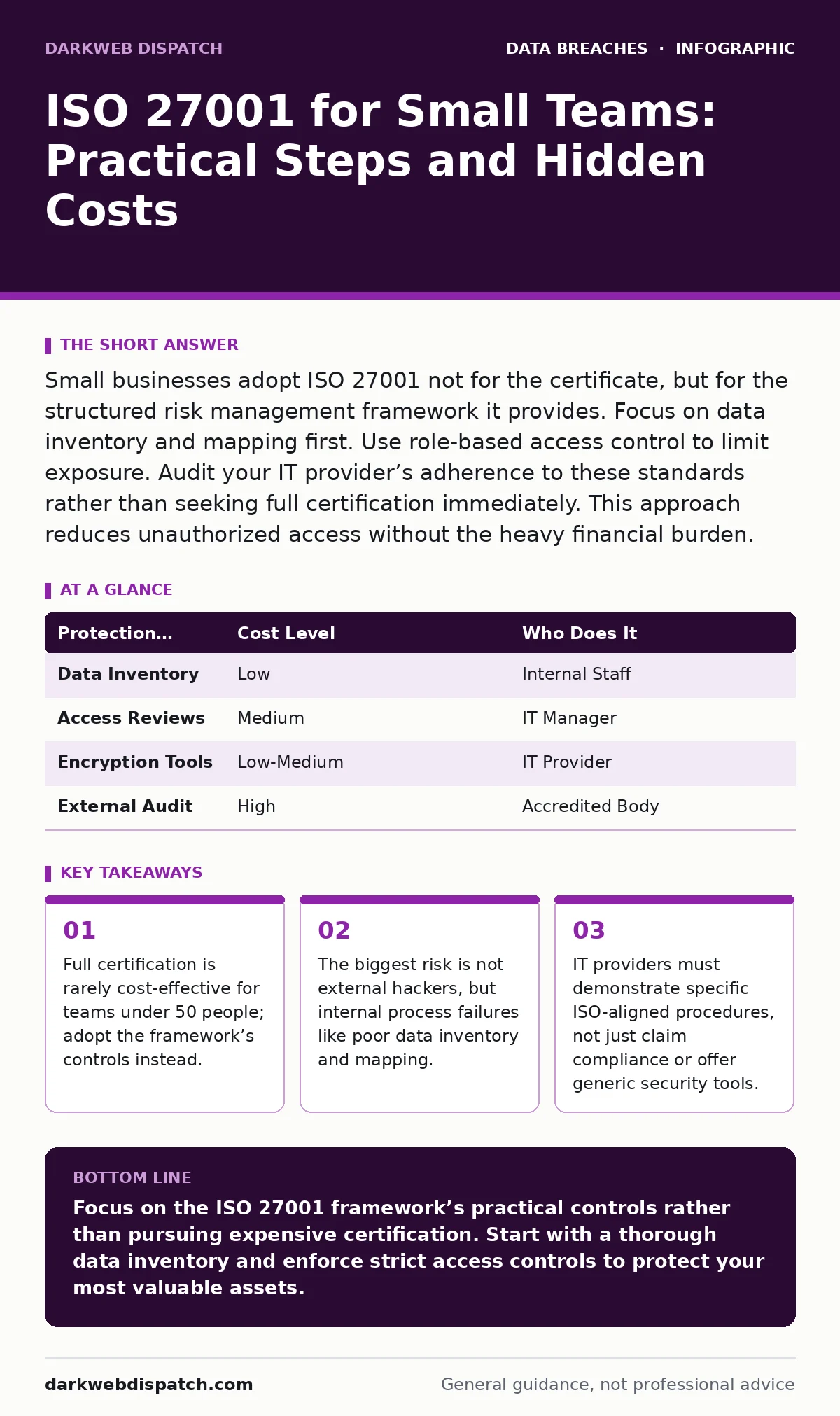
Small businesses adopt ISO 27001 not for the certificate, but for the structured risk management framework it provides. Focus on data inventory and mapping first. Use role-based access control to limit exposure. Audit your IT provider’s adherence to these standards rather than seeking full certification immediately. This approach reduces unauthorized access without the heavy financial burden.
Why Small Teams Adopt the Framework
ISO 27001 is a standard for information security management systems. It dictates how you identify, manage, and monitor risks to your information. Small businesses often ignore it, believing it applies only to large enterprises. This is a dangerous misconception. Small firms hold concentrated value in fewer hands, making them attractive targets for attackers who seek low-hanging fruit.
The standard forces you to document your processes. Documentation reveals gaps in your defences that informal teams often overlook. You cannot protect what you have not defined. A small team without a clear policy on password resets or data retention is vulnerable to social engineering and internal errors. ISO 27001 provides the structure to define these boundaries clearly.
Adopting the framework changes how you think about security. It shifts the focus from buying tools to managing risk. You stop asking which firewall is best and start asking what data needs protection and why. This mindset shift is more valuable than any single piece of software. It ensures that your security measures align with your business goals rather than creating friction that staff bypass.
The Hidden Cost of Certification
Formal certification involves an external audit by an accredited body. This process is expensive and time-consuming. For a small business, the cost of certification often exceeds the potential loss from a minor data leak. The audit requires extensive documentation, regular internal reviews, and evidence of continuous monitoring. Most small teams lack the administrative bandwidth to maintain this level of rigor.
The real value of ISO 27001 lies in its controls, not the certificate. You can implement these controls without paying for an audit. This approach, known as self-assessment or partial adoption, allows you to gain the security benefits without the financial overhead. You focus on the controls that matter most to your specific risk profile. This targeted approach is more efficient and sustainable for small organisations.
Certification can also create a false sense of security. A certificate is a snapshot in time. It does not guarantee ongoing protection. Attackers do not care about your certificate. They care about your vulnerabilities. If you focus on maintaining the certificate rather than securing your systems, you may neglect emerging threats. Prioritise practical security over bureaucratic compliance.
Practical Implementation Steps
Start with data inventory and mapping. You must know what data you hold, where it lives, and who can access it. Without this map, you cannot apply appropriate controls. Identify sensitive data such as customer records, financial details, and intellectual property. Classify this data based on its sensitivity and the impact of a breach. This classification drives your security decisions.
Implement role-based access control. Limit access to data based on job responsibilities. Employees should only have access to the information they need to perform their tasks. This minimises the damage if an account is compromised. Regularly review access rights, especially when employees change roles or leave the company. Automated tools can help manage these permissions, but human oversight remains critical.
Encrypt data at rest and in transit. Encryption ensures that even if data is stolen, it remains unreadable without the decryption key. Use strong, standardised encryption algorithms. Manage your keys securely. Losing your keys means losing your data permanently. Test your encryption regularly to ensure it works as expected. Do not rely on default settings, which may not provide sufficient protection.
| Protection Measure | Cost Level | Who Does It |
|---|---|---|
| Data Inventory | Low | Internal Staff |
| Access Reviews | Medium | IT Manager |
| Encryption Tools | Low-Medium | IT Provider |
| External Audit | High | Accredited Body |
What to Ask Your IT Provider
Your IT provider plays a pivotal role in your security posture. Do not assume their standard offerings meet your needs. Ask specific questions about their processes and adherence to recognised standards. This ensures they are aligned with your security objectives and not just selling products.
Ask how they handle incident response. A breach is inevitable; how they react determines the severity. Request to see their incident response plan. Ask how they test this plan. Regular simulations reveal weaknesses before an actual attack occurs. Ensure they have a clear communication protocol for notifying you of any security events.
Ask about their employee training. Human error is a leading cause of security failures. Your provider’s staff may have access to your systems. Verify that they receive regular security training. Ask how they prevent insider threats. Ensure they have strict controls on their own access to your data. Transparency in their internal processes is a sign of a trustworthy partner.
- How do you align your services with ISO 27001 controls?
- What is your process for managing third-party vendor risks?
- How do you ensure the integrity of your own security tools?
Common Pitfalls to Avoid
One common mistake is treating security as a one-time project. Security is a continuous process. Threats evolve, and your environment changes. You must regularly review and update your controls. Establish a rhythm of review, such as quarterly audits or monthly checks. This ensures your defences remain effective against new threats.
Another pitfall is over-reliance on technology. Tools alone cannot secure your organisation. Policies and procedures are equally important. Ensure your staff understands and follows these policies. Technology can enforce rules, but it cannot replace human judgement. Train your employees to recognise phishing attempts and other social engineering tactics.
Ignoring the HIPAA Security Rule if you handle health data is a critical error. This rule has specific requirements that go beyond general ISO controls. Ensure your provider understands these regulatory obligations. Non-compliance can result in severe penalties. Integrate these specific requirements into your broader security strategy. Do not treat them as separate or optional.
See also: Zero-Day Vulnerabilities: Risks and Protection for Small Businesses · Crypto Stealers: How Small Teams Lose Access and How to Stop It
Integrating with Broader Strategies
Security does not exist in isolation. It must integrate with your broader business strategies. Consider how data leaks might impact your reputation and customer trust. Develop a communication plan for potential breaches. Be transparent with your customers. Honesty can mitigate reputational damage, while cover-ups often worsen it.
Address synthetic identity fraud if you handle financial transactions. This type of fraud uses real and fake information to create new identities. Standard identity checks may not catch these attempts. Implement additional verification steps for high-risk transactions. Monitor for unusual patterns that may indicate fraudulent activity.
Understand the true data breach costs. These include direct costs such as notification and remediation, as well as indirect costs like lost business and legal fees. Quantify these potential costs to justify your security investments. This helps you prioritise controls that offer the best return on investment. Focus on preventing high-impact, high-probability events.
Maintaining Long-Term Resilience
Building resilience requires a culture of security. Encourage your staff to report suspicious activities without fear of reprisal. Reward proactive behaviour. Make security a shared responsibility, not just an IT issue. This cultural shift is difficult to achieve but essential for long-term success.
Regularly test your backups. Ensure you can restore data quickly and completely. Ransomware attacks often target backups to prevent recovery. Keep some backups offline or immutable. This ensures you have a clean copy to restore from, even if your primary systems are compromised. Test your restoration process regularly to ensure it works under pressure.
Stay informed about emerging threats. Subscribe to reputable security news sources. Participate in industry groups. Share knowledge with other small businesses. Collective intelligence helps everyone stay ahead of attackers. Never assume your organisation is too small to be noticed. Attackers use automated tools to scan for vulnerabilities indiscriminately.
Key takeaways
- Full certification is rarely cost-effective for teams under 50 people; adopt the framework’s controls instead.
- The biggest risk is not external hackers, but internal process failures like poor data inventory and mapping.
- IT providers must demonstrate specific ISO-aligned procedures, not just claim compliance or offer generic security tools.
Focus on the ISO 27001 framework’s practical controls rather than pursuing expensive certification. Start with a thorough data inventory and enforce strict access controls to protect your most valuable assets.
Frequently asked questions
Do I need ISO 27001 certification to protect my small business?
No, certification is optional. Adopting the framework’s controls provides significant security benefits without the cost and effort of formal auditing.
How much does implementing ISO 27001 controls cost?
Costs vary widely depending on your size and complexity. Basic controls like access reviews and encryption are low-cost. External audits and complex tools increase expenses.
What is the first step in adopting ISO 27001?
Conduct a data inventory and map your information flows. Understanding what you have and where it is located is the foundation for all subsequent security measures.
Can my IT provider handle ISO 27001 implementation?
They can assist, but you must retain ownership of your security strategy. Ensure they follow recognised standards and provide transparent reporting on their activities.
How this guide was produced: written by the DarkWeb Dispatch editorial team with AI assistance, checked against the public references listed below, and reviewed when the facts change. See our editorial policy or report an error.