Attack Surface Reduction Rules: Real Gains vs Hidden Costs
Attack surface reduction rules block specific execution paths rather than scanning file content, catching zero-day exploits that signature systems miss while risking legitimate application failures.

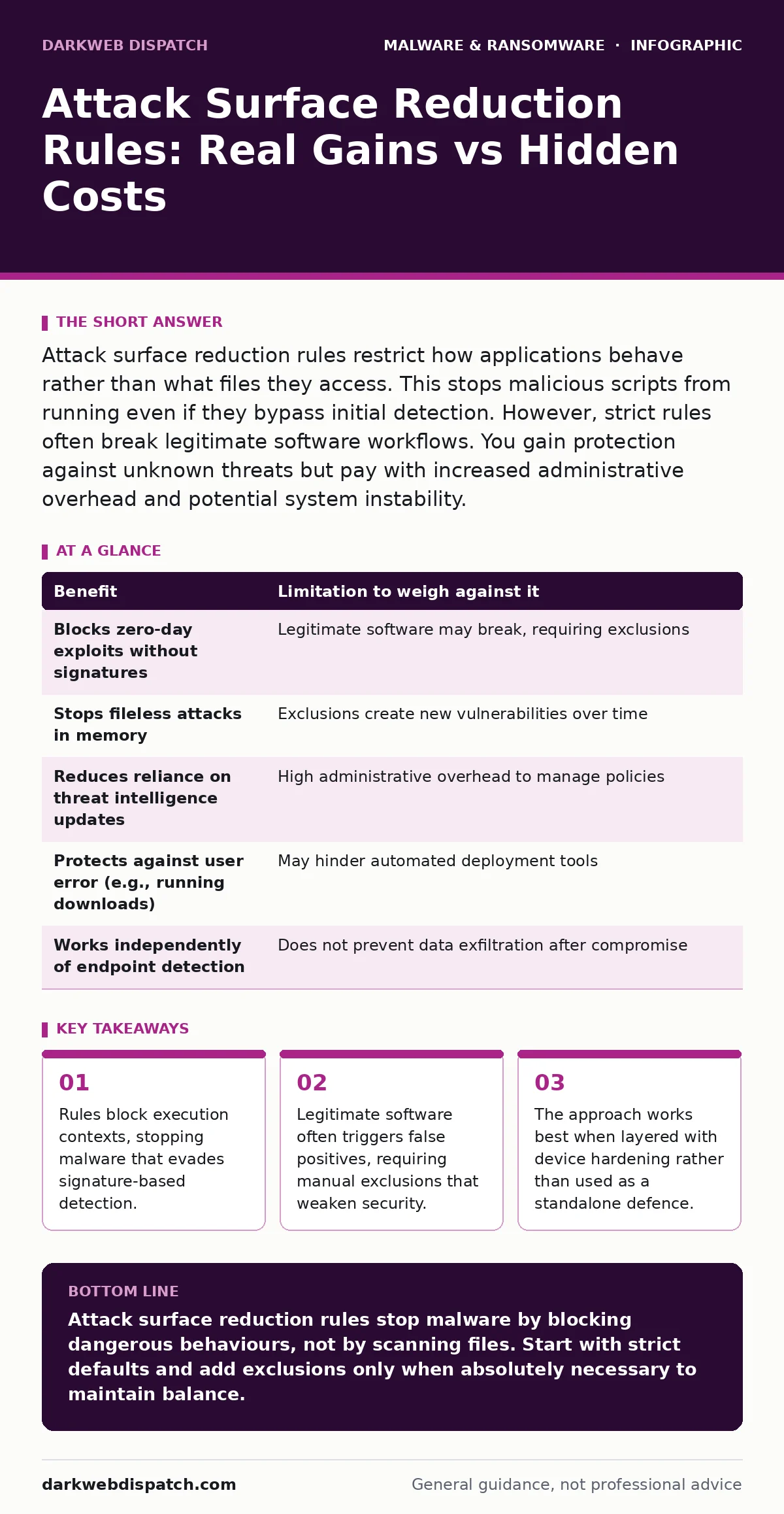
Attack surface reduction rules restrict how applications behave rather than what files they access. This stops malicious scripts from running even if they bypass initial detection. However, strict rules often break legitimate software workflows. You gain protection against unknown threats but pay with increased administrative overhead and potential system instability.
How Execution Contexts Replace File Scanning
Traditional antivirus software examines files for known patterns of malicious code. This method fails when attackers use new techniques or obfuscated scripts. Attack surface reduction rules take a different approach. They monitor how applications behave and where they attempt to run.
Imagine a script file sitting in your downloads folder. Traditional scanners might ignore it if it looks like a harmless document. Attack surface reduction rules check whether that script is trying to execute from an unusual location. If a web browser tries to launch a script directly, the rule blocks the action. This mechanism stops the attack before the code runs.
This method relies on behavioural constraints. It does not care if the file is malicious or benign. It only cares if the action violates the defined policy. This shifts the security focus from file content to execution context.
The Protection Gap Against Unknown Threats
The primary benefit of this approach is protection against zero-day exploits. These are vulnerabilities that have no known signature or patch. Since the rules block specific dangerous behaviours, they catch new malware that looks nothing like previous threats.
Consider a scenario where a user clicks a link in a malicious advertisement. This technique, often called malvertising, can download a payload without the user noticing. If the payload attempts to execute from the temporary internet files folder, the rule blocks it. The malware never runs, regardless of how novel its code is.
This creates a barrier against drive-by downloads and fileless attacks. Fileless attacks live in memory and often leave no trace on the hard drive. By restricting how processes spawn, you limit the ability of these threats to establish a foothold. This is particularly effective against ransomware-as-a-service groups that rely on quick, automated execution.
The Cost of Broken Functionality
The limitation of strict execution rules is that legitimate software often behaves in ways that look suspicious. Many applications install helper scripts or update components in temporary folders. When a rule blocks these actions, the application fails to function.
You will encounter false positives where the system blocks a trusted program. Resolving this requires identifying the legitimate process and adding an exclusion. This creates a trade-off between security and usability. Every exclusion you add creates a potential gap in your defence.
Administrators must balance strictness with operational needs. If the rules are too tight, users will bypass them or disable the protection entirely. If they are too loose, they provide little value. Finding the right balance requires continuous monitoring and adjustment.
Balancing Security and Usability
| Benefit | Limitation to weigh against it |
|---|---|
| Blocks zero-day exploits without signatures | Legitimate software may break, requiring exclusions |
| Stops fileless attacks in memory | Exclusions create new vulnerabilities over time |
| Reduces reliance on threat intelligence updates | High administrative overhead to manage policies |
| Protects against user error (e.g., running downloads) | May hinder automated deployment tools |
| Works independently of endpoint detection | Does not prevent data exfiltration after compromise |
When Strict Rules Are Worth the Effort
Attack surface reduction rules are worth implementing when you handle sensitive data or face targeted threats. If your environment includes high-value assets, the cost of a breach outweighs the administrative burden. These rules add a layer of defence that is difficult for attackers to bypass without significant effort.
They are particularly valuable when combined with other measures. For example, if you are concerned about infostealers that capture credentials, blocking scripts from running in protected folders adds a critical barrier. The rules stop the stealer from executing even if it lands on the system.
This approach is also worth it for organisations with limited IT support for individual users. By preventing common attack vectors, you reduce the number of incidents that require manual remediation. This frees up resources for more complex security tasks.
When to Avoid or Relax Controls
There are scenarios where strict rules cause more harm than good. If your environment relies heavily on custom scripts or legacy applications, the rules may break critical workflows. In these cases, the cost of maintaining exclusions may exceed the security benefit.
Suppose you use older software that cannot be updated. This software may rely on execution methods that modern rules block. You may need to relax controls for specific applications, which reduces the overall protection. In such environments, focusing on network segmentation might be more effective.
Additionally, if your users require high flexibility for development or testing, strict rules will hinder productivity. Developers often need to run code from various locations. Blocking these actions disrupts their work. In these cases, you might apply stricter rules only to production machines, not development environments.
Integrating with Broader Security Strategies
Attack surface reduction rules should not be your only defence. They work best as part of a layered strategy. Combine them with strong authentication, regular updates, and user training. This ensures that if one layer fails, others remain intact.
For instance, if you are dealing with Mac malware, similar principles apply. Restricting how applications behave on macOS can prevent many common threats. However, the specific rules and configurations will differ. You must tailor your approach to the operating system.
Remember that these rules do not stop all attacks. They reduce the likelihood of successful execution. They do not prevent an attacker from gaining initial access through social engineering or phishing. You still need to address the human element of security.
Managing Exclusions Carefully
Every exclusion you add weakens your defence. Treat exclusions as temporary measures until a permanent solution is found. Document why each exclusion is necessary and review them regularly. Remove any that are no longer needed.
Avoid creating broad exclusions for entire folders or applications. This can expose large areas of your system to risk. Instead, exclude specific processes or paths. This limits the potential damage if an attacker exploits the exclusion.
Regularly audit your exclusions to ensure they are still valid. Over time, software updates may change how applications behave. An exclusion that was once necessary may no longer be required. Keeping your exclusions clean maintains the effectiveness of your rules.
Key takeaways
- Rules block execution contexts, stopping malware that evades signature-based detection.
- Legitimate software often triggers false positives, requiring manual exclusions that weaken security.
- The approach works best when layered with device hardening rather than used as a standalone defence.
Attack surface reduction rules stop malware by blocking dangerous behaviours, not by scanning files. Start with strict defaults and add exclusions only when absolutely necessary to maintain balance.
Frequently asked questions
Do attack surface reduction rules protect against ransomware?
Yes, they can prevent ransomware from executing by blocking common delivery methods like scripts running from temporary folders. However, they do not stop ransomware that has already been allowed to run through an exclusion.
How do these rules differ from traditional antivirus?
Traditional antivirus looks for known malicious patterns in files. Attack surface reduction rules look at how applications behave and where they run. This allows them to block new, unknown threats that lack a signature.
Will these rules slow down my computer?
Generally, no. The rules operate at the system level and check execution requests. This has minimal impact on performance. However, poorly configured exclusions or constant false positives can cause delays.
Can attackers bypass attack surface reduction rules?
Yes, sophisticated attackers may find ways to bypass these rules. They might exploit vulnerabilities in the operating system or use legitimate tools to execute code. This is why layering multiple security measures is necessary.
How this guide was produced: written by the DarkWeb Dispatch editorial team with AI assistance, checked against the public references listed below, and reviewed when the facts change. See our editorial policy or report an error.