Ransomware-as-a-Service: How the Business Model Works
Criminals now lease encrypted locks to amateurs, turning complex cyberattacks into standardised commercial products with shared risk.

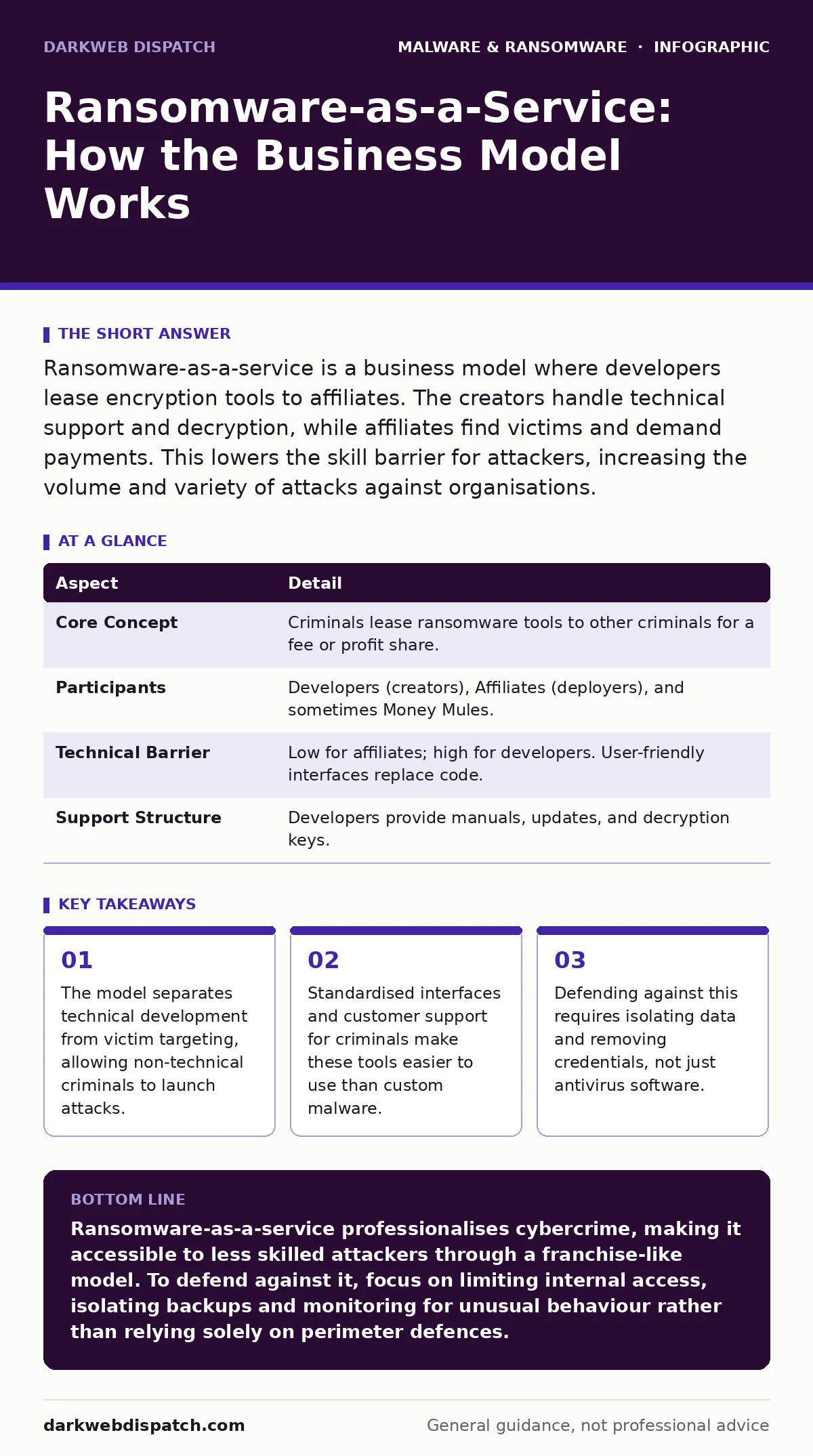
Ransomware-as-a-service is a business model where developers lease encryption tools to affiliates. The creators handle technical support and decryption, while affiliates find victims and demand payments. This lowers the skill barrier for attackers, increasing the volume and variety of attacks against organisations.
The Franchise Model of Cybercrime
Imagine a fast-food franchise. The headquarters provides the recipes, branding, kitchen equipment and training. The local owner finds customers, serves the food and handles local marketing. They split the profits. Ransomware-as-a-service operates on this exact structure. The developers create the malicious software and maintain the infrastructure. The affiliates, often individuals with little technical expertise, locate targets and deploy the software. This separation of duties allows attacks to scale rapidly without requiring every perpetrator to be a skilled programmer.
| Aspect | Detail |
|---|---|
| Core Concept | Criminals lease ransomware tools to other criminals for a fee or profit share. |
| Participants | Developers (creators), Affiliates (deployers), and sometimes Money Mules. |
| Technical Barrier | Low for affiliates; high for developers. User-friendly interfaces replace code. |
| Support Structure | Developers provide manuals, updates, and decryption keys. |
This structure changes how you must defend your systems. You are no longer just fighting a lone hacker. You are facing a professionalised supply chain. The developers have a vested interest in keeping the malware working and undetected. This creates a persistent, evolving threat that improves over time through user feedback and market competition.
How the Partnership Forms
The process begins with recruitment. Developers advertise their tools on private forums or invite-only chats. They demonstrate the malware’s capabilities, such as how quickly it encrypts files or how well it evades detection. Affiliates request access, often paying an upfront fee or agreeing to a revenue split. Once approved, the affiliate receives a customised version of the malware. This version is configured to decrypt files only with the developer’s private key. The affiliate cannot decrypt the data themselves. This ensures the developer retains control and prevents affiliates from stealing from each other.
The affiliate then selects a target. They often use stolen credentials or exploit unpatched software to gain initial access. Once inside, they deploy the ransomware. The encryption happens quickly, locking out users from their files. A ransom note appears, demanding payment in cryptocurrency. The note usually includes instructions for contacting the affiliate. The affiliate forwards the demand to the developer if necessary. The developer provides the decryption key upon payment.
Who Bears the Cost
You might think this model only affects large corporations with high-value data. That is a misconception. Small and medium-sized businesses are frequent targets. They often lack the dedicated security teams that larger organisations possess. This makes them easier to compromise and more likely to pay the ransom to restore operations. Healthcare providers, local governments and schools are also common victims. Their services are critical, creating pressure to resume operations quickly.
Suppose a small architectural firm falls victim to this model. The affiliate gained access through a weak password. Within hours, all project files are locked. The firm cannot meet client deadlines. The pressure to pay is immense. However, paying does not guarantee recovery. The developer might fail to provide the key. Or they might provide a broken key. There is no consumer protection in this transaction. The firm loses money, time and reputation. The affiliate keeps their share. The developer upgrades their tools based on what worked. The cycle continues.
Common Forms and Tactics
Ransomware-as-a-service is rarely just about encryption. Modern variants often include additional features to maximise pressure. One common addition is data theft. Before encrypting files, the malware exfiltrates sensitive information. This is known as double extortion. The attackers threaten to publish the stolen data if the ransom is not paid. This adds urgency for victims who fear regulatory fines or public embarrassment.
Another form involves infostealers. These are tools that harvest passwords, browser cookies and session tokens from infected machines. Affiliates may use infostealers to gain initial access or to find additional credentials to expand their reach within a network. This creates a chain reaction. One compromised account can lead to the compromise of many others. The ransomware then seals the breach by encrypting everything.
These tactics show that the threat is multifaceted. Encryption disrupts operations. Data theft threatens privacy and compliance. Understanding both aspects is necessary for effective defence. Relying solely on backup restoration ignores the risk of exposed data. You must consider the full impact of the breach, not just the locked files.
What People Usually Get Wrong
Many organisations believe that strong perimeter firewalls will stop ransomware-as-a-service. This is incorrect. Firewalls block external connections, but they do not stop malware that is already inside. Affiliates often use legitimate credentials to enter the network. This bypasses perimeter defences entirely. Once inside, the malware spreads laterally. It moves from one computer to another, encrypting shared drives and servers.
Another common error is assuming that antivirus software provides complete protection. Traditional antivirus relies on known signatures. New variants of ransomware-as-a-service often lack these signatures initially. By the time a signature is created, the damage may already be done. You need behavioural detection, not just signature matching. This means monitoring for unusual activities, such as mass file renaming or rapid data encryption.
Some users also misunderstand the role of backups. Having backups is good, but they are not enough if they are connected to the network. Ransomware can encrypt backups too. Backups must be isolated. They should be offline or immutable, meaning they cannot be changed or deleted. This ensures you have a clean copy to restore from.
Reducing Your Risk
Defending against ransomware-as-a-service requires a shift in mindset. You must assume that breaches will happen. The goal is to limit the damage. Start by reducing your attack surface. This means removing unnecessary access rights. Users should only have the permissions they need to do their jobs. This limits the spread of malware if one account is compromised.
Implement attack surface reduction rules. These are policies that restrict how applications can behave. For example, you can prevent scripts from running in certain directories. This stops many ransomware variants from executing. Combine this with software restriction policies. These policies allow only trusted applications to run. Unknown or unsigned programs are blocked. This makes it harder for affiliates to deploy their tools.
Regular, isolated backups are your last line of defence. Test your backups regularly. Ensure they can be restored quickly. If you have clean backups, you do not need to pay the ransom. You can simply wipe the infected systems and restore the data. This removes the leverage of the attackers. It also helps you recover from other threats, such as crypto-stealing malware, which may precede a ransomware attack.
Stay informed about new tactics. Read about spyware and other related threats. Understanding the full ecosystem helps you prepare better. Security is not a one-time fix. It is an ongoing process. By understanding the business model behind ransomware-as-a-service, you can anticipate the moves of your adversaries. You can build defences that are resilient to this commercialised threat.
Key takeaways
- The model separates technical development from victim targeting, allowing non-technical criminals to launch attacks.
- Standardised interfaces and customer support for criminals make these tools easier to use than custom malware.
- Defending against this requires isolating data and removing credentials, not just antivirus software.
Ransomware-as-a-service professionalises cybercrime, making it accessible to less skilled attackers through a franchise-like model. To defend against it, focus on limiting internal access, isolating backups and monitoring for unusual behaviour rather than relying solely on perimeter defences.
Frequently asked questions
Can ransomware-as-a-service infect Mac computers?
Yes, Mac malware is increasing. While less common than Windows targets, macOS systems are vulnerable to ransomware and data theft if not properly secured.
Does paying the ransom guarantee file recovery?
No. There is no guarantee. Attackers may fail to provide the decryption key, provide a broken key, or sell the data anyway. Paying also funds further criminal activity.
What is the difference between ransomware and ransomware-as-a-service?
Traditional ransomware is created and deployed by the same group. Ransomware-as-a-service involves developers leasing the tool to affiliates who deploy it, splitting the profits.
How do affiliates find victims?
Affiliates often use phishing emails, stolen credentials or vulnerabilities in public-facing software to gain initial access. They may also purchase access from other criminal groups.
How this guide was produced: written by the DarkWeb Dispatch editorial team with AI assistance, checked against the public references listed below, and reviewed when the facts change. See our editorial policy or report an error.