ISACs: The Real Value and Hidden Costs of Sector Sharing
Information Sharing and Analysis Centres turn isolated incident data into collective defence, but membership demands operational discipline rather than passive observation.

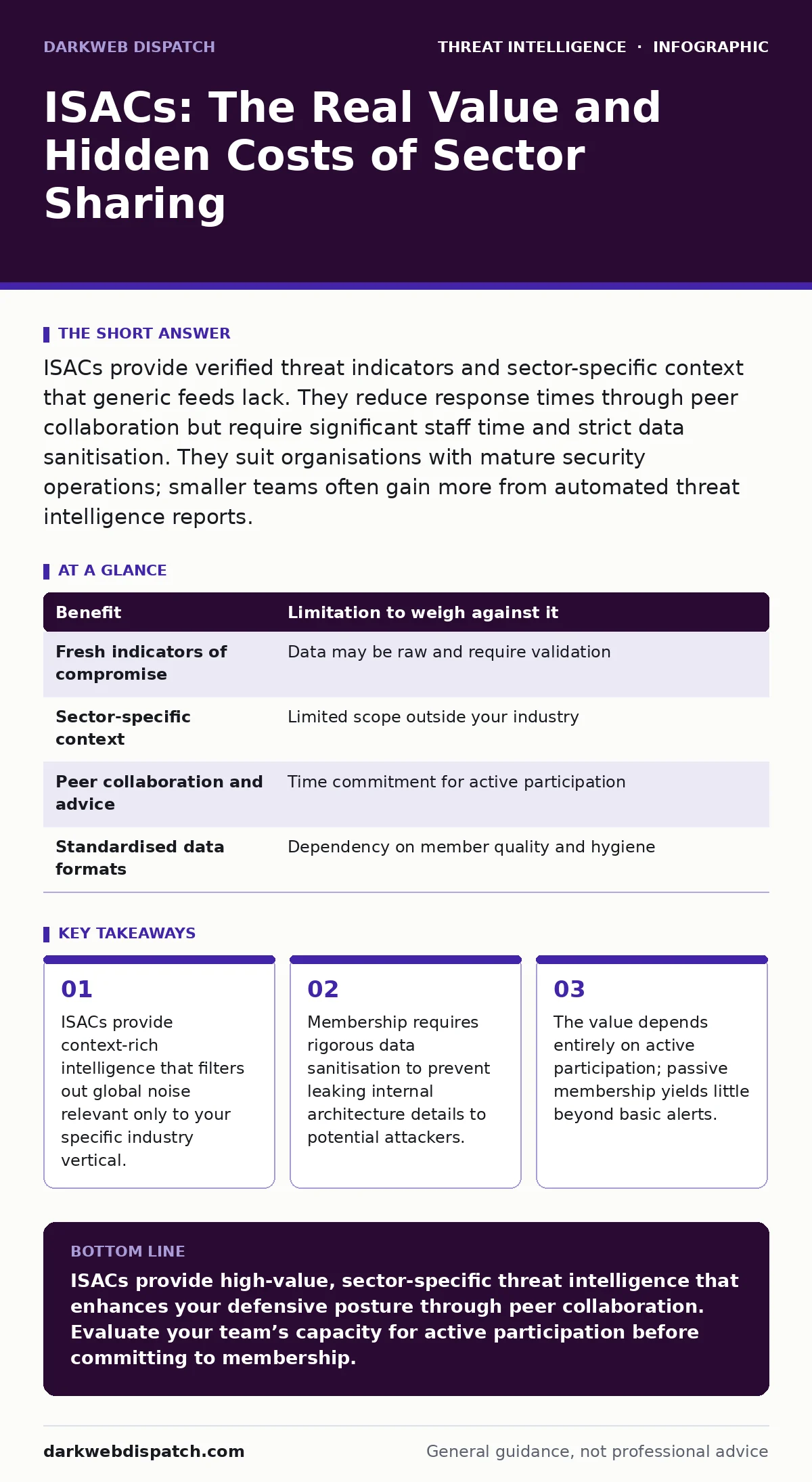
ISACs provide verified threat indicators and sector-specific context that generic feeds lack. They reduce response times through peer collaboration but require significant staff time and strict data sanitisation. They suit organisations with mature security operations; smaller teams often gain more from automated threat intelligence reports.
The Mechanism of Collective Defence
Information Sharing and Analysis Centres, or ISACs, are sector-specific entities that facilitate the exchange of cyber threat data among member organisations. Unlike open-source intelligence, which aggregates data from the entire internet, ISACs filter information through the lens of a specific industry. This creates a signal-to-noise ratio that is difficult to replicate with commercial tools alone.
Imagine a banking ISAC where a member detects a new phishing campaign targeting their login portal. They share the malicious domain indicators with the centre. Within hours, other banks update their firewalls to block traffic to those domains. This stops the attack before it spreads. The mechanism relies on trust and standardisation. Members agree to share data using common formats, such as STIX and TAXII, which are open standards for cyber threat intelligence. This ensures that automated systems can ingest the data without manual parsing.
Concrete Operational Benefits
The primary benefit is speed. Threat indicators from an ISAC are often fresher than those from commercial vendors because they come directly from peers who are currently under attack. You receive data before it appears in public reports or commercial feeds. This head start allows you to block indicators of compromise before adversaries establish persistence.
Another advantage is contextual relevance. A generic threat feed might list thousands of malicious IP addresses, many of which are irrelevant to your business. An ISAC focuses on threats that target your sector’s specific technologies and workflows. This reduces alert fatigue for your analysts. They spend less time triaging false positives and more time investigating genuine risks. This efficiency is critical when dealing with high-volume security information and event management, or SIEM systems, that generate vast amounts of log data.
| Benefit | Limitation to weigh against it |
|---|---|
| Fresh indicators of compromise | Data may be raw and require validation |
| Sector-specific context | Limited scope outside your industry |
| Peer collaboration and advice | Time commitment for active participation |
| Standardised data formats | Dependency on member quality and hygiene |
The Hidden Costs of Participation
Membership is not passive. You must contribute to receive maximum value. This requires staff time to sanitise incident data, write reports, and participate in working groups. If your team is small, this operational overhead can strain resources. You must balance the time spent sharing intelligence against the time spent hardening your own defences.
Data sanitisation is the most significant hurdle. Before sharing any incident details, you must remove identifying information about your network topology, internal IP ranges, and employee names. Failure to do so exposes your infrastructure to further attack. This process is manual and error-prone. A single mistake can leak sensitive architectural details to adversaries who may monitor ISAC communications. This risk is often underestimated by new members.
When Structural Integrity Fails
Consider a scenario where an organisation joins an ISAC but sends unverified alerts to the channel. This creates noise that degrades the value for all members. Other analysts must spend time filtering out these low-quality reports. Over time, trust erodes. The ISAC may restrict the member’s posting privileges. This highlights the need for quality control. You should only share data that has been internally validated. This aligns with the principles of purple teaming, where offensive and defensive teams collaborate to improve detection accuracy before external sharing.
Another edge case involves proprietary technology. If your organisation uses custom-built software that is not common in your sector, sharing indicators related to it may reveal vulnerabilities in your unique codebase. Attackers can reverse-engineer these clues to craft targeted exploits. You must assess the risk of revealing your unique attack surface before contributing technical details. This assessment is part of a broader Unified Kill Chain analysis, which maps adversary actions across multiple stages of an intrusion.
When It Is Worth It
Membership is valuable when you have a dedicated security operations centre with analysts who can process and act on shared intelligence. If your team uses automated tools to ingest threat feeds, an ISAC provides a high-quality source that integrates smoothly. You benefit from the collective wisdom of peers who face similar regulatory and technical challenges. This is particularly true for highly regulated industries where compliance requirements drive security priorities.
It is also worth it when you need to understand emerging tactics specific to your sector. Adversaries often tailor their methods to the unique workflows of a particular industry. An ISAC provides early warning of these tailored campaigns. You can adjust your MITRE D3FEND strategies, which describe defensive techniques mapped to adversary behaviours, based on real-world peer experiences. This proactive adjustment strengthens your posture before an attack lands.
See also: Pyramid of Pain Cyber: How Indicator Difficulty Shapes Defence · How Autonomous System Numbers Work in Threat Intelligence
When It Is Not Worth It
If your security team is understaffed, the time required for sanitisation and participation may outweigh the benefits. You may find that automated threat intelligence platforms provide sufficient coverage for your needs. These platforms aggregate data from multiple sources, including ISACs, and present it in a curated format. You avoid the operational burden of direct membership while still accessing the data.
It is also not worth it if your organisation is small and has a limited attack surface. Adversaries often target large organisations with significant resources. Smaller entities may be lower priority targets. In this case, focusing on basic hygiene and monitoring is more effective than joining a sector-specific intelligence body. You should evaluate your risk profile before committing resources. This evaluation should include an analysis of potential golden ticket attacks, which are high-impact breaches that require advanced persistence techniques often seen in larger targets.
Integrating Intelligence into Defence
To maximise value, integrate ISAC data into your daily workflows. Do not treat it as a separate stream of information. Feed indicators into your SIEM and firewall rules automatically. This ensures that your defences update in real-time as new threats emerge. You should also review the Diamond Model of intrusion analysis to understand the relationship between adversary, infrastructure, victim, and capability. This model helps you contextualise the raw data you receive from the ISAC.
Regularly test your detection rules against shared indicators. This practice ensures that your tools are configured correctly to spot the threats described by your peers. It also helps you identify gaps in your monitoring. You may find that certain attack vectors, such as scheduled task abuse, are not being detected despite being reported by the ISAC. Addressing these gaps closes the loop between intelligence and prevention.
Key takeaways
- ISACs provide context-rich intelligence that filters out global noise relevant only to your specific industry vertical.
- Membership requires rigorous data sanitisation to prevent leaking internal architecture details to potential attackers.
- The value depends entirely on active participation; passive membership yields little beyond basic alerts.
ISACs provide high-value, sector-specific threat intelligence that enhances your defensive posture through peer collaboration. Evaluate your team’s capacity for active participation before committing to membership.
Frequently asked questions
Do ISACs share data with law enforcement?
ISACs may share aggregated, anonymised data with law enforcement to support investigations, but they do not share identifiable member information without consent. This protects member privacy while aiding broader security efforts.
Can small businesses join ISACs?
Most ISACs have membership criteria based on industry role and size. Small businesses may find partner programmes or affiliate memberships that offer limited access to data without full participation requirements.
How is data sanitised before sharing?
Members remove internal IP addresses, hostnames, employee names, and other identifying details. They also generalise technical details to prevent revealing specific vulnerabilities in their unique infrastructure.
What happens if a member shares false information?
ISACs have validation processes to verify reports. If false information is shared, it may be flagged and removed. Repeated sharing of low-quality data can result in restricted posting privileges for the member.
How this guide was produced: written by the DarkWeb Dispatch editorial team with AI assistance, checked against the public references listed below, and reviewed when the facts change. See our editorial policy or report an error.