Cyber Kill Chain Steps: Mapping Attack Phases to Defence
Most defenders focus on the final breach, but the kill chain reveals that early detection disrupts attacks with far less operational cost than incident response.

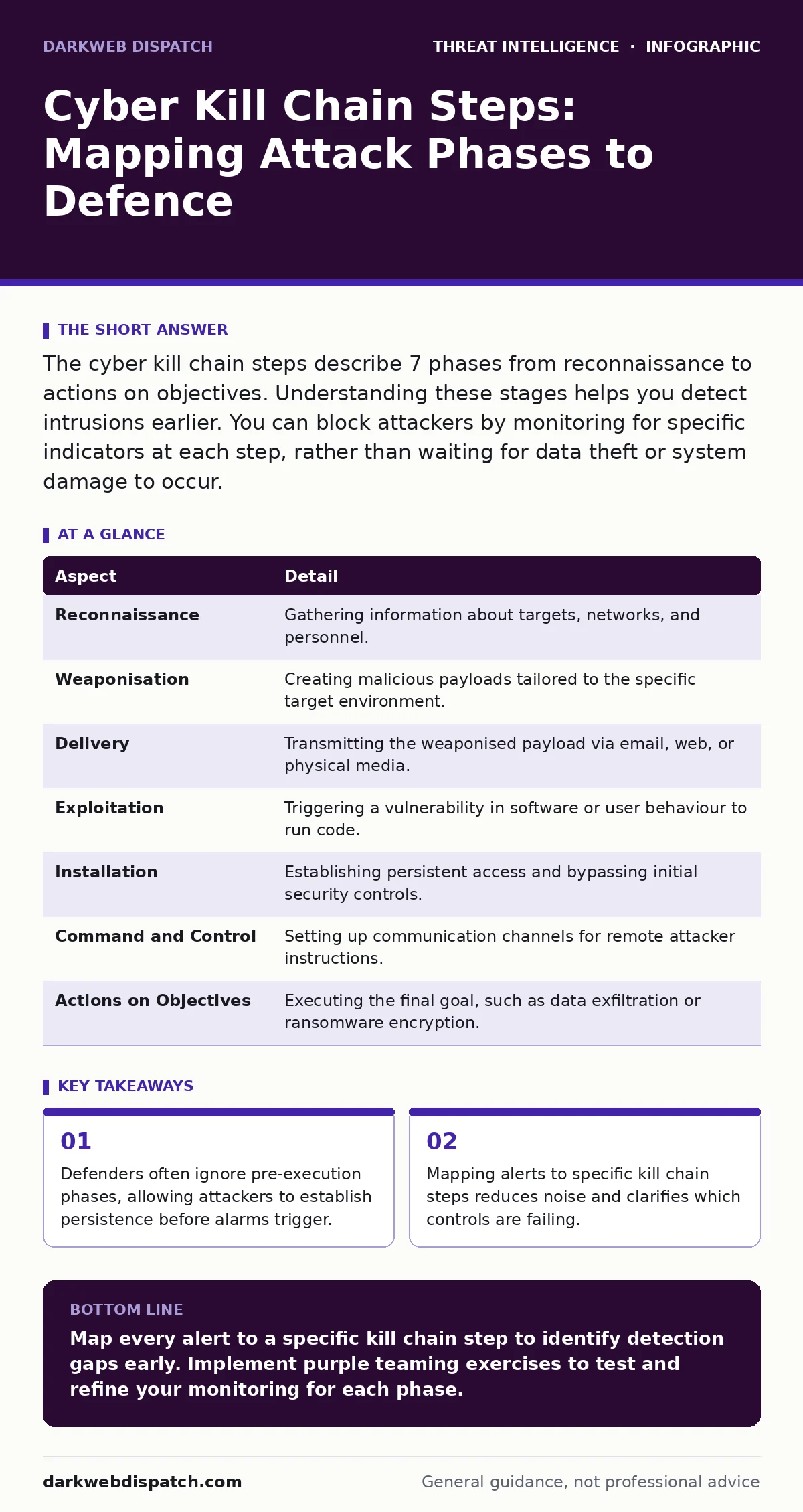
The cyber kill chain steps describe 7 phases from reconnaissance to actions on objectives. Understanding these stages helps you detect intrusions earlier. You can block attackers by monitoring for specific indicators at each step, rather than waiting for data theft or system damage to occur.
Everyday Analogy: Planning a Heist
Imagine a thief planning to steal a painting from a museum. They do not simply kick down the front door. They first study the building layout, note guard routines, and acquire tools. They might create a fake identity to gain access during opening hours. Only after hours of preparation do they enter the restricted area. If security cameras catch them scouting the perimeter days earlier, the theft never happens.
The cyber kill chain steps follow this same logical progression. Attackers require time and resources to move from idea to impact. Each phase leaves digital footprints that differ significantly from the final breach. Recognising these early signs changes your defensive posture from reactive cleanup to proactive disruption. This model shifts the focus from preventing the door from opening to detecting the person picking the lock.
At a Glance: The 7 Phases
| Aspect | Detail |
|---|---|
| Reconnaissance | Gathering information about targets, networks, and personnel. |
| Weaponisation | Creating malicious payloads tailored to the specific target environment. |
| Delivery | Transmitting the weaponised payload via email, web, or physical media. |
| Exploitation | Triggering a vulnerability in software or user behaviour to run code. |
| Installation | Establishing persistent access and bypassing initial security controls. |
| Command and Control | Setting up communication channels for remote attacker instructions. |
| Actions on Objectives | Executing the final goal, such as data exfiltration or ransomware encryption. |
How the Cyber Kill Chain Steps Work
The model breaks down an intrusion into discrete, sequential stages. Reconnaissance involves passive data collection. Attackers scan public records, social media, and network ports to find weak points. This phase is often invisible to standard security tools because it generates no malicious traffic. Weaponisation combines the gathered intelligence with exploit code. The attacker creates a file that appears legitimate but contains hidden instructions. This step is offline and leaves no trace on your network.
Delivery moves the payload into your environment. Common methods include phishing emails with attachments or links to compromised websites. Once delivered, Exploitation occurs when the victim interacts with the payload. This interaction triggers a vulnerability in software or tricks the user into executing code. The success of this step depends on unpatched systems or human error.
Installation follows successful exploitation. The attacker places a backdoor or trojan on the system to maintain access. This persistence mechanism ensures that even if the initial entry point is closed, the attacker remains inside. Command and Control establishes a beacon back to the attacker’s server. This channel allows remote instruction. Finally, Actions on Objectives represents the payoff. The attacker steals data, encrypts files, or disrupts services. Each step increases the attacker’s investment and reduces their options for retreat.
Who It Affects and Why It Matters
Every organisation with digital assets faces this threat model. Small businesses often suffer because they lack visibility into the early stages. They only detect the attack when Actions on Objectives disrupt operations. Large enterprises face complexity. Their diverse environments create blind spots between phases. Attackers exploit these gaps to move laterally. Understanding the kill chain helps you prioritise resources.
Monitoring for Delivery attempts is cheaper than responding to Actions on Objectives. It also helps you coordinate with external partners. Sharing indicators of compromise related to specific steps improves collective defence. This is why ISACs exist to distribute threat intelligence across sectors. By knowing which step an attack is in, you can choose the right containment strategy.
What People Usually Get Wrong
Defenders often treat the cyber kill chain steps as a linear checklist that must be stopped at step one. This is a false premise. Attackers adapt. If they detect resistance at Delivery, they may try a different vector. If Exploitation fails, they might use credential stuffing instead. The model is not a guarantee of failure if one step is breached.
It is a framework for measurement. Another common error is ignoring Reconnaissance. Many teams do not monitor for port scans or DNS queries that indicate information gathering. By the time they see traffic, the attacker has already weaponised their approach. You cannot defend against what you do not measure.
A third misconception is that stopping the chain means total safety. Attackers can dwell in the Command and Control phase for months. They wait for the right moment to act. This persistence is why scheduled task abuse is a frequent tactic. Attackers use legitimate system functions to maintain access without triggering obvious alarms. Detecting this requires behavioural analysis, not just signature matching. You must assume breach and verify integrity continuously.
See also: How Autonomous System Numbers Work in Threat Intelligence · ISACs: The Real Value and Hidden Costs of Sector Sharing
Improving Detection with Purple Teaming
Traditional defence relies on blue teams to react to alerts. This is often too late. Purple teaming bridges the gap between attack and defence. It involves coordinated exercises where offensive and defensive teams work together. The offensive team simulates specific kill chain steps. The defensive team monitors for those specific indicators. This collaboration identifies blind spots in real-time.
For example, you might simulate a Command and Control beacon and see if your network monitoring catches the unusual outbound traffic. This method reveals whether your tools are configured correctly. It also helps refine alert rules. You learn which signals generate noise and which indicate genuine threats. This reduces false positives in threat detection by focusing on high-fidelity indicators.
The goal is not to prove vulnerability but to improve detection speed. By mapping alerts to the kill chain, you can calculate Mean Time to Detect (MTTD) for each phase. If you detect Installation quickly but miss Delivery, you know where to invest. This data-driven approach replaces guesswork with empirical evidence. It ensures your defences align with actual attacker behaviour.
Leveraging the Pyramid of Pain
Not all indicators of compromise are equally useful. The Pyramid of Pain categorises indicators by how difficult they are for attackers to change. Low on the pyramid are file hashes and IP addresses. Attackers can regenerate these easily. High on the pyramid are attacker tools and techniques. Changing these requires significant effort and planning. When you disrupt an attack at a high pain point, you force the attacker to rebuild their campaign. Focus your threat actor profiling on these high-value indicators. Sharing these details with partners makes life harder for adversaries across the industry.
Monitor for behaviours that reflect high-pain indicators. Instead of blocking a single IP, block the protocol abuse or the specific exploit technique. This approach is more durable. It survives attacker evasion tactics. It also helps you understand the sophistication of the threat. A casual hacker uses low-pain indicators. An advanced group invests in high-pain capabilities. Knowing this helps you allocate response resources appropriately.
Blue Team Operations and Response
Your blue team operations must be structured around these phases. Create playbooks for each step. Define who responds, what tools they use, and what data they need. For Delivery, focus on email security and web filtering logs. For Exploitation, monitor for unusual process execution or memory anomalies. For Command and Control, analyse outbound traffic patterns and DNS queries. Ensure your logging covers all phases. Gaps in logging create gaps in defence.
Regularly test your response procedures. Conduct tabletop exercises that simulate attacks at different stages. Ask how your team would detect and contain an attack at the Installation phase versus the Actions on Objectives phase. The response differs significantly. Early containment involves isolation and credential reset. Late containment involves forensic analysis and data recovery. Clear roles and procedures reduce chaos during an incident.
Using the Traffic Light Protocol
Sharing threat intelligence requires careful handling. The Traffic Light Protocol helps you decide what information can be shared and with whom. Green means share freely. Amber means share within the community. Red means share only with the originator. Black means do not share. Use this protocol when discussing kill chain indicators. Some details, like specific internal IP ranges, must remain confidential. Others, like generic exploit techniques, can be shared widely. This balance protects your organisation while contributing to collective security. It prevents accidental disclosure of sensitive data during collaboration.
Key takeaways
- Defenders often ignore pre-execution phases, allowing attackers to establish persistence before alarms trigger.
- Mapping alerts to specific kill chain steps reduces noise and clarifies which controls are failing.
Map every alert to a specific kill chain step to identify detection gaps early. Implement purple teaming exercises to test and refine your monitoring for each phase.
Frequently asked questions
How many steps are in the cyber kill chain?
There are 7 distinct steps: reconnaissance, weaponisation, delivery, exploitation, installation, command and control, and actions on objectives.
Can the kill chain be used for defensive planning?
Yes. It helps defenders prioritise monitoring and response efforts by identifying which phases are most vulnerable in their environment.
Is the kill chain only for advanced threats?
No. While advanced attackers use all steps, even simple attacks follow a subset of these phases. Understanding the model helps detect both sophisticated and basic intrusions.
What is the difference between MITRE ATT&CK and the kill chain?
The kill chain is a high-level model with 7 phases. MITRE ATT&CK is a detailed framework with hundreds of specific tactics and techniques. They complement each other.
How this guide was produced: written by the DarkWeb Dispatch editorial team with AI assistance, checked against the public references listed below, and reviewed when the facts change. See our editorial policy or report an error.