How Autonomous System Numbers Work in Threat Intelligence
Autonomous system numbers expose the network owner behind an attack, allowing analysts to attribute traffic to specific organisations rather than isolated IP addresses.

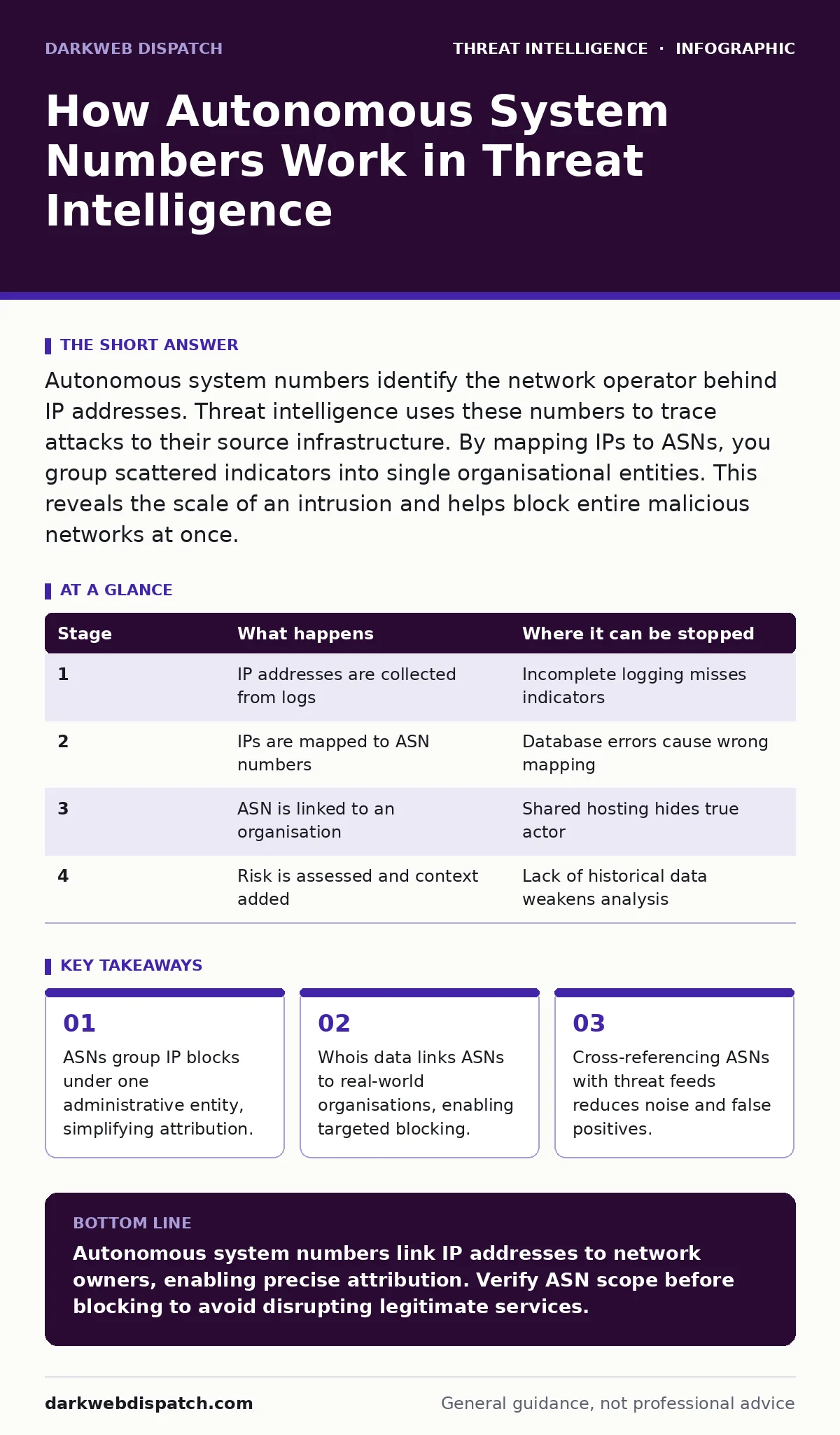
Autonomous system numbers identify the network operator behind IP addresses. Threat intelligence uses these numbers to trace attacks to their source infrastructure. By mapping IPs to ASNs, you group scattered indicators into single organisational entities. This reveals the scale of an intrusion and helps block entire malicious networks at once.
Understanding the Network Backbone
The internet operates as a collection of interconnected networks rather than one monolithic system. Each large network belongs to an autonomous system. An autonomous system is a collection of IP prefixes under the control of one administrative entity that presents a common routing policy to the internet. Every autonomous system receives a unique autonomous system number. This number acts as a digital fingerprint for the network owner. Threat intelligence relies on these numbers to move beyond individual IP addresses.
Relying solely on IP addresses creates fragmentation. A single attacker may rotate through hundreds of addresses within one network. An autonomous system number groups these addresses together. This grouping reveals the true scope of an operation. Analysts use this grouping to identify patterns that single IPs hide. Understanding this structure is fundamental to effective defence. You must look at the network, not just the host.
Stage 1: IP Address Collection
The process begins with raw network traffic or security logs. Your sensors capture source and destination IP addresses during an incident. These addresses are the starting points for attribution. You collect these indicators of compromise from firewalls, intrusion detection systems, or endpoint protection platforms. The volume of data can be overwhelming. Filtering noise at this stage prevents analysis paralysis. Focus on addresses that exhibit suspicious behaviour. Do not discard data prematurely.
Imagine a scenario where a server receives requests from multiple addresses. These addresses appear unrelated at first glance. They belong to different subnets and regions. Collecting them separately misses the bigger picture. You must aggregate them before proceeding. This aggregation allows you to see the forest instead of the trees. The quality of your collection determines the accuracy of later stages. Ensure your logging captures full IP headers.
Stage 2: ASN Resolution
Once you have IP addresses, you must map them to their autonomous system numbers. This step is called resolution. You query public databases like the Internet Routing Registry. These databases maintain the relationship between IP prefixes and autonomous system numbers. The resolution process returns the number associated with each IP. It also provides the name of the network operator. This name is often the organisation managing the infrastructure.
This step introduces a critical nuance. Some networks use shared hosting or cloud services. The autonomous system number may belong to a cloud provider rather than the attacker. This creates ambiguity in attribution. You must distinguish between the infrastructure owner and the tenant. Misidentifying the owner leads to incorrect blocking. Verify the relationship between the IP and the autonomous system number. Check if the IP falls within a known public cloud range.
Stage 3: Entity Attribution
With autonomous system numbers in hand, you identify the organisation behind them. This is entity attribution. You cross-reference the number with registration data. This data includes contact details, physical addresses, and organisation names. This step transforms technical identifiers into real-world entities. It allows you to assess the reputation of the network. You can check if the organisation is known for hosting malicious activity.
Attribution is not always straightforward. Some attackers use compromised servers in legitimate businesses. The autonomous system number points to the victim, not the criminal. This is known as a pivot. You must look for additional context. Correlate the autonomous system number with other threat intelligence sources. Use frameworks like the cyber kill chain to understand the actor's stage. This helps separate compromised infrastructure from intentional malicious networks.
Stage 4: Threat Contextualisation
The final stage adds meaning to the attribution. You contextualise the autonomous system number within your threat model. This involves checking historical data and current alerts. You determine if the organisation is a known bad actor. You assess the risk level of the traffic. This step informs your response strategy. It helps you decide whether to block, monitor, or investigate further.
Contextualisation reduces false positives. Not all traffic from a suspicious autonomous system is malicious. Some organisations have lax security and get compromised. Blocking their entire range may disrupt legitimate business. You need a nuanced approach. Use the Traffic Light Protocol to share intelligence safely. Share only what is necessary and appropriate for the audience. This protects sensitive information while enabling collaboration.
See also: Pyramid of Pain Cyber: How Indicator Difficulty Shapes Defence · ISACs: The Real Value and Hidden Costs of Sector Sharing
How to Read ASN Data
Reading autonomous system number data requires attention to detail. Look for the prefix length. Shorter prefixes cover larger IP ranges. A single autonomous system number may cover multiple prefixes. Check the description field in registration data. This field often contains the organisation name. Be wary of generic descriptions. They may indicate a reseller or a shared hosting provider.
Compare the autonomous system number with known threat feeds. Many feeds include autonomous system numbers in their reports. This saves you the resolution step. However, verify the data yourself. Feeds can be outdated or inaccurate. Cross-reference with multiple sources. Ensure consistency across your data sets. Inconsistent data leads to poor decisions. Always validate your findings before taking action.
Worked Illustration
Suppose your firewall blocks an IP address. You resolve it to autonomous system number 12345. The registration shows "Example Cloud Services". This is a major cloud provider. You cannot block the entire autonomous system. Doing so would break global internet connectivity. Instead, you block the specific IP. You monitor other IPs in the same prefix for similar behaviour. You report the incident to the cloud provider. They may take action against the tenant. This targeted approach minimises collateral damage.
This example highlights the importance of prefix length. Blocking a /24 subnet may be acceptable. Blocking a /8 subnet is not. Always check the scope before acting. Use automated tools to help with this analysis. But always review the output manually. Automation can miss subtle context. Human judgment remains vital in threat intelligence.
| Stage | What happens | Where it can be stopped |
|---|---|---|
| 1 | IP addresses are collected from logs | Incomplete logging misses indicators |
| 2 | IPs are mapped to ASN numbers | Database errors cause wrong mapping |
| 3 | ASN is linked to an organisation | Shared hosting hides true actor |
| 4 | Risk is assessed and context added | Lack of historical data weakens analysis |
Common Pitfalls and Fixes
One common pitfall is assuming ownership equals guilt. An organisation may own the network but not control the attacker. This is common in shared hosting environments. Another pitfall is ignoring prefix length. Blocking a large prefix causes outages. Always verify the scope of your actions. Use least privilege in your blocking strategies.
False positives in threat detection can arise from misattributed ASNs. If a feed incorrectly labels an ASN as malicious, you may block legitimate traffic. Verify feed accuracy regularly. Use multiple sources to confirm findings. This reduces the risk of error. Collaboration with ISACs can help validate findings. Share your observations to improve collective defence.
Remember that autonomous system numbers change. Networks migrate. Data becomes stale. Regularly update your reference data. Schedule periodic reviews of your threat intelligence sources. This ensures your data remains accurate. Stale data leads to missed threats and false alarms. Keep your processes dynamic and adaptable.
Key takeaways
- ASNs group IP blocks under one administrative entity, simplifying attribution.
- Whois data links ASNs to real-world organisations, enabling targeted blocking.
- Cross-referencing ASNs with threat feeds reduces noise and false positives.
Autonomous system numbers link IP addresses to network owners, enabling precise attribution. Verify ASN scope before blocking to avoid disrupting legitimate services.
Frequently asked questions
Can an ASN change over time?
Yes, network operators may change their ASN or reassign IP prefixes. Regularly update your data sources to reflect these changes.
How do I find the ASN for an IP?
Use online WHOIS tools or local databases that map IP addresses to their registered autonomous system numbers.
Is ASN attribution always accurate?
No, shared hosting and cloud services can obscure the true attacker. Cross-reference with other intelligence sources to improve accuracy.
Should I block an entire ASN?
Only if the ASN is small and exclusively used for malicious activity. Blocking large ASNs causes significant collateral damage.
How this guide was produced: written by the DarkWeb Dispatch editorial team with AI assistance, checked against the public references listed below, and reviewed when the facts change. See our editorial policy or report an error.