Pyramid of Pain Cyber: How Indicator Difficulty Shapes Defence
The pyramid of pain cyber framework proves that forcing attackers to change high-level tactics is far more disruptive than blocking low-level technical indicators.

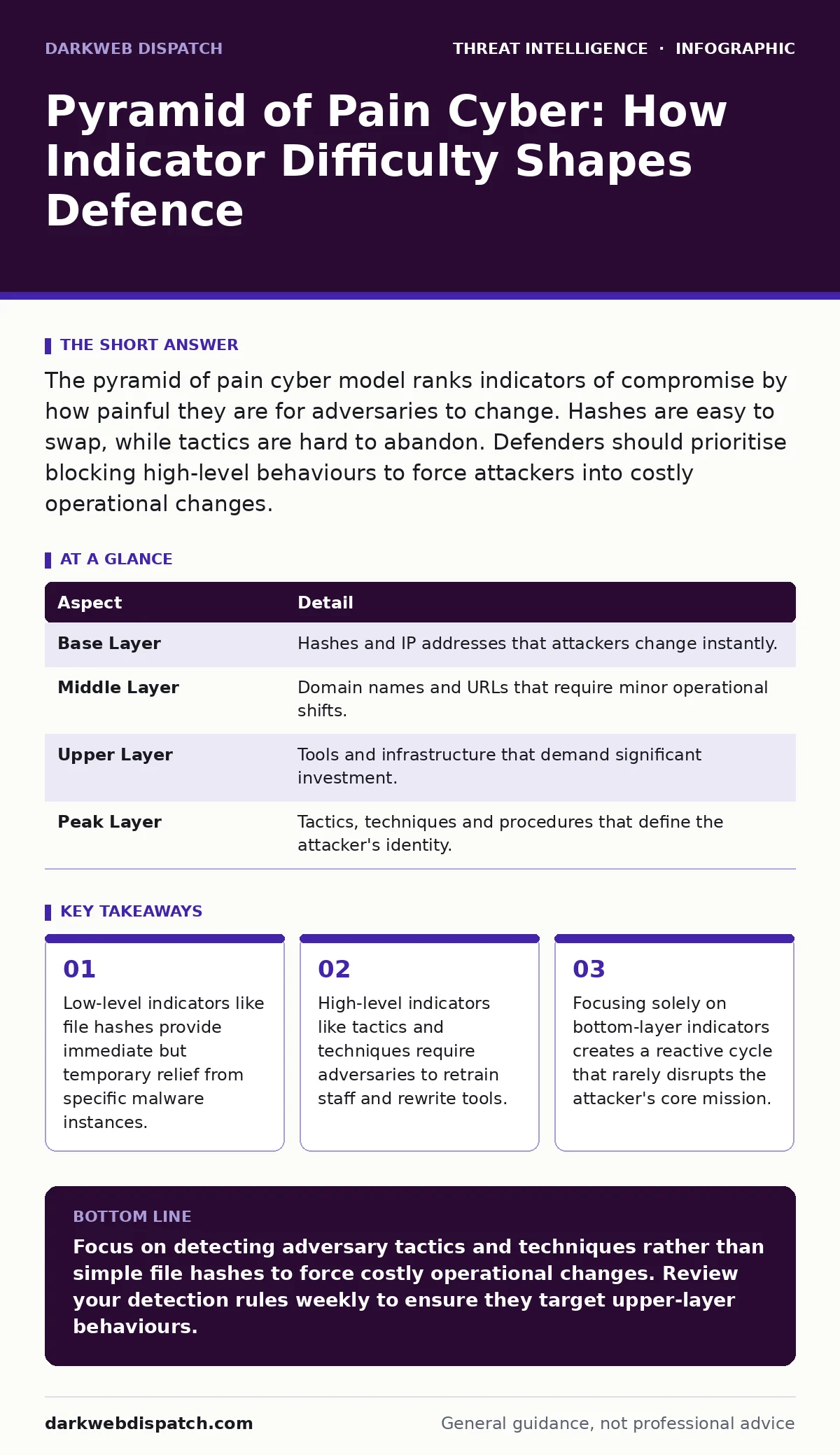
The pyramid of pain cyber model ranks indicators of compromise by how painful they are for adversaries to change. Hashes are easy to swap, while tactics are hard to abandon. Defenders should prioritise blocking high-level behaviours to force attackers into costly operational changes.
Imagine catching a burglar by recognising the specific pair of shoes he wore last Tuesday. You block those shoes at the door, but he simply buys new ones and returns the next day. This is the fundamental flaw in relying on technical signatures alone. The pyramid of pain cyber framework illustrates why this approach fails and how to make the burglar change his entire method of entry rather than just his footwear.
The pyramid of pain cyber concept maps the difficulty an adversary faces when forced to change aspects of their operation. At the base sit indicators that are trivial to replace, such as file hashes or IP addresses. At the peak sit strategies that are expensive and time-consuming to alter, such as the underlying tactics and procedures. Understanding this hierarchy changes how you allocate detection resources.
| Aspect | Detail |
|---|---|
| Base Layer | Hashes and IP addresses that attackers change instantly. |
| Middle Layer | Domain names and URLs that require minor operational shifts. |
| Upper Layer | Tools and infrastructure that demand significant investment. |
| Peak Layer | Tactics, techniques and procedures that define the attacker's identity. |
What is the pyramid of pain cyber model?
The pyramid of pain cyber model categorises indicators of compromise by the cost of replacement for the adversary. The lowest rung contains cryptographic hashes of files. If you block a specific malicious file hash, the attacker merely modifies a single byte in the code. This generates a new hash, bypassing your defence instantly. The next rung holds IP addresses. Adversaries often use cloud services or bulletproof hosting to rotate these quickly. Blocking an IP is like chasing a shadow; it disappears as soon as you focus on it.
As you climb the pyramid, the pain increases. Domain names require registration and propagation time. URLs depend on specific web server configurations. Tools, such as custom malware variants or command-and-control frameworks, require development effort. An attacker must rewrite code to replace a tool. Tactics, techniques and procedures sit at the top. These are the methods an attacker uses, such as exploiting a specific vulnerability or abusing a scheduled task. Changing these requires retraining operators and redesigning the attack flow.
How the pyramid affects defensive operations
Blue team operations often focus heavily on the bottom layers because they are easier to automate. Signature-based detection systems excel at matching hashes and known IP addresses. This creates a false sense of security. You block thousands of known bad indicators, but the adversary continues to reach your systems with new ones. The pyramid of pain cyber framework reveals that this is a losing war of attrition. You are reacting to their current state, not preventing their future success.
Defenders who ignore the upper layers remain reactive. They wait for a sample to arrive before they can detect it. This delays response time significantly. By shifting focus to tactics and techniques, you detect the behaviour regardless of the tool used. For example, detecting the act of injecting code into a process is more valuable than detecting the specific injector tool. This approach survives tool changes and minor code modifications.
Common mistakes in applying the framework
Many organisations mistake the presence of high-level indicators for complete security. They assume that because they detect a tactic, they are safe. This overlooks the reality that adversaries adapt. An attacker might switch from exploiting one vulnerability to another if the first becomes too noisy. The pyramid of pain cyber model is not a static shield. It is a dynamic map of adversary effort. You must continuously update your understanding of their tactics.
Another frequent error is neglecting the middle layers entirely. While hashes are useless long-term, domains and URLs offer valuable context. They can reveal the scope of an intrusion or the stage of an attack. Ignoring them deprives you of early warning signals. A balanced approach uses low-level indicators for immediate containment and high-level indicators for strategic disruption. This reduces false positives in threat detection by focusing on context rather than isolated artefacts.
Integrating with threat intelligence practices
Threat actor profiling benefits directly from upper-layer analysis. By tracking how an adversary changes their tactics, you can attribute activity with greater confidence. Tools are often shared or sold, but tactics reflect the operator's mindset and training. The Traffic Light Protocol helps share this sensitive information with partners without revealing source methods. This collaborative approach strengthens the collective defence against persistent threats.
Network traffic analysis provides the raw data needed to identify upper-layer behaviours. You must look beyond simple packet headers. Analysing the protocol usage and timing patterns reveals the underlying technique. This requires more sophisticated monitoring but yields far better results. It allows you to detect novel attacks that lack known signatures. The investment in analysis capability pays off by staying ahead of the adversary's adaptation cycle.
Practical steps for implementation
Start by mapping your existing detections to the pyramid. Identify which alerts rely on hashes or IPs. These are your low-priority items for long-term strategy. Next, develop detection rules for common tactics relevant to your industry. Focus on the most damaging actions, such as privilege escalation or data staging. Use purple teaming exercises to test these detections against realistic adversary simulations. This validates that your rules catch the behaviour, not just the tool.
Refine your alerts to reduce noise. High-level detections can generate more false positives initially. Tune them based on your environment's baseline. Document the tactics you monitor and why they matter. This creates a living reference for your team. Regularly review your detection coverage against emerging threat reports. Ensure you are not leaving gaps in the upper layers of the pyramid.
See also: How Autonomous System Numbers Work in Threat Intelligence · ISACs: The Real Value and Hidden Costs of Sector Sharing
Why upper layers matter most
The ultimate goal is to make the attack economically unviable for the adversary. When you force them to change their tactics, you impose a high cost. They must invest time in research, development and training. This slows their campaign and increases the risk of detection. The pyramid of pain cyber framework is not about blocking every attack. It is about raising the cost of each attack until it is no longer worth pursuing.
Defenders who master this shift from reactive to proactive. They anticipate adversary moves by understanding their motivations and constraints. This strategic depth provides sustainable security. It protects against both known and unknown threats. By focusing on the pain point that matters most to the attacker, you build a defence that endures.
Key takeaways
- Low-level indicators like file hashes provide immediate but temporary relief from specific malware instances.
- High-level indicators like tactics and techniques require adversaries to retrain staff and rewrite tools.
- Focusing solely on bottom-layer indicators creates a reactive cycle that rarely disrupts the attacker's core mission.
- Effective defence shifts from detecting what an attacker used to understanding how they operate.
Focus on detecting adversary tactics and techniques rather than simple file hashes to force costly operational changes. Review your detection rules weekly to ensure they target upper-layer behaviours.
Frequently asked questions
Does the pyramid of pain apply to all types of attacks?
Yes, the framework applies to any adversarial activity where the actor can modify their methods, tools or infrastructure to bypass defences.
How do I detect tactics without specific tool signatures?
You detect tactics by monitoring for specific behaviours, such as unusual process execution patterns or abnormal data transfers, regardless of the tool used.
Is the pyramid of pain still relevant with AI-driven attacks?
Yes, AI may speed up tool generation, but it does not eliminate the cost of changing fundamental tactics and procedures for the adversary.
Can small organisations use this framework effectively?
Small organisations should focus on the most critical tactics relevant to their assets, prioritising high-impact detections over comprehensive coverage.
How this guide was produced: written by the DarkWeb Dispatch editorial team with AI assistance, checked against the public references listed below, and reviewed when the facts change. See our editorial policy or report an error.