Threat Actor Profiling: Definition, Purpose and Practical Application
Profiling threat actors reveals the human and economic motives behind attacks, allowing defenders to prioritise risks based on behaviour rather than just technical signatures.

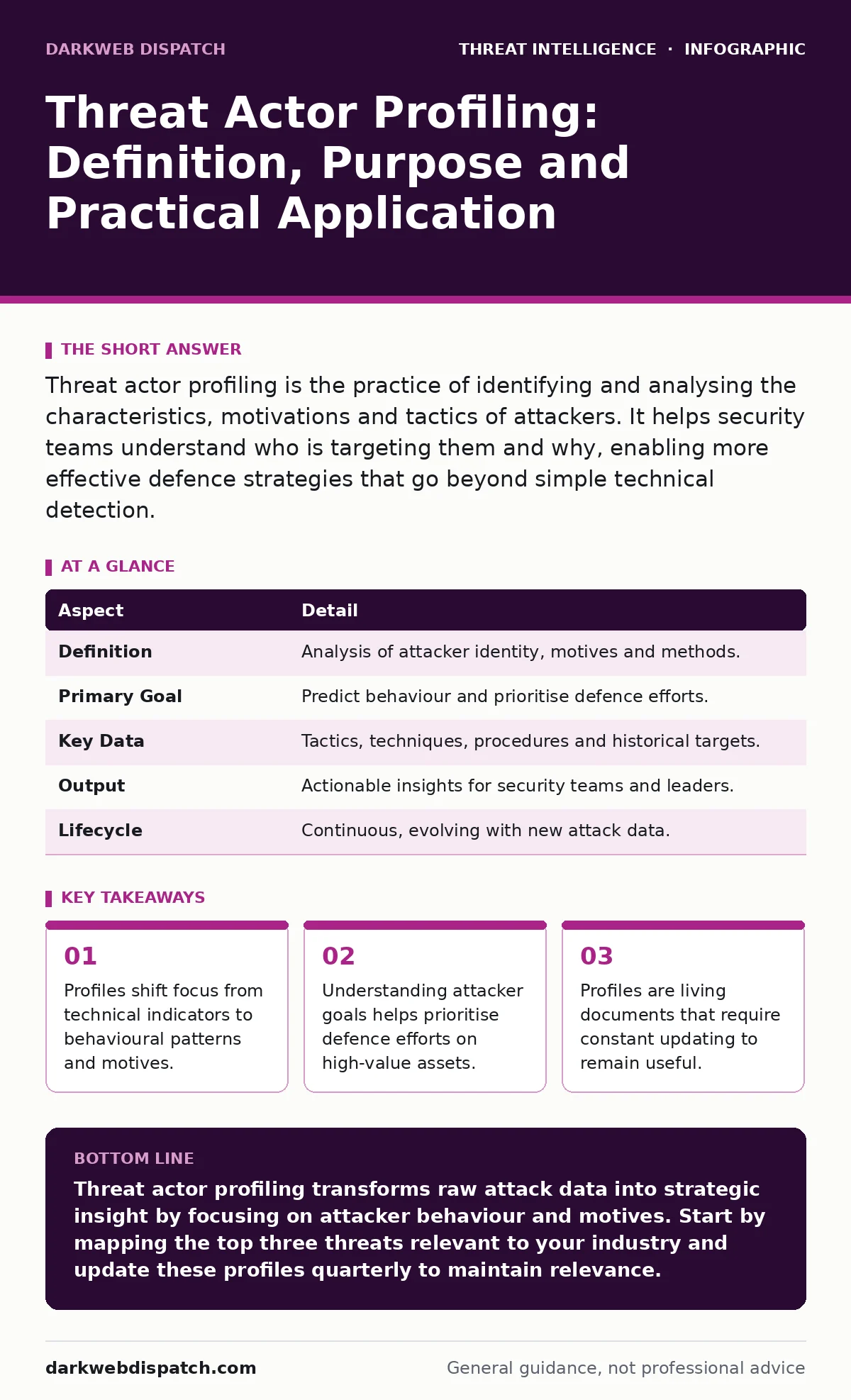
Threat actor profiling is the practice of identifying and analysing the characteristics, motivations and tactics of attackers. It helps security teams understand who is targeting them and why, enabling more effective defence strategies that go beyond simple technical detection.
From Suspects to Patterns
Imagine a detective investigating a series of burglaries. If they only note that a window was broken, they miss the pattern. But if they notice the thief only enters through unlocked doors on Tuesdays, they can predict the next move. Threat actor profiling works similarly in cybersecurity. It moves beyond the technical "how" to the behavioural "who" and "why".
This approach transforms raw data into actionable intelligence. Instead of reacting to every alert, you understand the context. You learn whether an attacker seeks financial gain, political influence or pure disruption. This distinction changes how you respond. A financially motivated group may ignore certain systems, while a state-sponsored actor might persist for months.
| Aspect | Detail |
|---|---|
| Definition | Analysis of attacker identity, motives and methods. |
| Primary Goal | Predict behaviour and prioritise defence efforts. |
| Key Data | Tactics, techniques, procedures and historical targets. |
| Output | Actionable insights for security teams and leaders. |
| Lifecycle | Continuous, evolving with new attack data. |
The Problem It Solves
Security teams face an overwhelming volume of alerts. Most are noise. Without context, every breach attempt looks equally dangerous. This leads to alert fatigue, where critical threats are missed because they are buried in routine warnings. Profiling solves this by adding weight to specific events.
It helps you distinguish between a script kiddie running automated tools and a sophisticated group planning a long-term infiltration. The former might be blocked by standard filters. The latter requires deep inspection and behavioural analysis. By knowing who is attacking, you can tailor your defences. You stop wasting resources on low-risk threats and focus on those that match your specific risk profile.
Core Components of a Profile
A complete profile combines several elements. The first is identity, which may be known or anonymous. Even if the name is unknown, you can infer characteristics. The second is motivation. Is the goal money, espionage or sabotage? This drives the attacker's choices. The third is capability. What tools and skills do they possess? A low-budget group uses different methods than a well-funded one.
The fourth component is tactics, techniques and procedures (TTPs). These are the specific actions an attacker takes. Unlike tools, which can change, TTPs often remain consistent. This makes them reliable indicators for detection. Finally, consider the infrastructure. Where do they operate? What languages or time zones do they prefer? These details help attribute activity and predict future moves.
Integration with Defence Frameworks
Profiling does not exist in isolation. It connects with other security practices. For instance, the Diamond Model of intrusion analysis provides a structure for mapping these profiles. It links adversaries, infrastructure, victims and capabilities. This model helps visualise the attack chain and identify gaps in your detection.
Similarly, threat intelligence reports often contain profiling data. You can use these reports to update your internal profiles. However, you must contextualise the information. A report on a global banking threat may not apply to your local retail business. Always filter intelligence through your specific risk lens.
Common Misconceptions
Many organisations treat profiling as a static exercise. They create a list of known bad actors and file it away. This is a mistake. Profiles are living documents. Attackers evolve, adopt new tools and change motives. Your profiles must reflect these changes. Regular updates are necessary to maintain accuracy.
Another error is over-attribution. It is tempting to blame every attack on a famous group. However, attackers often mimic others to create confusion. Relying on surface-level similarities leads to false conclusions. Focus on unique behavioural quirks rather than generic tool usage. This requires deeper analysis and patience.
See also: YARA vs Sigma Rules: Which Detection Method Fits Your Environment · Network Traffic Analysis: Fixing 6 Common Misconceptions
Practical Application in Security
How does this affect your daily work? It influences your SIEM (Security Information and Event Management) configuration. You can create custom rules that look for specific TTPs associated with high-risk profiles. This reduces noise and highlights relevant alerts. It also informs your incident response plans. Knowing the likely attacker helps you anticipate their next steps.
Furthermore, it supports purple teaming exercises. Instead of generic penetration tests, you can simulate attacks based on real-world profiles. This tests your defences against realistic threats. It reveals weaknesses that standard audits might miss. By aligning your testing with actual adversary behaviour, you gain a more accurate picture of your security posture.
The Hidden Cost of Ignorance
Ignoring profiling has a hidden cost: inefficiency. You may invest heavily in advanced endpoint detection, only to find attackers bypassing your email filters. Without understanding the attacker's path, you cannot optimise your controls. This leads to wasted budget and a false sense of security.
Additionally, it hampers collaboration. If you cannot articulate who is attacking you and why, you cannot effectively share information with partners or industry groups. This isolation makes you a more attractive target. Profiling enables you to contribute to and benefit from collective defence efforts. It turns individual data into shared wisdom.
Key takeaways
- Profiles shift focus from technical indicators to behavioural patterns and motives.
- Understanding attacker goals helps prioritise defence efforts on high-value assets.
- Profiles are living documents that require constant updating to remain useful.
- Integration with other frameworks provides a holistic view of the threat environment.
Threat actor profiling transforms raw attack data into strategic insight by focusing on attacker behaviour and motives. Start by mapping the top three threats relevant to your industry and update these profiles quarterly to maintain relevance.
Frequently asked questions
How is threat actor profiling different from threat intelligence?
Threat intelligence is the raw data and analysis of threats. Profiling is the structured application of that intelligence to understand specific attacker groups and their behavioural patterns.
Can small organisations benefit from threat actor profiling?
Yes, even small organisations can benefit by focusing on profiles relevant to their size and sector. It helps them prioritise limited security resources effectively against likely threats.
How often should threat actor profiles be updated?
Profiles should be updated whenever significant new data emerges or an attacker changes their tactics. Regular quarterly reviews are recommended to ensure accuracy and relevance.
What is the first step in creating a threat actor profile?
Begin by identifying your organisation's assets and value proposition. Then, research which attacker groups historically target similar industries or asset types.
How this guide was produced: written by the DarkWeb Dispatch editorial team with AI assistance, checked against the public references listed below, and reviewed when the facts change. See our editorial policy or report an error.