Network Traffic Analysis: Fixing 6 Common Misconceptions
Network traffic analysis reveals behaviour patterns rather than specific file contents, meaning encryption and protocol quirks dictate what you can actually see.

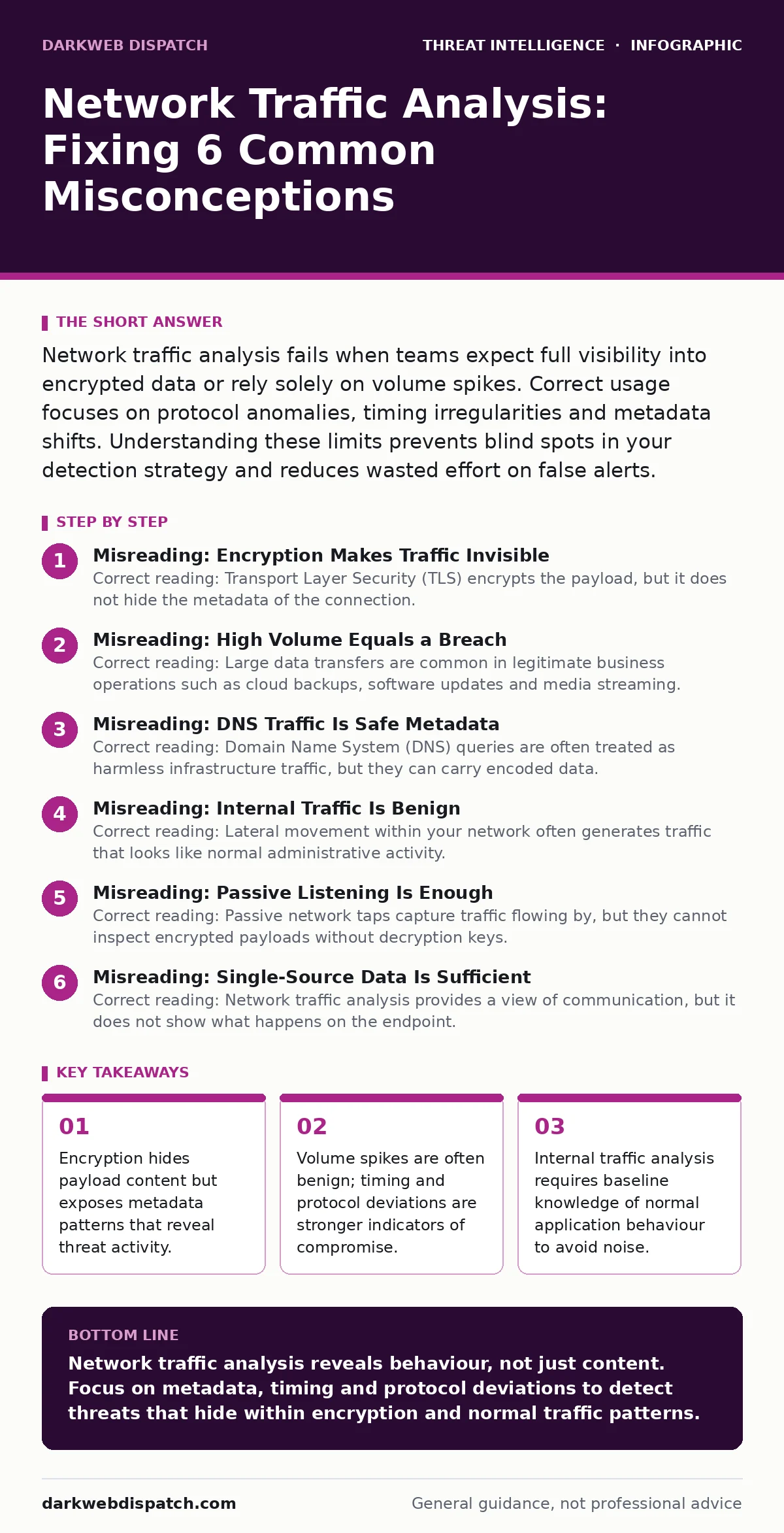
Network traffic analysis fails when teams expect full visibility into encrypted data or rely solely on volume spikes. Correct usage focuses on protocol anomalies, timing irregularities and metadata shifts. Understanding these limits prevents blind spots in your detection strategy and reduces wasted effort on false alerts.
Misreading: Encryption Makes Traffic Invisible
Correct reading: Transport Layer Security (TLS) encrypts the payload, but it does not hide the metadata of the connection. You can still see source and destination IP addresses, port numbers, packet sizes and timing intervals. Attackers often assume encryption renders their commands invisible. This assumption fails because consistent packet sizes or regular heartbeat intervals create a fingerprint.
Imagine a botnet sending exactly 500 bytes every 10 seconds. That pattern stands out against normal web browsing, which varies wildly in size and frequency. Analysing this metadata allows you to identify command and control channels even when the content remains encrypted. This approach complements blue team operations by providing context that endpoint logs alone cannot supply.
Misreading: High Volume Equals a Breach
Correct reading: Large data transfers are common in legitimate business operations such as cloud backups, software updates and media streaming. Focusing only on volume creates excessive noise and distracts from subtle exfiltration methods. Threat actors often send small amounts of data over long periods to avoid triggering threshold alerts. This technique, known as low-and-slow exfiltration, blends into background noise. You must analyse the destination of the traffic alongside the volume. A small file sent to an unusual external IP is more suspicious than a large file sent to a known cloud provider. Context determines risk, not just bandwidth consumption.
Misreading: DNS Traffic Is Safe Metadata
Correct reading: Domain Name System (DNS) queries are often treated as harmless infrastructure traffic, but they can carry encoded data. Attackers use DNS tunnelling to exfiltrate information or receive commands by encoding payloads in domain names. This method bypasses firewalls that allow outbound DNS traffic by default.
You should monitor for unusually long domain names, high query frequency to new domains and base64-encoded strings in subdomains. These indicators suggest data is being hidden within the request structure. Domain fronting is a related technique where attackers hide their destination behind legitimate CDN domains, further complicating detection. Understanding these mechanisms prevents blind spots in your perimeter defence.
Misreading: Internal Traffic Is Benign
Correct reading: Lateral movement within your network often generates traffic that looks like normal administrative activity. Attackers exploit trusted protocols such as SMB, RDP and WinRM to move between systems. Assuming internal traffic is safe ignores the reality of compromised credentials. You must establish a baseline of normal internal communication patterns.
Deviations such as a server initiating connections to multiple workstations or unusual protocol usage indicate potential compromise. This is particularly relevant when investigating scheduled task abuse, where attackers automate lateral movement to avoid detection. Internal visibility is just as critical as perimeter monitoring.
Misreading: Passive Listening Is Enough
Correct reading: Passive network taps capture traffic flowing by, but they cannot inspect encrypted payloads without decryption keys. This limitation means malicious commands hidden in TLS or SSH sessions remain invisible to passive tools alone. Active inspection methods, such as inline proxies or endpoint agents, are required to see inside encrypted connections. Relying solely on passive analysis creates a false sense of security. You must combine passive metadata analysis with active inspection capabilities to achieve full visibility. This hybrid approach ensures you catch threats that evade perimeter controls and hide within encrypted tunnels.
See also: Intrusion Detection Mistakes That Blind Your Network · Man-in-the-Middle Attack Response: Containment and Recovery Steps
Misreading: Single-Source Data Is Sufficient
Correct reading: Network traffic analysis provides a view of communication, but it does not show what happens on the endpoint. An attacker might use a legitimate application to execute malicious code, generating no unusual network traffic. Correlating network data with endpoint logs is necessary to confirm activity.
For instance, golden ticket attacks allow an attacker to authenticate without network-based ticket requests, bypassing network detection entirely. Similarly, LSASS credential theft occurs locally and may not generate distinct network signatures. Combining these data sources reduces false positives in threat detection and provides a complete picture of the attack chain.
Misreading: All Protocols Behave Standardly
Correct reading: Applications often deviate from standard protocol specifications, creating unique signatures. Browsers use HTTP/2 and QUIC, which multiplex streams and reduce latency, altering traditional packet structures. Ignoring these modern protocols leads to missed detections. You must update your analysis tools to understand current protocol behaviours.
Misinterpreting legitimate protocol quirks as threats generates false positives, while failing to recognise non-standard usage hides attacks. Staying current with protocol standards ensures your analysis remains effective against evolving techniques. This knowledge supports a Unified Kill Chain approach by identifying early-stage reconnaissance that uses non-standard ports or protocols.
Misreading: Historical Data Is Irrelevant
Correct reading: Baseline traffic patterns change over time due to business growth, new applications and seasonal variations. Static baselines become inaccurate, leading to increased false positives or missed anomalies. You must continuously update your baseline to reflect current normal behaviour. Historical data helps distinguish between a new threat and a legitimate change in usage. For example, a sudden spike in traffic might be a marketing campaign rather than an attack. Comparing current traffic against recent history provides context that static rules cannot. This dynamic approach ensures your analysis remains relevant and accurate.
Misreading: Manual Analysis Scales
Correct reading: Manual review of network logs is impractical for large networks due to data volume. Human analysts cannot process millions of packets per second. Automation and machine learning are necessary to filter noise and highlight anomalies. However, automation requires careful tuning to avoid false positives. You must validate automated alerts with manual investigation to refine detection rules. This balance ensures efficient use of resources while maintaining detection accuracy. Relying solely on automation without human oversight leads to alert fatigue and missed threats.
Key takeaways
- Encryption hides payload content but exposes metadata patterns that reveal threat activity.
- Volume spikes are often benign; timing and protocol deviations are stronger indicators of compromise.
- Internal traffic analysis requires baseline knowledge of normal application behaviour to avoid noise.
- Passive listening misses encrypted command channels that active inspection or endpoint data would catch.
Network traffic analysis reveals behaviour, not just content. Focus on metadata, timing and protocol deviations to detect threats that hide within encryption and normal traffic patterns.
Frequently asked questions
Does network traffic analysis work with encrypted traffic?
It works on metadata such as packet size, timing and destination. It cannot see the payload without decryption keys, so it relies on behavioural patterns to identify threats.
How do I reduce false positives in traffic analysis?
Establish dynamic baselines of normal traffic and focus on anomalies in timing and protocol usage rather than static volume thresholds. Correlate network data with endpoint logs for context.
Is passive listening sufficient for security monitoring?
Passive listening misses encrypted payloads and requires complementary active inspection or endpoint data to provide full visibility. It is best used for metadata analysis and baseline establishment.
What is the difference between network analysis and packet capture?
Packet capture records raw data for deep inspection, while network analysis often processes metadata and flow data for broader behavioural insights. Both are necessary for comprehensive threat detection.
How this guide was produced: written by the DarkWeb Dispatch editorial team with AI assistance, checked against the public references listed below, and reviewed when the facts change. See our editorial policy or report an error.