YARA vs Sigma Rules: Which Detection Method Fits Your Environment
YARA scans static files for byte patterns while Sigma translates detection logic into platform-specific queries, making them complementary rather than competitive tools.

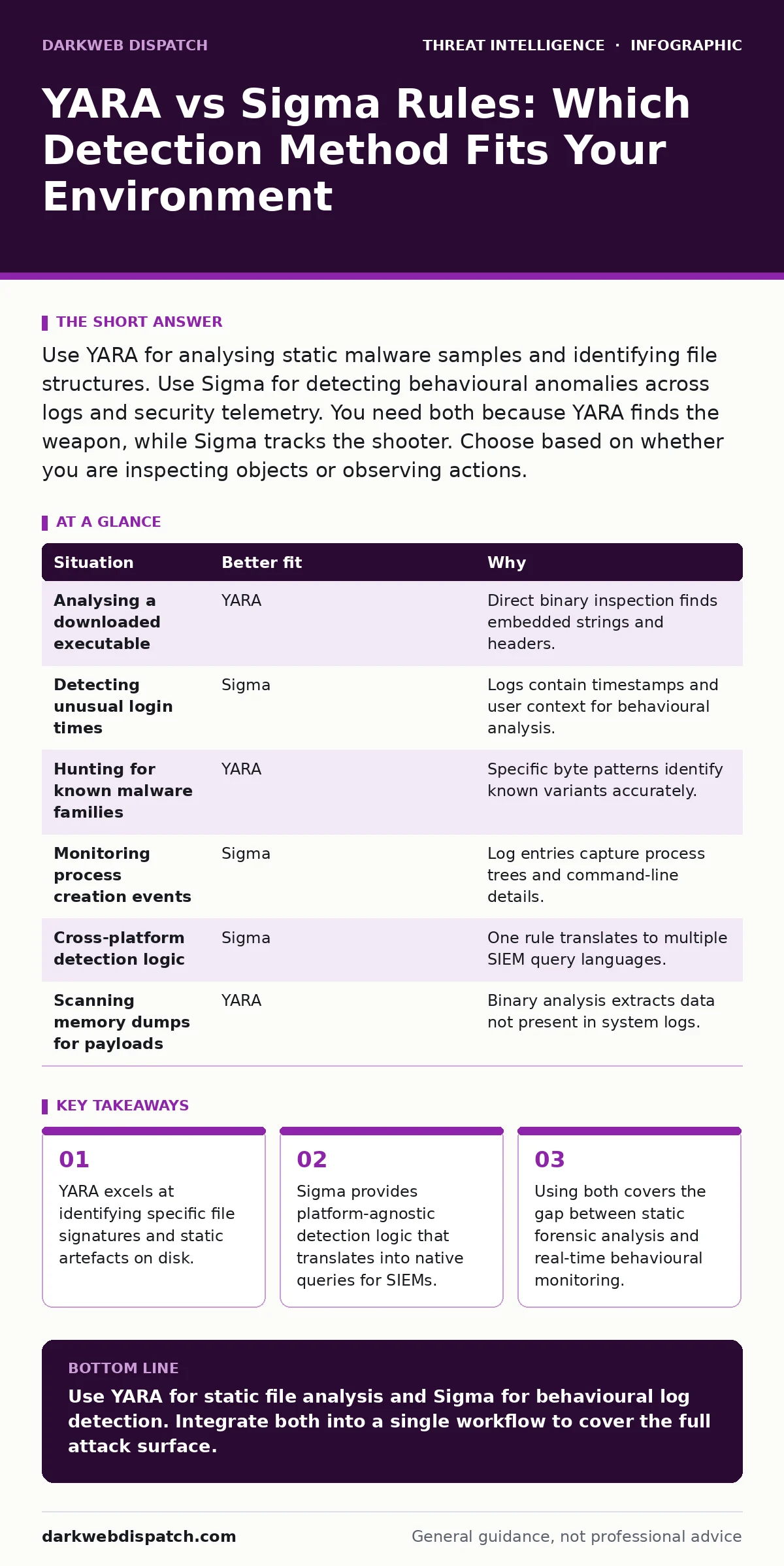
Use YARA for analysing static malware samples and identifying file structures. Use Sigma for detecting behavioural anomalies across logs and security telemetry. You need both because YARA finds the weapon, while Sigma tracks the shooter. Choose based on whether you are inspecting objects or observing actions.
Does the data exist as a static file or a log entry?
YARA rules operate on binary data. They scan files, memory dumps or disk images to find specific byte sequences, strings or structural patterns. This makes YARA ideal for static analysis where you have physical possession of the artefact. Sigma rules, by contrast, are designed for log data. They describe detection logic in a human-readable format that can be translated into queries for Splunk, Elastic, Sentinel or other platforms. If your primary source is a log stream, Sigma is the correct starting point.
If you are working with a captured network packet or a memory dump, YARA is often more effective. These formats contain binary structures that log parsers cannot easily interpret. Sigma requires structured fields like event IDs or process names. You cannot write a Sigma rule to detect a specific header in a raw PE file without first extracting that data into a log format.
Is the threat defined by its structure or its behaviour?
Malware often changes its code to avoid signature detection. This technique, known as polymorphism, alters the binary appearance while keeping the function identical. YARA struggles here unless you use advanced techniques like fuzzy hashing or rule sets that target logical structures rather than raw bytes. Sigma shines when the behaviour remains constant despite code changes. A process spawning a command shell looks the same in logs regardless of the malware variant.
Imagine a threat actor using a legitimate tool to execute malicious commands. This is living off the land. The binary signature of the tool is clean. YARA will not flag it. Sigma can detect the anomalous command-line arguments or the unusual parent-child process relationship. You must choose based on whether the threat leaves a unique fingerprint in the file or a unique trail in the logs.
How do you handle platform diversity and query translation?
Sigma rules are platform-agnostic. You write the detection logic once in YAML format. Then you translate it to the specific query language of your security information and event management (SIEM) system. This saves effort when you use multiple logging platforms. YARA rules are universal for file scanning but do not translate between different log analysis tools. They run on the file, not the infrastructure.
This abstraction layer in Sigma reduces maintenance overhead. If you switch SIEM vendors, you keep your Sigma rules and only change the backend translator. YARA rules remain valid regardless of the operating system or scanner used. However, YARA requires a scanning engine to run. Sigma requires a log source and a query engine. Neither works in isolation without the underlying infrastructure.
| Situation | Better fit | Why |
|---|---|---|
| Analysing a downloaded executable | YARA | Direct binary inspection finds embedded strings and headers. |
| Detecting unusual login times | Sigma | Logs contain timestamps and user context for behavioural analysis. |
| Hunting for known malware families | YARA | Specific byte patterns identify known variants accurately. |
| Monitoring process creation events | Sigma | Log entries capture process trees and command-line details. |
| Cross-platform detection logic | Sigma | One rule translates to multiple SIEM query languages. |
| Scanning memory dumps for payloads | YARA | Binary analysis extracts data not present in system logs. |
When does static analysis fail without behavioural context?
Relying solely on YARA creates blind spots for fileless attacks. These threats execute in memory without writing to disk. There is no file to scan. YARA can analyse memory dumps, but this is reactive. Sigma detects the execution attempt in real-time through process creation logs. Combining both allows you to catch the initial execution via Sigma and analyse any dropped files via YARA.
Consider the case of pass-the-hash attacks. The attacker uses stolen credentials to move laterally. No new files are created. YARA finds nothing. Sigma detects the authentication events and lateral movement patterns. Similarly, DNS tunneling hides data within DNS queries. YARA cannot see the traffic unless it is logged. Sigma queries the DNS logs for high-entropy queries or unusual domain lengths.
How do you integrate both into a unified workflow?
You do not choose between YARA and Sigma. You use them in sequence. Sigma alerts you to suspicious activity. You investigate the alert by collecting the relevant files. You then scan those files with YARA to confirm the presence of known malware components. This workflow bridges the gap between detection and forensics.
Integrate YARA into your endpoint detection and response (EDR) agents. Configure them to scan any file that triggers a Sigma alert. This automated correlation reduces analyst fatigue. You also feed YARA results back into your SIEM. If YARA identifies a known threat, you create a Sigma rule to hunt for similar behaviour elsewhere. This closed loop improves your detection coverage over time.
See also: Blue Team Myths: Correcting Common Misunderstandings · Unified Kill Chain: Why Fragmented Threat Models Fail Your Defences
What are the hidden costs of maintaining detection rules?
Rule maintenance is a continuous burden. YARA rules produce false positives when legitimate software shares code libraries with malware. You must tune exclusion lists carefully. Sigma rules require accurate log parsing. If your log source changes format, your rules break. Both require regular testing against known benign and malicious datasets.
False positives waste analyst time. False negatives miss threats. You must balance sensitivity with precision. Use threat intelligence reports to update your YARA rules with new indicators. Use purple teaming exercises to test your Sigma rules against simulated attacks. This ensures your detections remain effective against evolving tactics.
How do you validate rule effectiveness before deployment?
Testing is non-negotiable. Use a controlled environment with known malware samples for YARA. Verify that the rule triggers only on the intended targets. For Sigma, use simulated log data or attack simulations. Check that the rule translates correctly to your SIEM query language. Ensure the logic captures the intended behaviour without excessive noise.
Document the rationale for each rule. Include the threat context and the expected false positive rate. This documentation helps future analysts understand why the rule exists. It also aids in triage when alerts fire. Clear documentation reduces the time spent investigating benign alerts.
Key takeaways
- YARA excels at identifying specific file signatures and static artefacts on disk.
- Sigma provides platform-agnostic detection logic that translates into native queries for SIEMs.
- Using both covers the gap between static forensic analysis and real-time behavioural monitoring.
Use YARA for static file analysis and Sigma for behavioural log detection. Integrate both into a single workflow to cover the full attack surface.
Frequently asked questions
Can YARA rules be converted to Sigma rules?
No, they serve different purposes. YARA scans binary data while Sigma queries log fields. You cannot directly convert one to the other without manual translation of the detection logic.
Do I need a SIEM to use Sigma rules?
Yes, Sigma requires a platform that supports log querying. You can use standalone tools for testing, but production use requires a SIEM or similar log aggregation system.
Are YARA rules effective against encrypted files?
Generally no, unless you have the decryption key. YARA scans the raw bytes. Encrypted files appear as random data to the scanner, preventing pattern matching.
How often should I update my detection rules?
Update them regularly based on new threat intelligence and observed false positives. There is no fixed schedule, but weekly reviews are common in active security operations.
How this guide was produced: written by the DarkWeb Dispatch editorial team with AI assistance, checked against the public references listed below, and reviewed when the facts change. See our editorial policy or report an error.