Tor browser privacy risks and small firm protection
Unmonitored Tor traffic inside small networks exposes corporate data to malicious exit nodes while concealing employee misuse from safety controls.

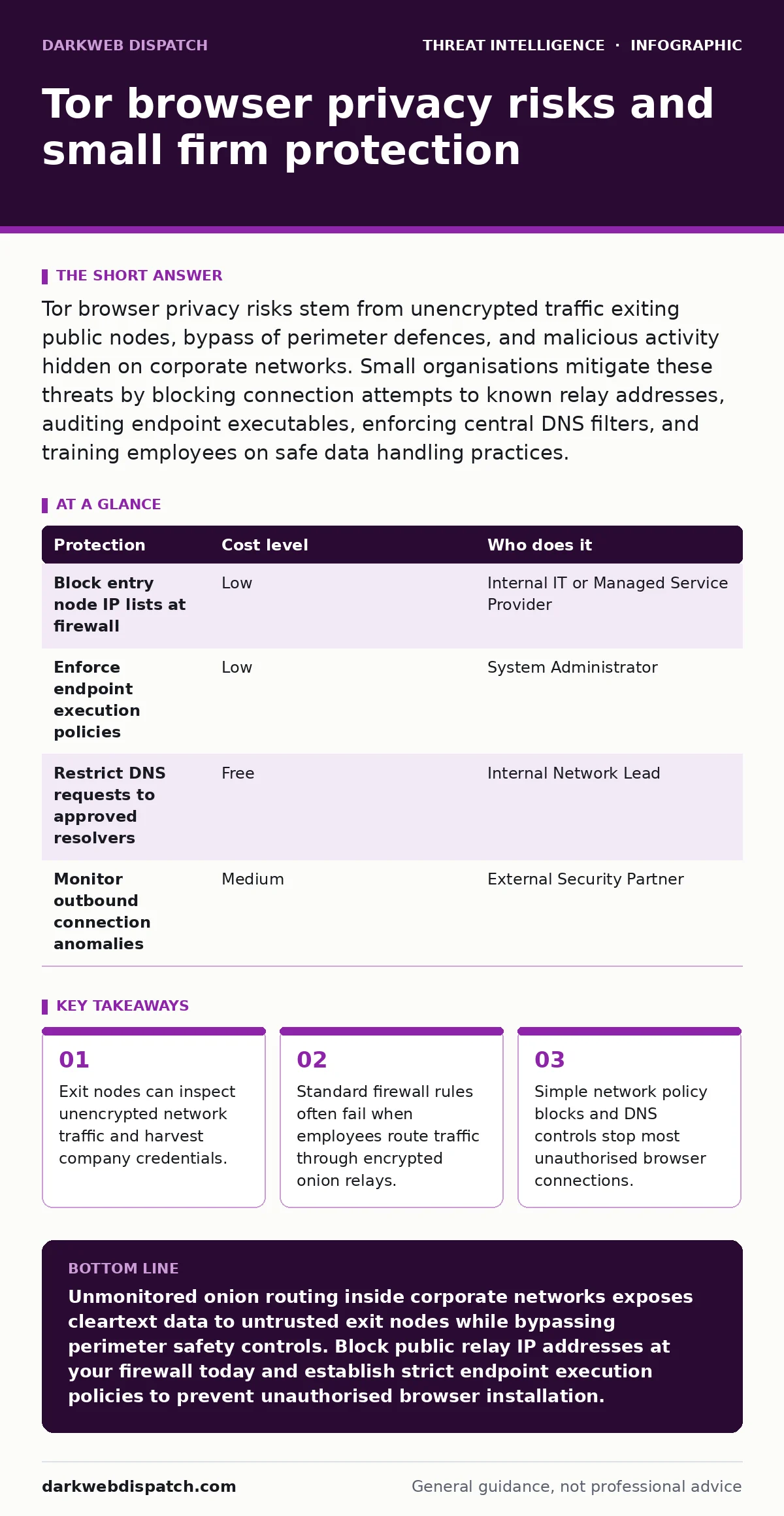
Tor browser privacy risks stem from unencrypted traffic exiting public nodes, bypass of perimeter defences, and malicious activity hidden on corporate networks. Small organisations mitigate these threats by blocking connection attempts to known relay addresses, auditing endpoint executables, enforcing central DNS filters, and training employees on safe data handling practices.
Why small networks face hidden exposure from onion routing
Small organisations frequently assume their modest size makes them uninteresting targets for cyber criminals. In reality, attackers scan broad IP address blocks to find vulnerable systems regardless of workforce count. When staff download privacy browsers to circumvent workplace restrictions, they inadvertently open unmonitored tunnels through the corporate network perimeter.
Internal security controls lose visibility the moment an encrypted browser channel establishes a connection. Perimeter firewalls cannot inspect packet contents inside multi-layered onion encryption, preventing automated security tools from detecting data exfiltration. Smaller teams rarely employ dedicated security analysts to flag unusual outbound connections, leaving these invisible tunnels open for weeks.
In corporate environments lacking centralised endpoint management, single devices become hidden bridgeheads. Threat actors who gain access to an endpoint through a browser exploit can pivot deeper into shared network drives. Lacking dedicated security teams, small businesses often miss subtle indicators of lateral movement until central databases suffer total exposure.
The primary security mechanisms behind dark web traffic
Tor functions by routing network packets through 3 successive encrypted relays known as entry, middle, and exit nodes. An entry node sees your local IP address but cannot read the destination. The middle node sees only adjacent relays. The exit node decrypts the final layer to send your request to the public web server.
The core technology relies on onion routing, a protocol that wraps data in multiple layers of encryption. While onion routing hides original sender IP addresses effectively, it introduces severe risks when used on business networks. Anyone can operate an exit node, including intelligence agencies, commercial competitors, and independent threat actors seeking credentials.
Network administrators often misinterpret dark web anonymity as inherent safety. While the connection between your computer and the entry relay remains secure, the leg between the exit node and unencrypted web destinations remains fully exposed. Examining autonomous system numbers (ASNs) in threat intelligence reveals how malicious operators host clusters of untrusted relays across specific network providers.
Exit node inspection risks and data interception
What are the main risks associated with Tor exit node inspection? Exit node inspection risks include cleartext packet harvesting, malicious code injection, session hijacking, and fake security certificate swapping. Malicious exit node operators actively monitor unencrypted web traffic passing through their relays to collect active session cookies and sensitive corporate credentials.
If an employee accesses an HTTP site or misconfigured web portal, the exit node operator can read every submitted form field. Attackers combine this positioning with automated software to harvest credentials around the clock. Your company network perimeter remains completely unaware that internal authentication tokens were captured thousands of miles away.
Attackers also use compromised exit nodes to alter web content in transit. By stripping security headers or downgrading encrypted connections, rogue relays force browsers to accept altered software updates containing malware. Once a single machine executes malicious code, attackers gain persistent local network access across administrative credentials.
Low-cost defensive measures for small operations
How can small organisations defend against Tor browser privacy risks? Small organisations implement protection using 3 key steps: blocking public relay directory IP addresses, restricting non-standard outbound network ports, and enforcing centralised endpoint application controls. These low-cost defensive controls prevent unauthorised onion routing without requiring expensive hardware investments.
| Protection | Cost level | Who does it |
|---|---|---|
| Block entry node IP lists at firewall | Low | Internal IT or Managed Service Provider |
| Enforce endpoint execution policies | Low | System Administrator |
| Restrict DNS requests to approved resolvers | Free | Internal Network Lead |
| Monitor outbound connection anomalies | Medium | External Security Partner |
Standard firewalls can automatically pull daily lists of published node addresses to block connection requests instantly. Combining firewall bans with strict DNS filtering stops the browser from resolving directory authorities altogether. Small security teams employ blue team operations practices to create automated alerts whenever internal hosts attempt to reach known anonymising proxies.
Core questions to evaluate external technology partners
What specific questions should you ask an IT provider regarding Tor privacy risks? You should ask your IT provider at least 3 direct questions about proxy blocking, endpoint execution rules, and incident reporting timelines. Evaluating external partners through structured inquiries ensures your managed service provider actively limits dark web exposure across all managed corporate devices.
- How does your firewall management service detect and block outbound connections to known anonymising relays?
- What software execution policies do you enforce on local endpoints to prevent portable browser executables from running?
- Which logging mechanisms track non-standard outbound traffic ports across our office networks?
- How quickly will your team notify our management if an internal machine establishes a persistent relay tunnel?
- Do you integrate public threat feeds from ISACs to update IP blocklists automatically?
Managed service providers must demonstrate a clear strategy when handling hidden proxy usage within client networks. Requesting written responses to these questions ensures your service provider actively monitors outbound risk rather than assuming perimeter firewalls catch every threat. Clear accountability prevents dangerous security gaps between internal staff and outsourced support teams.
See also: Network Traffic Analysis: Fixing 6 Common Misconceptions · Bulletproof Hosting Mistakes: 7 Errors That Expose Your Network
Network governance and long-term risk containment
Establishing clear corporate policies regarding anonymising software reduces technology risks significantly. Employees often install privacy tools out of simple curiosity or a misplaced desire for personal browsing privacy. Written acceptable use policies must explicitly prohibit non-standard browsers on corporate hardware while explaining the underlying data security risks to all staff members.
Network administrators must couple clear policies with continuous monitoring of system processes. Portable software builds allow users to run browsers from USB drives without administrative rights, bypassing basic installation blocks. Restricting executable launches to approved program directories stops unauthorised applications regardless of how the files arrived on the system.
Combining user education with technical safeguards creates resilient network governance across all office endpoints. Simple network controls keep business data secure while minimising operational friction for employees. Applying consistent network discipline keeps business data safe without introducing complex management overhead or costly software licenses.
Key takeaways
- Exit nodes can inspect unencrypted network traffic and harvest company credentials.
- Standard firewall rules often fail when employees route traffic through encrypted onion relays.
- Simple network policy blocks and DNS controls stop most unauthorised browser connections.
Unmonitored onion routing inside corporate networks exposes cleartext data to untrusted exit nodes while bypassing perimeter safety controls. Block public relay IP addresses at your firewall today and establish strict endpoint execution policies to prevent unauthorised browser installation.
Frequently asked questions
Can Tor browser usage be detected on an internal company network?
Yes, network administrators detect onion routing by identifying outbound connection requests to public relay directory IP addresses or watching for non-standard port traffic. Deep packet inspection tools also flag characteristic handshake patterns produced during encrypted relay negotiation.
Does using HTTPS inside the Tor browser keep employee data safe?
End-to-end HTTPS encryption protects website contents from being read by the exit node operator, but metadata remains visible. The exit node still sees destination domains, connection timestamps, and total transferred data volumes.
Why do employees install dark web browsers on work computers?
Employees often install these browsers to bypass restricted internet filters, view blocked content, or seek personal online privacy while on corporate hardware. Most workers do not realise that routing workplace traffic through untrusted relays exposes company network credentials to external interception.
How often do public Tor relay IP lists change?
Public relay directories update constantly as new nodes join and old relays go offline. Security firewalls must fetch updated address feeds at least once every 24 hours to maintain effective connection blocks.
How this guide was produced: written by the DarkWeb Dispatch editorial team with AI assistance, checked against the public references listed below, and reviewed when the facts change. See our editorial policy or report an error.