Stop Cyber Range Platforms Leaking Data: Prevention Measures
Network isolation fails when virtual machine agents bypass standard firewalls, allowing training data to escape into production environments undetected.

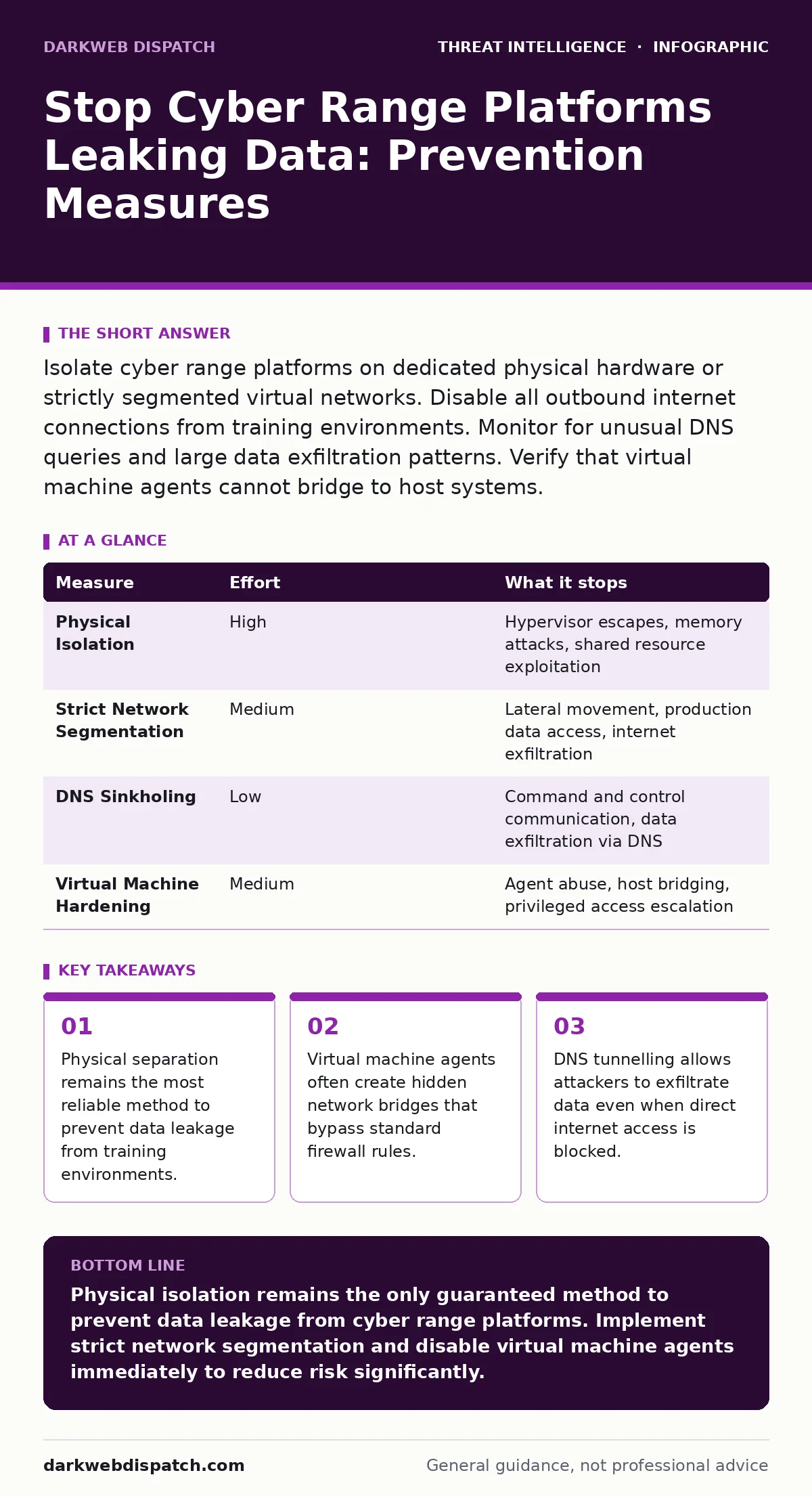
Isolate cyber range platforms on dedicated physical hardware or strictly segmented virtual networks. Disable all outbound internet connections from training environments. Monitor for unusual DNS queries and large data exfiltration patterns. Verify that virtual machine agents cannot bridge to host systems.
Physical Isolation Removes Attack Surface
Physical separation provides the highest level of security for cyber range platforms. Training environments should never share physical servers with production systems. Shared hardware introduces risks through memory side-channel attacks and hypervisor vulnerabilities. An attacker who compromises a training virtual machine may exploit a flaw in the virtualisation layer. This compromise could allow access to other virtual machines on the same host.
Physical isolation ensures that no shared resources exist between training and production. This separation eliminates the risk of cross-tenant attacks. It also prevents accidental data leakage through shared storage subsystems. You must verify that training hardware has no physical network connections to production facilities. Separate power circuits and cooling systems further reduce operational risks. This approach requires significant capital expenditure but removes almost all technical risk.
Network Segmentation Limits Lateral Movement
Strict network segmentation is the next best defence when physical isolation is impossible. Cyber range platforms must operate on a dedicated network segment with no routes to production networks. Use separate virtual local area networks for each training scenario. Implement strict access control lists that deny all traffic between segments. Allow only specific management traffic from authorised administrative workstations.
Block all outbound internet traffic from the training network. This prevents compromised training systems from communicating with command and control servers. It also stops accidental data leakage to external services. You must configure firewalls to drop all traffic by default. Only explicitly allow necessary management protocols. This zero-trust approach ensures that any lateral movement attempt fails immediately.
| Measure | Effort | What it stops |
|---|---|---|
| Physical Isolation | High | Hypervisor escapes, memory attacks, shared resource exploitation |
| Strict Network Segmentation | Medium | Lateral movement, production data access, internet exfiltration |
| DNS Sinkholing | Low | Command and control communication, data exfiltration via DNS |
| Virtual Machine Hardening | Medium | Agent abuse, host bridging, privileged access escalation |
Disable Virtual Machine Agents
Virtual machine agents often create hidden network paths that bypass standard security controls. These agents facilitate management tasks such as snapshotting and live migration. They also provide high-performance networking interfaces that can bridge virtual and physical networks. Attackers frequently abuse these agents to establish persistent backdoors. They may modify agent configurations to create tunnels to external networks.
You must disable all unnecessary virtual machine agents on training systems. If agents are required for management, restrict their network access strictly. Monitor agent traffic for anomalies such as unexpected outbound connections. Regularly audit agent configurations to ensure they have not been modified. This step addresses a common blind spot in virtualised security architectures.
Monitor DNS Traffic for Exfiltration
DNS tunnelling allows attackers to exfiltrate data even when direct internet access is blocked. This technique encodes data within DNS queries and responses. Standard firewalls often allow DNS traffic by default, assuming it is necessary for name resolution. Cyber range platforms generate significant DNS traffic during training exercises. Attackers can hide malicious traffic within this normal-looking noise.
You must implement DNS sinkholing for all training environments. Redirect all DNS queries to an internal resolver that blocks external lookups. Log all DNS queries for analysis. Look for unusually long domain names or high query volumes to single domains. These patterns often indicate data exfiltration attempts. This method detects exfiltration attempts that bypass traditional network monitoring.
Implement Strict Access Controls
Access control prevents unauthorised users from interacting with cyber range platforms. Training environments often contain sensitive data used for simulation purposes. This data may include realistic network topologies and user credentials. Unauthorised access could lead to data leakage or platform compromise. You must enforce multi-factor authentication for all administrative access.
Use role-based access control to limit user privileges. Regularly audit access logs to identify unusual activity. Disable default accounts and change default passwords immediately. Restrict physical access to training hardware facilities. This measure reduces the risk of insider threats and accidental misconfiguration.
See also: YARA vs Sigma Rules: Which Detection Method Fits Your Environment · Network Traffic Analysis: Fixing 6 Common Misconceptions
Validate Training Data Integrity
Training data must be sanitised to prevent accidental leakage of sensitive information. Real production data should never be used in cyber range platforms. Even anonymised data can sometimes be re-identified through correlation attacks. You must generate synthetic data for all training scenarios. Verify that synthetic data does not contain patterns that could be linked to real systems. Regularly review training data sets for new vulnerabilities. This practice ensures that even if a breach occurs, no real sensitive data is exposed. It also reduces legal and compliance risks associated with data handling.
Automate Configuration Drift Detection
Configuration drift occurs when system settings deviate from their secure baseline. Cyber range platforms undergo constant changes during training exercises. These changes can inadvertently introduce security weaknesses. Attackers may exploit these weaknesses to escalate privileges or exfiltrate data. You must implement automated configuration management tools.
These tools continuously monitor system configurations against a known good state. They alert administrators to any deviations. This allows for rapid remediation of security issues. Regular audits complement automated monitoring by providing a human review layer. This combination ensures that security controls remain effective over time.
Closing Checklist for Immediate Action
- Verify that cyber range platforms run on physically separate hardware or strictly segmented virtual networks.
- Disable all virtual machine agents that are not strictly required for management tasks.
- Implement DNS sinkholing to block all external DNS queries from training environments.
Key takeaways
- Physical separation remains the most reliable method to prevent data leakage from training environments.
- Virtual machine agents often create hidden network bridges that bypass standard firewall rules.
- DNS tunnelling allows attackers to exfiltrate data even when direct internet access is blocked.
Physical isolation remains the only guaranteed method to prevent data leakage from cyber range platforms. Implement strict network segmentation and disable virtual machine agents immediately to reduce risk significantly.
Frequently asked questions
Can I use cloud-based cyber range platforms safely?
Cloud platforms introduce shared infrastructure risks. Ensure strict tenant isolation and verify that the provider offers dedicated hardware options. Monitor all outbound traffic carefully.
How often should I audit cyber range configurations?
Audit configurations after every major training exercise. Implement continuous monitoring to detect drift between audits. Regular reviews ensure that security controls remain effective.
What is the biggest risk in virtualised training environments?
Hypervisor vulnerabilities pose the greatest risk. A compromised virtual machine can potentially access the host system. Physical isolation eliminates this risk entirely.
Does air-gapping solve all cyber range security problems?
Air-gapping prevents network-based attacks but not physical attacks. Ensure physical security controls are also in place. Insider threats remain a risk even in air-gapped systems.
How this guide was produced: written by the DarkWeb Dispatch editorial team with AI assistance, checked against the public references listed below, and reviewed when the facts change. See our editorial policy or report an error.