What Are Threat Intelligence Reports: Definition, Purpose and Structure
Threat intelligence reports transform raw data into actionable context, allowing you to distinguish between genuine threats and noise that would otherwise overwhelm your security operations.
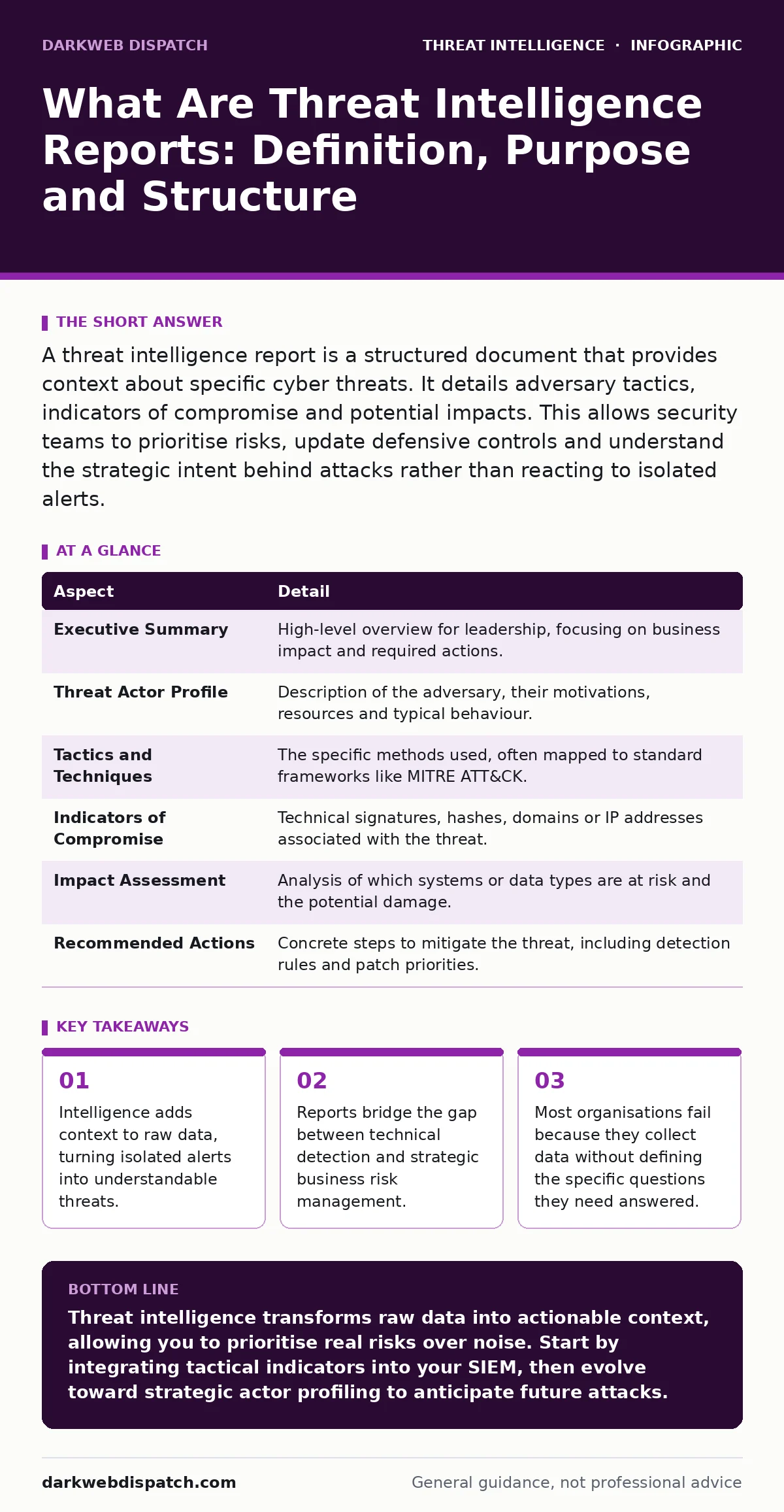
A threat intelligence report is a structured document that provides context about specific cyber threats. It details adversary tactics, indicators of compromise and potential impacts. This allows security teams to prioritise risks, update defensive controls and understand the strategic intent behind attacks rather than reacting to isolated alerts.
From Noise to Signal
Imagine a lighthouse keeper watching the horizon. A single flash of light could be a ship, a reflection or a storm. Without context, the flash is useless. Threat intelligence works similarly. It takes raw observations from the internet and interprets them to tell you whether that flash represents a danger to your specific coastline.
Raw data is abundant. Security tools generate millions of logs daily. Most of these are benign. A threat intelligence report filters this noise. It connects disparate data points to reveal patterns. You stop seeing random IP addresses and start seeing coordinated campaigns.
The core problem these reports solve is ambiguity. When an alert fires, you need to know three things: what is happening, why it matters and what to do next. Without intelligence, you only have the first piece. You react blindly. With it, you respond with precision.
Anatomy of a Standard Report
A well-structured report follows a predictable hierarchy. This structure ensures that both technical engineers and executive decision-makers can extract value. The complexity varies, but the foundational elements remain constant.
| Aspect | Detail |
|---|---|
| Executive Summary | High-level overview for leadership, focusing on business impact and required actions. |
| Threat Actor Profile | Description of the adversary, their motivations, resources and typical behaviour. |
| Tactics and Techniques | The specific methods used, often mapped to standard frameworks like MITRE ATT&CK. |
| Indicators of Compromise | Technical signatures, hashes, domains or IP addresses associated with the threat. |
| Impact Assessment | Analysis of which systems or data types are at risk and the potential damage. |
| Recommended Actions | Concrete steps to mitigate the threat, including detection rules and patch priorities. |
The Executive Summary is often the most ignored section by technical staff, yet it contains the strategic justification for your work. It answers the question of resource allocation. The Tactics and Techniques section is where the operational value lies. It allows you to tune your defences based on how the adversary thinks, not just what they left behind.
The Role of Context
Data without context is merely a liability. An IP address appearing in a log file is just a number. When that same IP is linked to a known command-and-control server targeting your industry, it becomes critical intelligence. This transformation is the purpose of the report.
Context comes from correlation. Analysts combine data from multiple sources. They look at historical behaviour, geolocation data and social media chatter. This creates a narrative. You begin to understand the adversary's intent. Are they looking for quick financial gain or long-term espionage? This distinction changes your defensive posture entirely.
Consider threat actor profiling. This process involves building a detailed picture of the adversary. It goes beyond simple labels. It examines their technical sophistication, preferred tools and operational security. If you know an actor prefers scheduled task abuse to maintain persistence, you can monitor for unusual task creations specifically, rather than scanning for every possible malware signature.
Integration with Defensive Layers
Threat intelligence does not operate in a vacuum. It must feed into your existing security architecture. If the report sits in a folder unread, it has zero value. The intelligence must become automated or actionable.
Your SIEM (Security Information and Event Management) system is the primary consumer of this data. You ingest indicators of compromise directly into your SIEM rules. This allows for real-time detection. When a known malicious hash appears in your environment, the SIEM triggers an alert immediately. This reduces the time between detection and response.
However, automation has limits. Blindly blocking every indicator from a report can cause disruption. Some indicators are shared across legitimate services. False positives erode trust in your security tools. You must validate intelligence before automation. This is where human analysis remains vital. The report provides the hypothesis; your environment provides the proof.
Common Misconceptions
Many organisations treat threat intelligence as a commodity. They subscribe to feeds and assume their problems are solved. This is a fundamental error. Generic intelligence is rarely useful for specific defence. You need intelligence tailored to your environment, your industry and your risk profile.
Another mistake is focusing solely on tactical indicators. IP addresses and domains change rapidly. They have a short shelf-life. If you only build defences around these fleeting items, you will always be reacting. You must focus on the strategic layer. Understanding the adversary's goals allows you to defend against future variations of an attack, not just the current one.
See also: Pyramid of Pain Cyber: How Indicator Difficulty Shapes Defence · How Autonomous System Numbers Work in Threat Intelligence
Strategic versus Tactical Intelligence
Tactical intelligence answers the question: "What is happening right now?" It includes indicators of compromise and immediate threats. This is useful for daily operations. It helps your security operations centre filter noise.
Strategic intelligence answers the question: "What will happen next?" It looks at broader trends, economic factors and geopolitical shifts. This helps leadership plan budgets and long-term security strategies. It predicts where attacks will move. For instance, if a region becomes unstable, you might expect an increase in hacktivism or state-sponsored activity.
Operational intelligence sits between these two. It describes the adversary's infrastructure and procedures. It answers: "How do they operate?" This is the bridge between strategy and tactics. It allows you to anticipate the steps an attacker will take. You can prepare your purple teaming exercises to simulate these specific operational behaviours, testing your readiness against realistic scenarios.
Measuring Value
Determining the value of a threat intelligence report is difficult. You cannot easily measure attacks that did not happen because you were prepared. However, you can measure efficiency.
Look at the reduction in mean time to detect and mean time to respond. If your team spends less time investigating benign alerts, the intelligence is working. Look at the number of successful mitigations. If you blocked a campaign before it impacted users, that is a tangible win.
Ultimately, the value lies in decision-making. A good report gives you the confidence to act or the clarity to ignore noise. It transforms security from a cost centre into a risk management function. You stop guessing and start knowing.
Final Considerations
Threat intelligence is a continuous process, not a one-time purchase. The threat environment changes daily. Your defences must evolve with it. Regularly review your intelligence sources. Ensure they align with your current risk profile. If your business expands into new regions or industries, your intelligence requirements will change too.
Do not rely on a single source. Diversity reduces bias. Different providers have different strengths. By combining multiple perspectives, you get a more accurate picture of the threat environment. This reduces the risk of blind spots.
Remember that intelligence is only as good as the action it inspires. If you read a report and take no action, you have gained nothing. Integrate the findings into your daily workflow. Update your rules. Brief your teams. Train your staff. Intelligence must drive behaviour change to be effective.
Key takeaways
- Intelligence adds context to raw data, turning isolated alerts into understandable threats.
- Reports bridge the gap between technical detection and strategic business risk management.
- Most organisations fail because they collect data without defining the specific questions they need answered.
Threat intelligence transforms raw data into actionable context, allowing you to prioritise real risks over noise. Start by integrating tactical indicators into your SIEM, then evolve toward strategic actor profiling to anticipate future attacks.
Frequently asked questions
How often should I review threat intelligence reports?
Review tactical reports daily to update your immediate defences. Review strategic reports quarterly to adjust your long-term security planning and resource allocation.
Can threat intelligence prevent all cyber attacks?
No. Intelligence reduces risk and improves detection speed. It cannot guarantee complete protection, as adversaries constantly adapt their methods to bypass known defences.
What is the difference between threat intelligence and threat detection?
Detection identifies that an event is occurring. Intelligence explains why it is occurring, who is behind it and how significant it is. Detection is the alarm; intelligence is the investigation.
Do small businesses need threat intelligence?
Yes, but they should focus on curated, high-fidelity intelligence rather than raw data feeds. Generic advice is often insufficient, but targeted insights on common attack vectors are highly valuable.
How this guide was produced: written by the DarkWeb Dispatch editorial team with AI assistance, checked against the public references listed below, and reviewed when the facts change. See our editorial policy or report an error.