Broken Object Level Authorisation: Response and Recovery Steps
Broken object level authorisation fails because the application trusts the client to define access rights, allowing lateral data theft without further authentication.

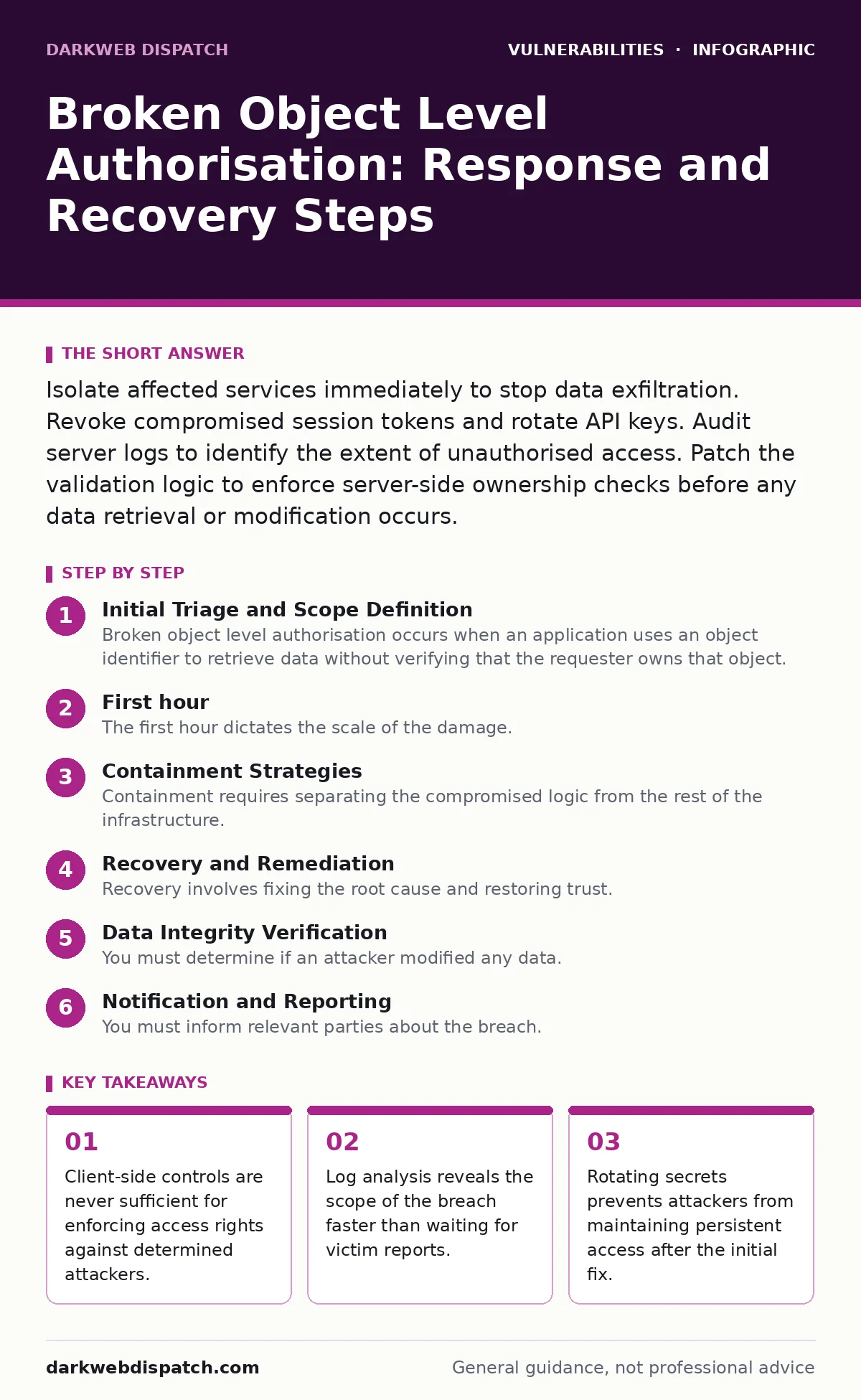
Isolate affected services immediately to stop data exfiltration. Revoke compromised session tokens and rotate API keys. Audit server logs to identify the extent of unauthorised access. Patch the validation logic to enforce server-side ownership checks before any data retrieval or modification occurs.
Initial Triage and Scope Definition
Broken object level authorisation occurs when an application uses an object identifier to retrieve data without verifying that the requester owns that object. You must determine if the vulnerability affects read operations, write operations, or both. Read-only exposure allows data theft. Write exposure allows data manipulation or deletion. Check your application logs for sequential ID enumeration patterns.
Attackers often iterate through numeric IDs to find valid records. Look for unusual spikes in 404 Not Found responses followed by 200 OK responses. This pattern indicates successful ID guessing. Identify which endpoints accept external input for object identification. Focus your initial investigation on endpoints that handle sensitive data such as personal information or financial records.
First hour
The first hour dictates the scale of the damage. You cannot fix the code instantly, so you must limit the attack surface. The following checklist ensures you address the most critical vectors immediately.
- Disable public access to affected API endpoints if possible.
- Revoke all active session tokens for the affected service.
- Rotate any API keys or service account credentials that might have been exposed.
- Enable verbose logging on the application gateway to capture all request parameters.
- Notify the development team to halt any non-critical deployments.
Containment Strategies
Containment requires separating the compromised logic from the rest of the infrastructure. If you use a web application firewall, add temporary rules to block requests with sequential integer parameters. This stops automated scanning tools while you build a permanent fix. Isolate the database servers from direct internet access if they were previously exposed.
Review your network segmentation to ensure that the application layer cannot directly query the database without an intermediate service layer. This intermediate layer should enforce strict access controls. If you have microservices, verify that service-to-service communication uses mutual authentication. An attacker who gains access to one service should not be able to pivot to others using stolen tokens.
Recovery and Remediation
Recovery involves fixing the root cause and restoring trust. The primary fix is implementing server-side authorisation checks. Every request must verify that the user associated with the session token owns the requested object. Do not rely on hiding object IDs or using UUIDs alone. Attackers can still guess or harvest UUIDs. Use a database query that joins the user ID with the object ID. If the join returns no results, the access is denied. This approach ensures that the database itself enforces the boundary. Test the fix by attempting to access another user’s data with a valid session. The request must fail. Verify that legitimate users can still access their own data without interruption.
Data Integrity Verification
You must determine if an attacker modified any data. Compare database records against known good backups if available. Look for inconsistencies in timestamps or user agents in the audit logs. If you use version control for your application code, check for any unauthorised commits. Although BOLA typically affects data, not code, an attacker might use the access to inject malicious payloads if the application allows file uploads. Scan uploaded files for malware. Verify that no new administrative accounts were created. Check for changes in configuration files that might persist access after a restart. This step is critical for ensuring that the system returns to a trusted state.
See also: Stop Credential Leaks: A Practical Prevention Checklist · Difference Between Authorized and Unauthorized Access: The Hidden Boundaries
Notification and Reporting
You must inform relevant parties about the breach. Internal stakeholders need to know the scope to manage customer communications. External users whose data was accessed should be notified promptly. Provide clear instructions on what they can do to protect themselves, such as changing passwords or monitoring financial statements. Regulatory bodies may require notification within specific timeframes. Prepare a detailed incident report that includes the timeline, the affected data, and the remediation steps taken. This report helps demonstrate that you have addressed the vulnerability effectively. Transparency builds trust with your users and regulators.
Preventing Recurrence
Stopping a repeat requires changing how you build and test software. Integrate automated security testing into your development pipeline. Use static application security testing tools to detect missing authorisation checks. Perform regular penetration tests that specifically target object-level access. Train developers to assume that all client-side input is hostile. Implement the principle of least privilege for all application accounts. Review your architecture for similar patterns. If one endpoint has BOLA, others likely do too. Conduct a full audit of all endpoints that accept object identifiers. This proactive approach reduces the risk of future incidents.
Long-Term Security Hygiene
Security is an ongoing process, not a one-time fix. Regularly review your access control policies. Update your libraries and frameworks to patch known vulnerabilities. Stay informed about emerging threats and best practices. Engage with the security community to learn from others’ experiences. Implement a bug bounty program to encourage responsible disclosure. This allows external researchers to find and report vulnerabilities before attackers exploit them. Maintain an up-to-date incident response plan. Practice your response procedures regularly to ensure that your team can act quickly and effectively under pressure.
Key takeaways
- Client-side controls are never sufficient for enforcing access rights against determined attackers.
- Log analysis reveals the scope of the breach faster than waiting for victim reports.
- Rotating secrets prevents attackers from maintaining persistent access after the initial fix.
Frequently asked questions
How do I detect broken object level authorisation in my application?
Manually test endpoints by changing object IDs in requests while logged in as a different user. Automated tools can also scan for sequential ID patterns and unexpected access grants.
Is using UUIDs enough to prevent BOLA?
No. UUIDs are harder to guess but not impossible. Attackers can still obtain valid UUIDs through other means. Server-side verification of ownership is always required regardless of the ID format.
What is the difference between BOLA and broken function level authorisation?
BOLA affects access to specific data objects. Broken function level authorisation affects access to specific functions or features. Both require server-side validation, but they target different aspects of the application logic.
Should I use JWTs to fix BOLA?
JWTs can help by embedding user context in the token. However, they do not solve BOLA if the application fails to verify the token’s claims against the requested object. Proper validation logic is still necessary.
How this guide was produced: written by the DarkWeb Dispatch editorial team with AI assistance, checked against the public references listed below, and reviewed when the facts change. See our editorial policy or report an error.