Runtime Application Self-Protection (RASP): Definition and Purpose
Runtime Application Self-Protection sits inside your code to see attacks in real time, stopping threats that external tools miss by understanding context.

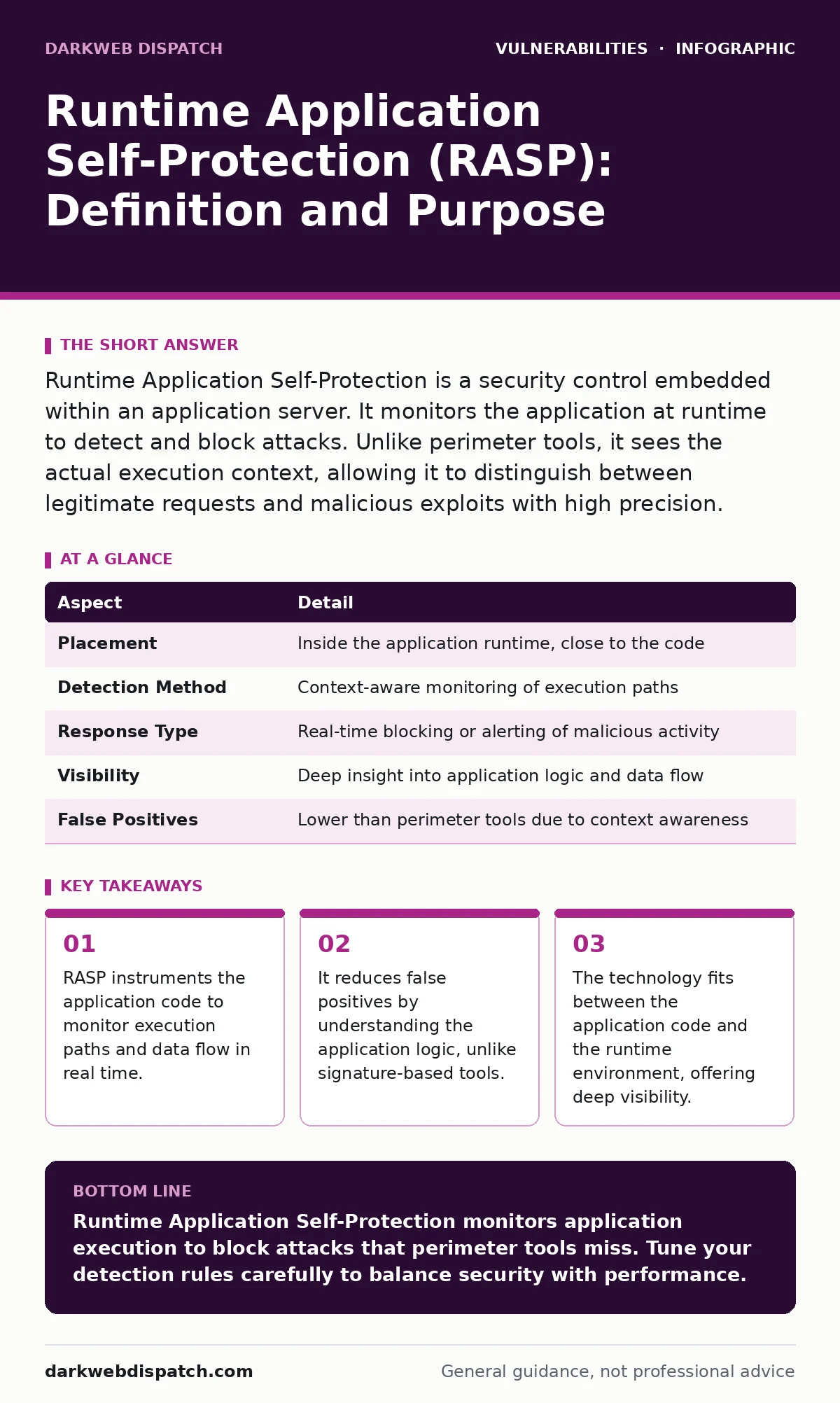
Runtime Application Self-Protection is a security control embedded within an application server. It monitors the application at runtime to detect and block attacks. Unlike perimeter tools, it sees the actual execution context, allowing it to distinguish between legitimate requests and malicious exploits with high precision.
The Internal Security Guard Analogy
Imagine a bank with a metal detector at the front door. This device stops obvious weapons, but it cannot see a pen that hides a needle. Now imagine a security guard standing next to every teller. This guard watches every transaction, checks the intent behind each action, and stops a suspicious deposit before it enters the ledger. Runtime Application Self-Protection works like that guard.
It lives inside the application environment rather than at the network edge. It sees what the application sees, not just what the network sees. This internal position allows it to understand the context of every request. A standard firewall sees a data packet. RASP sees a database query being constructed. It knows whether that query is safe or dangerous because it watches the code execute.
What RASP Actually Is
Runtime Application Self-Protection is a software component that integrates with an application server or runtime environment. It does not require changes to the source code of the application itself. Instead, it hooks into the execution engine to monitor calls and data flows. When the application runs, RASP observes every interaction between the code and the underlying system.
It checks inputs as they enter the logic and outputs as they leave. If it detects a pattern that matches a known attack vector, it can block the request immediately. This happens at the moment of execution. The protection is dynamic and responsive. It adapts to the specific behaviour of the application it protects. This makes it distinct from static analysis tools that scan code before it runs.
| Aspect | Detail |
|---|---|
| Placement | Inside the application runtime, close to the code |
| Detection Method | Context-aware monitoring of execution paths |
| Response Type | Real-time blocking or alerting of malicious activity |
| Visibility | Deep insight into application logic and data flow |
| False Positives | Lower than perimeter tools due to context awareness |
The Problem It Solves
Traditional security tools often rely on signatures or static rules. A web application firewall blocks requests that look like known attacks. However, attackers constantly change their methods to bypass these rules. They might split a malicious payload across multiple requests or use encoded characters. These techniques can trick perimeter defences. Runtime Application Self-Protection solves this by looking at the result of the request, not just the request itself.
It asks whether the code is doing something dangerous, regardless of how the data arrived. This approach catches zero-day exploits that have no known signature yet. It also handles complex logic flaws that depend on the sequence of actions. For instance, it can detect when a user tries to access a resource they should not see, even if the request looks normal in isolation.
Main Components of RASP
Runtime Application Self-Protection consists of three main parts. The first is the instrumentation layer. This code attaches to the application runtime. It intercepts function calls and monitors data as it moves through the application. The second part is the detection engine. This component analyses the intercepted data against a set of rules. These rules define what constitutes an attack.
The engine uses context to make decisions. It considers the state of the application and the user session. The third part is the response module. When the detection engine finds a threat, this module takes action. It can block the request, log the event, or alert a security team. Some implementations also provide remediation advice. They tell developers exactly where in the code the vulnerability exists.
Where RASP Fits in Defence
Security works best in layers. Runtime Application Self-Protection sits deep within the stack. It complements other tools rather than replacing them. A web application firewall handles traffic at the network level. It stops obvious attacks before they reach the server. Input validation ensures that data entering the application meets expected formats. These are first lines of defence. RASP acts as a final check before the code executes.
It catches what the outer layers miss. It is particularly useful for applications that cannot be easily patched. In such cases, RASP provides a virtual patch. It blocks the exploit path without changing the code. This is similar to how mitigations and workarounds protect systems while a permanent fix is prepared. RASP does not replace secure coding practices. It adds a safety net for when those practices fail.
See also: ISACs: The Real Value and Hidden Costs of Sector Sharing · What Are Threat Intelligence Reports: Definition, Purpose and Structure
What People Usually Get Wrong
Many teams believe that Runtime Application Self-Protection replaces the need for secure development. This is a dangerous assumption. RASP detects and blocks attacks, but it does not fix the underlying code. The vulnerability remains in the application. If RASP is disabled or misconfigured, the application is exposed again. Another common mistake is assuming RASP catches all attacks. It focuses on execution-time threats.
It does not protect against logical flaws that do not trigger security rules. For example, a business logic error that allows a user to buy an item for free might not be flagged as a security threat. RASP is also not a substitute for identity management. It cannot prevent account takeover if the credentials are valid. It works best when combined with strong authentication and session management.
Limitations and Trade-offs
Runtime Application Self-Protection has clear limits. It requires integration with the application runtime. This means it only works for supported environments. If you use a rare or custom runtime, RASP may not support it. The technology also consumes system resources. Monitoring every call takes CPU and memory. In high-traffic applications, this can become a bottleneck. Tuning the detection rules is complex.
Too strict, and you block legitimate users. Too loose, and you miss attacks. This requires ongoing maintenance. Security teams must review alerts and adjust rules regularly. RASP is not a set-and-forget solution. It demands attention and expertise. It is also less effective against attacks that do not involve code execution. Social engineering or physical theft are outside its scope.
Conclusion on RASP Value
Runtime Application Self-Protection offers a unique perspective on application security. By sitting inside the application, it sees what external tools cannot. It provides context-aware protection that reduces false positives. It catches advanced attacks that bypass perimeter defences. However, it is not a magic bullet. It adds complexity and performance overhead.
It works best as part of a layered defence strategy. Combine it with input validation and secure coding practices. Use it to buy time for patching critical flaws. Understand its limits and tune it carefully. When used correctly, RASP strengthens your security posture significantly. It turns the application itself into an active defender. This shifts the balance against attackers who rely on hidden payloads.
Key takeaways
- RASP instruments the application code to monitor execution paths and data flow in real time.
- It reduces false positives by understanding the application logic, unlike signature-based tools.
- The technology fits between the application code and the runtime environment, offering deep visibility.
- RASP complements other defences by catching issues that input validation and web application firewalls miss.
Runtime Application Self-Protection monitors application execution to block attacks that perimeter tools miss. Tune your detection rules carefully to balance security with performance.
Frequently asked questions
Does RASP replace a web application firewall?
No, RASP complements a web application firewall. The firewall stops attacks at the network edge, while RASP monitors execution inside the application. They work together to provide layered defence.
Can RASP protect against all types of vulnerabilities?
RASP focuses on execution-time attacks. It is effective against injection and code execution flaws. It does not protect against logical errors or social engineering. It works best for specific technical threats.
How much does RASP slow down an application?
RASP adds some processing overhead. The impact depends on the implementation and traffic volume. You should test performance in a staging environment. Proper tuning minimises the slowdown for end users.
Is RASP suitable for legacy applications?
Yes, RASP is often used for legacy apps. It does not require code changes. It provides protection where updating the code is difficult. It acts as a virtual patch for known vulnerabilities in old systems.
How this guide was produced: written by the DarkWeb Dispatch editorial team with AI assistance, checked against the public references listed below, and reviewed when the facts change. See our editorial policy or report an error.