How to Prevent Zero-Day Vulnerabilities Before They Hit
You cannot patch every unknown flaw, but you can architect your systems so that an exploit fails to gain traction or move laterally.

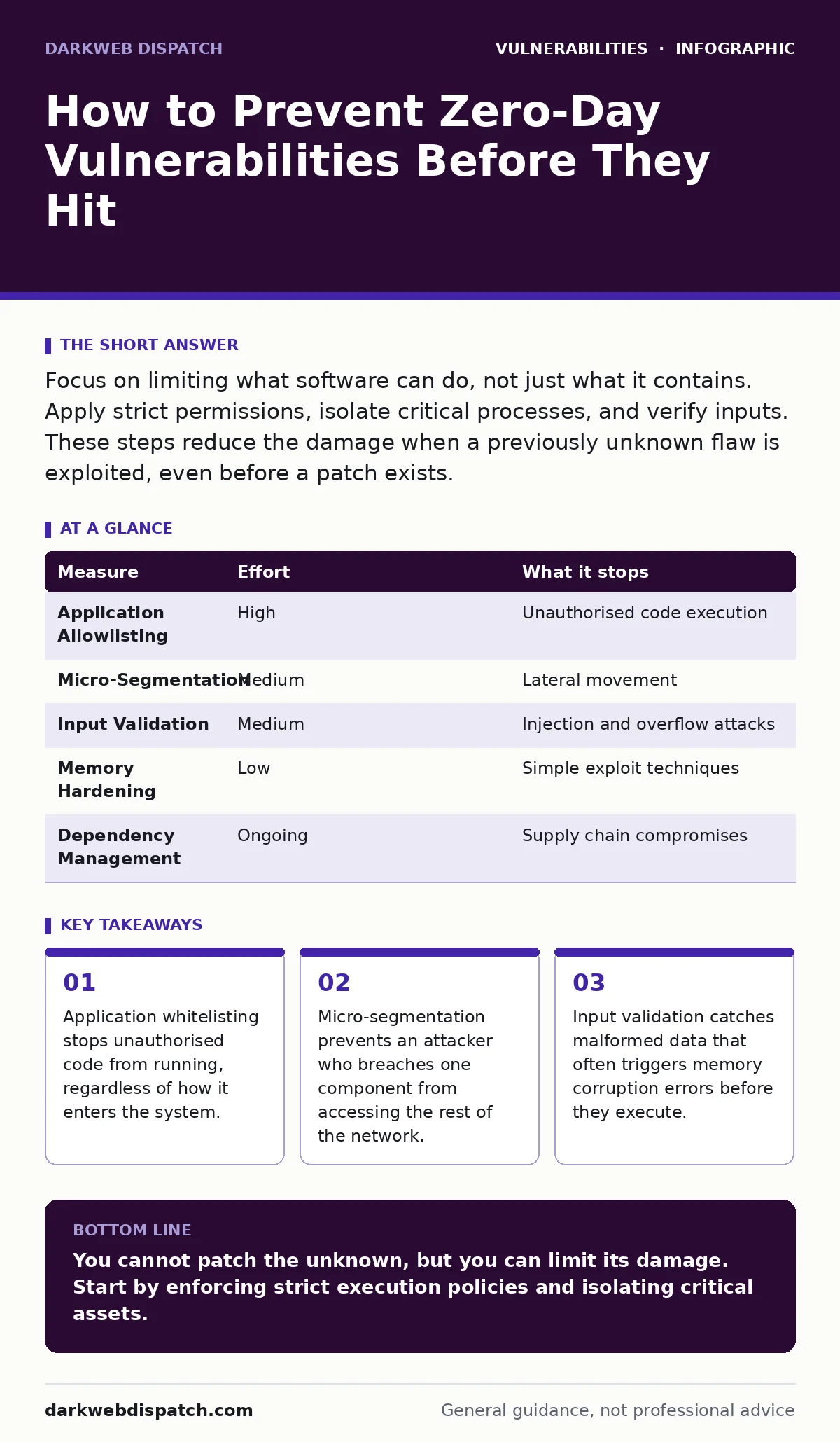
Focus on limiting what software can do, not just what it contains. Apply strict permissions, isolate critical processes, and verify inputs. These steps reduce the damage when a previously unknown flaw is exploited, even before a patch exists.
The Myth of the Invisible Shield
A zero-day vulnerability is a security flaw unknown to the vendor or the public. Because no patch exists, traditional detection methods often fail. You cannot wait for a signature to be written. Instead, you must assume the flaw exists and design your environment to limit its impact. This approach shifts the burden from perfect prevention to resilient containment.
Restrict Execution with Allowlisting
The most effective defence is to stop unauthorised programmes from running at all. Application allowlisting, also known as whitelisting, permits only trusted executables to launch. It ignores everything else. If a zero-day exploit attempts to drop a malicious payload, the system blocks it immediately. This works because the attacker relies on executing new code. You do not need to know the code is malicious; you only need to know it is not on your list.
This method requires maintenance. You must update the list when you install new software. The trade-off is rigidity. A legitimate new tool will fail to run until you approve it. For critical servers, this friction is worth the security gain. It eliminates the risk of drive-by downloads and many supply chain attacks.
Isolate Components Through Micro-Segmentation
Imagine a firewall breach. In a flat network, an attacker moves freely to sensitive data. Micro-segmentation divides the network into small, isolated zones. Each zone has strict rules about what traffic can enter or leave. If a zero-day exploit compromises a web server, the attacker cannot jump to the database server. The blast radius remains contained within the single segment.
This strategy reduces lateral movement. It forces an attacker to find multiple vulnerabilities to progress. You achieve this by defining security groups and applying least-privilege network rules. Do not rely on perimeter defences alone. Internal boundaries matter just as much as external ones. This approach is vital for cloud environments where traditional network borders are blurred.
Validate Every Input Rigorously
Many zero-days stem from how software handles unexpected data. Input validation ensures that data entering a system meets strict criteria. It checks type, length, format, and range. If a field expects a number, it rejects letters. This prevents buffer overflows and injection attacks. It is a proactive measure that stops exploitation before it starts.
You must validate at every boundary. Do not trust data from internal systems either. Internal services can be compromised or misconfigured. Treat all input as hostile. This practice addresses the root cause of many memory corruption bugs. It complements other measures by reducing the attack surface. See our guide on input validation for deeper technical patterns.
Harden the Kernel and Memory
Modern operating systems include features to make exploitation harder. Data Execution Prevention (DEP) marks memory regions as non-executable. Address Space Layout Randomisation (ASLR) randomises the location of key system components. These features complicate an attacker’s ability to predict memory addresses. They turn a reliable exploit into a guessing game.
You must enable these features by default. Many systems ship with them disabled for compatibility reasons. Check your configuration settings. Disable legacy applications that require these protections to be turned off. This is a low-effort, high-reward step. It raises the bar for attackers significantly. It does not stop all exploits, but it stops the easy ones.
See also: Broken Object Level Authorisation: Response and Recovery Steps
Manage Third-Party Risk
Your security is only as strong as your weakest dependency. Libraries and frameworks often contain hidden flaws. A zero-day in a popular library can affect thousands of applications. You must track the components you use. Keep them updated. Remove unused libraries. This reduces the number of potential entry points.
Consider the complexity of your supply chain. Each added component increases risk. Prefer well-maintained, open-source libraries with active communities. They are more likely to have security reviews. Monitor for advisories. This is an ongoing process, not a one-time task. It requires discipline and consistent review.
What Does Not Work Alone
Many organisations believe that scanning for malware is enough. It is not. Zero-day exploits often do not drop traditional malware files. They may execute in memory. They may use legitimate system tools. Signature-based detection misses these techniques. You need behaviour-based controls and architectural defences.
Quick Wins for Today
Start with these three actions. They require minimal effort but provide immediate risk reduction.
- Enable Data Execution Prevention on all servers.
- Audit and remove unused network ports and services.
- Review application permissions to ensure least privilege.
These steps close common gaps. They do not require new software. They require configuration changes. Implement them now. They buy you time while you build more robust defences.
| Measure | Effort | What it stops |
|---|---|---|
| Application Allowlisting | High | Unauthorised code execution |
| Micro-Segmentation | Medium | Lateral movement |
| Input Validation | Medium | Injection and overflow attacks |
| Memory Hardening | Low | Simple exploit techniques |
| Dependency Management | Ongoing | Supply chain compromises |
Key takeaways
- Application whitelisting stops unauthorised code from running, regardless of how it enters the system.
- Micro-segmentation prevents an attacker who breaches one component from accessing the rest of the network.
- Input validation catches malformed data that often triggers memory corruption errors before they execute.
You cannot patch the unknown, but you can limit its damage. Start by enforcing strict execution policies and isolating critical assets.
Frequently asked questions
Can I prevent all zero-day attacks?
No. Zero-days are unknown by definition. You can only reduce the likelihood of success and limit the impact.
Does encryption help against zero-days?
Encryption protects data at rest and in transit. It does not prevent the exploit itself. It limits the value of stolen data.
How this guide was produced: written by the DarkWeb Dispatch editorial team with AI assistance, checked against the public references listed below, and reviewed when the facts change. See our editorial policy or report an error.