Fuzz Testing Misconceptions: What Automated Inputs Actually Reveal
Fuzz testing finds crashes by breaking inputs, not by understanding business logic or validating security policies against known attack vectors.

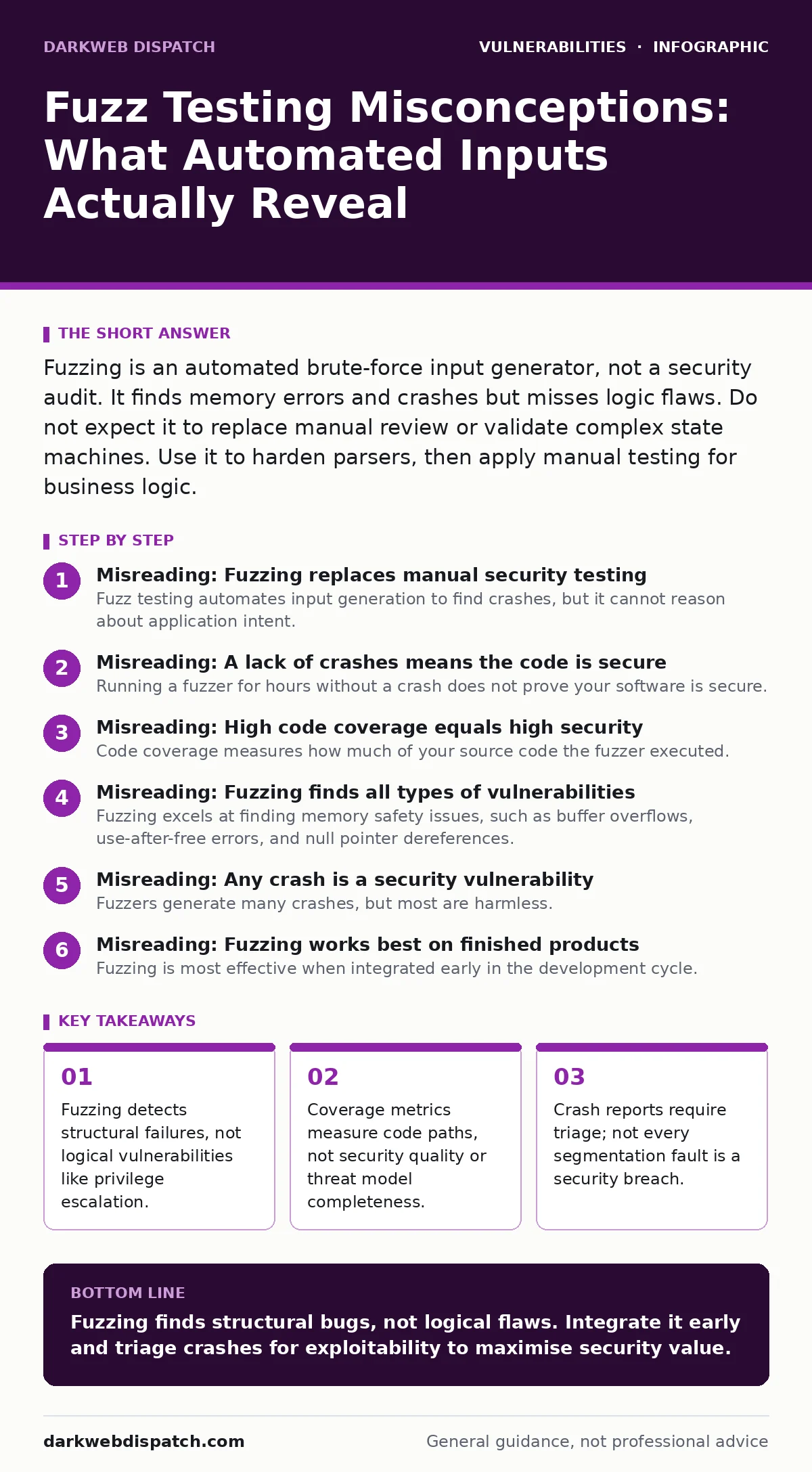
Fuzzing is an automated brute-force input generator, not a security audit. It finds memory errors and crashes but misses logic flaws. Do not expect it to replace manual review or validate complex state machines. Use it to harden parsers, then apply manual testing for business logic.
Misreading: Fuzzing replaces manual security testing
Fuzz testing automates input generation to find crashes, but it cannot reason about application intent. It treats your software as a black box or a grey box, feeding it random or mutated data. It does not understand that a user must be logged in to delete an account. It will happily test the delete function with garbage data, but it will not test whether a guest user can delete an admin’s account. Manual testing remains necessary for business logic errors. These logic flaws often bypass the very protections fuzzing helps build. You must combine automated fuzzing with human-led threat modelling to catch both structural and logical failures.
Correct reading: Treat fuzzing as a complement to manual review, not a substitute. Use it to harden the input layer, then use manual testing to verify that the hardened inputs are processed correctly within the business context. This dual approach ensures you catch both memory corruption and privilege escalation attempts.
Misreading: A lack of crashes means the code is secure
Running a fuzzer for hours without a crash does not prove your software is secure. It only proves that the specific inputs generated so far did not trigger a failure in the tested code paths. Fuzzers explore a tiny fraction of the possible input space. They rely on heuristics to navigate the code, which means they often miss deep branches. If your code has complex conditional logic, the fuzzer may never reach the vulnerable line. A clean run is a sign of stability, not security. You should view zero crashes as a baseline, not a certificate of safety.
Correct reading: Zero crashes indicate resilience against the specific test corpus, not immunity to all attacks. Continue to expand your seed corpus and increase coverage thresholds. Do not stop testing just because the initial run is clean. Security is a continuous process of finding new edge cases, not a one-time pass/fail check.
Misreading: High code coverage equals high security
Code coverage measures how much of your source code the fuzzer executed. High coverage is a good metric for test thoroughness, but it is not a security metric. It might walk through every line of a safe parser but miss the one line where a buffer overflows under rare conditions. Coverage tells you where the fuzzer has been, not what it has broken.
Correct reading: Use coverage to guide the fuzzer towards unexplored areas, not to declare victory. If coverage plateaus, change the mutation strategy or add new seed files. High coverage is a means to an end, not the end itself.
Misreading: Fuzzing finds all types of vulnerabilities
Fuzzing excels at finding memory safety issues, such as buffer overflows, use-after-free errors, and null pointer dereferences. It struggles with logic flaws, race conditions, and cryptographic weaknesses. These vulnerabilities depend on timing, state, or specific input relationships that random mutation rarely reproduces. For example, a race condition requires two threads to execute in a specific order. A standard fuzzer cannot orchestrate this timing. It will feed data to one thread, not both simultaneously. You need specialized tools for concurrency bugs and logic errors. Relying on fuzzing alone leaves these blind spots open.
Correct reading: Understand the strengths and limits of your tool. Use fuzzing for input validation and parsing errors. Use other methods for logic and timing issues. This targeted approach ensures you are using the right tool for each type of vulnerability. Do not expect a single tool to solve every security problem.
Misreading: Any crash is a security vulnerability
Fuzzers generate many crashes, but most are harmless. A crash might occur because of an out-of-memory error or an assertion failure in debug mode. These are stability issues, not necessarily security flaws. Security vulnerabilities require an attacker to exploit the crash for code execution or data leakage. A crash that only denies service is less severe than one that allows remote code execution. You must triage every crash to determine its exploitability. Assuming every crash is critical wastes time and resources. Focus on crashes that leave the program in an exploitable state.
Correct reading: Triage crashes based on exploitability, not just occurrence. Check if the crash allows control over the instruction pointer or memory access. Ignore benign crashes that do not lead to security breaches. This prioritisation ensures you fix the most dangerous issues first. It also prevents alert fatigue from trivial findings.
See also: Mitigations and Workarounds: How to Secure Systems When Patches Fail · WordPress Plugin Update Policy Mistakes and How to Fix Them
Misreading: Fuzzing works best on finished products
Fuzzing is most effective when integrated early in the development cycle. Testing finished products is harder because the code is complex and intertwined. Early fuzzing allows developers to fix issues before they become entrenched. It also encourages writing testable code with clear interfaces. If you wait until release, you face a massive codebase with hidden dependencies. Fuzzing such a system is slow and yields fewer useful results. Shift left by fuzzing modules and libraries as they are written. This proactive approach reduces technical debt and improves overall quality.
Correct reading: Integrate fuzzing into your continuous integration pipeline. Run it on every commit to catch regressions immediately. This continuous feedback loop helps developers write safer code from the start. It also makes debugging easier because the change set is small. Early detection is cheaper and faster than late-stage remediation.
Key takeaways
- Fuzzing detects structural failures, not logical vulnerabilities like privilege escalation.
- Coverage metrics measure code paths, not security quality or threat model completeness.
- Crash reports require triage; not every segmentation fault is a security breach.
- Seed quality determines discovery rate more than runtime duration or corpus size.
Fuzzing finds structural bugs, not logical flaws. Integrate it early and triage crashes for exploitability to maximise security value.
Frequently asked questions
Does fuzzing find SQL injection vulnerabilities?
Fuzzing can find SQL injection if the input directly reaches the database without sanitisation. It is less effective for complex injection scenarios that require specific context or authentication states. Use specialised scanners for comprehensive SQL injection testing.
How long should I run a fuzzer?
Run fuzzers continuously in your CI pipeline. For longer runs, aim for days or weeks to increase coverage. The duration depends on code complexity and mutation strategy. Stop when coverage plateaus or resources are exhausted.
Can fuzzing replace penetration testing?
No. Fuzzing automates input testing but lacks human intuition and context. Penetration testing covers business logic, social engineering, and complex attack chains. Use both for a complete security assessment. Fuzzing handles volume; pentesting handles nuance.
Is fuzzing only for C and C++ code?
Fuzzing works for any language, but it is most critical for memory-unsafe languages like C and C++. Managed languages like Java and Python have fewer memory errors but still benefit from fuzzing for logic and parsing bugs. Adapt your strategy to the language’s risk profile.
How this guide was produced: written by the DarkWeb Dispatch editorial team with AI assistance, checked against the public references listed below, and reviewed when the facts change. See our editorial policy or report an error.