Mitigations and Workarounds: How to Secure Systems When Patches Fail
Technical controls often provide stronger protection than code fixes by blocking the attack path regardless of whether the underlying bug remains unpatched.

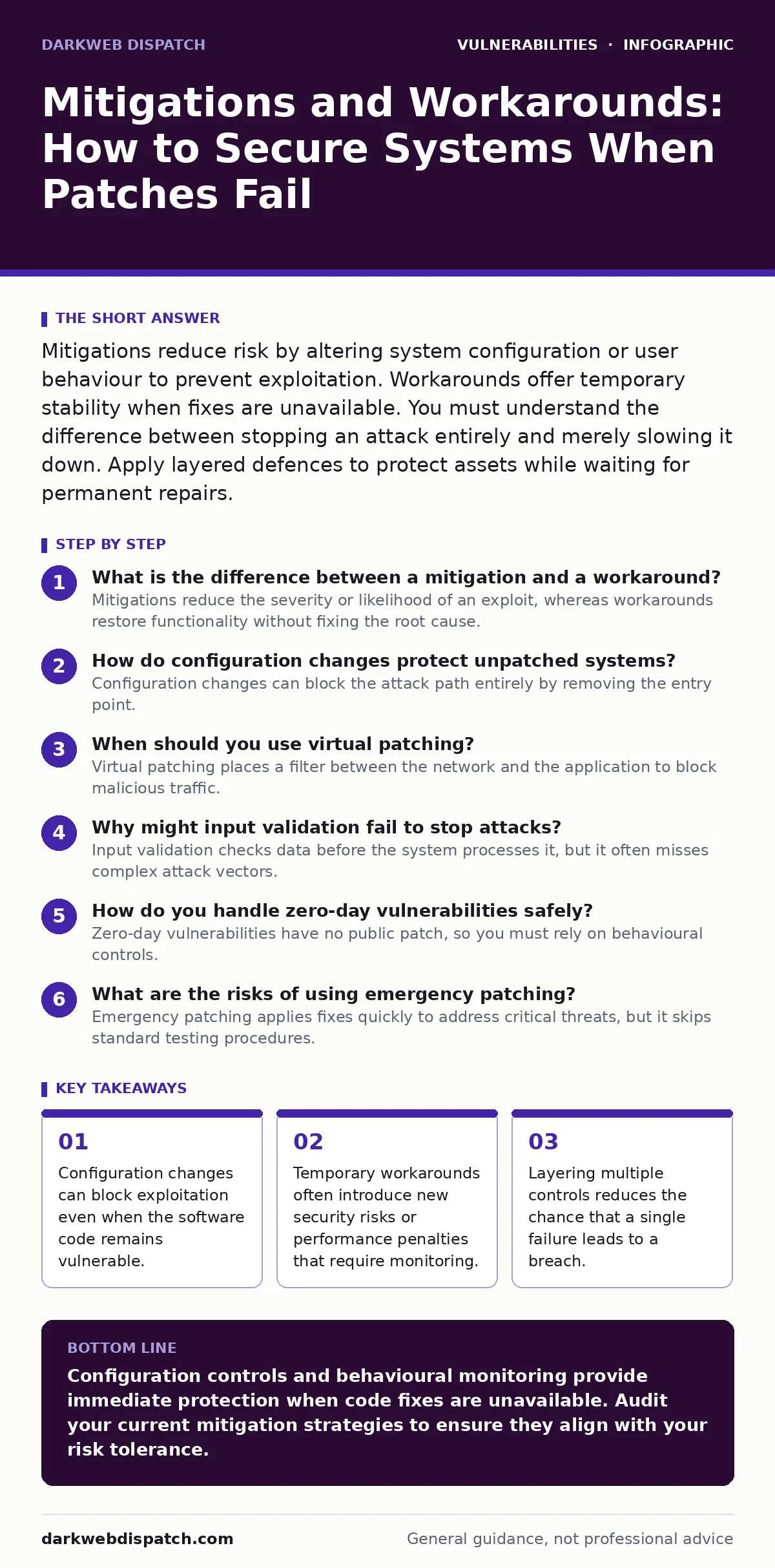
Mitigations reduce risk by altering system configuration or user behaviour to prevent exploitation. Workarounds offer temporary stability when fixes are unavailable. You must understand the difference between stopping an attack entirely and merely slowing it down. Apply layered defences to protect assets while waiting for permanent repairs.
What is the difference between a mitigation and a workaround?
Mitigations reduce the severity or likelihood of an exploit, whereas workarounds restore functionality without fixing the root cause. A mitigation might involve disabling a specific feature that attackers target. A workaround might involve restarting a service to clear a memory leak. You must distinguish between these two approaches to manage risk correctly. Mitigations are often permanent changes to your security posture. Workarounds are usually temporary measures until a proper patch arrives. Confusing the two can lead to long-term technical debt.
How do configuration changes protect unpatched systems?
Configuration changes can block the attack path entirely by removing the entry point. For example, disabling a specific port or protocol prevents remote access to a vulnerable service. This method works because the attacker cannot reach the flawed code. You must verify that disabling the feature does not break critical business functions. Configuration hardening is often more effective than waiting for a vendor patch. It shifts the burden from code correction to access control. This approach remains valid even if the underlying vulnerability is complex.
When should you use virtual patching?
Virtual patching places a filter between the network and the application to block malicious traffic. This method is useful when you cannot restart servers to apply traditional patches. You deploy rules on a web application firewall or an intrusion prevention system. These rules inspect incoming requests and drop those matching known exploit patterns. Virtual patching provides immediate protection without touching the application code. It does not fix the software, but it stops the attack. You must maintain these rules as attackers evolve their techniques.
| Control Type | Primary Goal | Duration | Maintenance Required |
|---|---|---|---|
| Configuration Change | Block access | Permanent | Low |
| Virtual Patching | Filter traffic | Temporary | High |
| Code Fix | Remove bug | Permanent | None |
| Workaround | Restore function | Temporary | Medium |
Why might input validation fail to stop attacks?
Input validation checks data before the system processes it, but it often misses complex attack vectors. Attackers can encode data in ways that bypass simple checks. For instance, a multi-byte character might split across buffer boundaries, evading detection. You must validate data at every layer, not just at the entry point. Deep inspection requires understanding the full context of the data. Standard libraries often lack the depth needed for complex formats. Relying solely on input validation leaves gaps in your defence.
How do you handle zero-day vulnerabilities safely?
Zero-day vulnerabilities have no public patch, so you must rely on behavioural controls. Monitor for unusual activity that indicates exploitation, such as unexpected network connections. Isolate critical systems to limit lateral movement if a breach occurs. You can also use application whitelisting to ensure only approved programs run. This prevents unknown code from executing, even if it exploits a zero-day. You must accept some residual risk because you cannot patch what you do not know. Focus on containment and detection rather than prevention.
See also: Fuzz Testing Misconceptions: What Automated Inputs Actually Reveal · WordPress Plugin Update Policy Mistakes and How to Fix Them
What are the risks of using emergency patching?
Emergency patching applies fixes quickly to address critical threats, but it skips standard testing procedures. This speed increases the risk of introducing new bugs or breaking existing features. You must weigh the risk of the vulnerability against the risk of instability. A broken system is often more dangerous than a vulnerable one. Test patches in a staging environment that mirrors production before deployment. Verify that business-critical functions still work after the update. Document every change to facilitate rollback if problems arise.
How can you mitigate use-after-free vulnerabilities?
Use-after-free vulnerabilities occur when code accesses memory that has been freed. You cannot always fix the code immediately, so you must limit the impact. Use address space layout randomisation to make memory locations unpredictable. Enable stack canaries to detect buffer overflows that might lead to use-after-free. These compiler-level protections make exploitation significantly harder. You should also limit the privileges of the affected service. A low-privilege process cannot do much damage even if compromised.
Why is fuzz testing important for finding weaknesses?
Fuzz testing sends random or malformed data to a program to find crashes. This automated process discovers bugs that manual testing might miss. You can use fuzz testing to validate the effectiveness of your mitigations. If a fuzzer cannot crash the application, your controls are likely working. Fuzz testing is particularly effective for complex parsers and file handlers. It helps you identify edge cases in input validation. You must run fuzz tests regularly to catch regressions.
How do you manage WordPress plugin update policies securely?
WordPress plugins are frequent targets due to their widespread use. You must enforce strict update policies to minimise exposure. Disable plugins that are not actively maintained. Keep all active plugins updated to the latest stable version. You should also limit admin access to trusted users only. Regular backups allow you to restore the site if an update fails. Monitor for unusual login attempts or content changes. A disciplined update routine reduces the window of opportunity for attackers.
What is the role of server-side template injection defences?
Server-side template injection allows attackers to execute code through template variables. You must prevent user input from being interpreted as code. Use strict output encoding to ensure data is treated as text. Separate data from logic in your application architecture. Avoid using complex template engines for user-facing content. Validate and sanitise all inputs before they reach the template engine. These measures prevent the execution of arbitrary code. You must also limit the capabilities of the template engine itself.
Key takeaways
- Configuration changes can block exploitation even when the software code remains vulnerable.
- Temporary workarounds often introduce new security risks or performance penalties that require monitoring.
- Layering multiple controls reduces the chance that a single failure leads to a breach.
Configuration controls and behavioural monitoring provide immediate protection when code fixes are unavailable. Audit your current mitigation strategies to ensure they align with your risk tolerance.
Frequently asked questions
Can I rely on antivirus software to stop zero-day exploits?
Antivirus software relies on known signatures, so it cannot detect unknown zero-day exploits. You must use behavioural monitoring and network segmentation instead.
How long should I keep a workaround in place?
Workarounds should be temporary. Plan to replace them with permanent patches or architectural changes within weeks.
Is virtual patching a substitute for code fixes?
No, virtual patching only filters traffic. It does not fix the underlying code vulnerability, which remains a risk.
What is the first step in mitigating a critical vulnerability?
Isolate the affected system to prevent further exploitation. Then assess the impact and apply the most immediate control.
How this guide was produced: written by the DarkWeb Dispatch editorial team with AI assistance, checked against the public references listed below, and reviewed when the facts change. See our editorial policy or report an error.