How Disputed and Rejected CVEs Affect Your Patching Strategy
Rejected CVEs often indicate misclassification rather than safety, requiring manual validation before you skip a vendor patch.

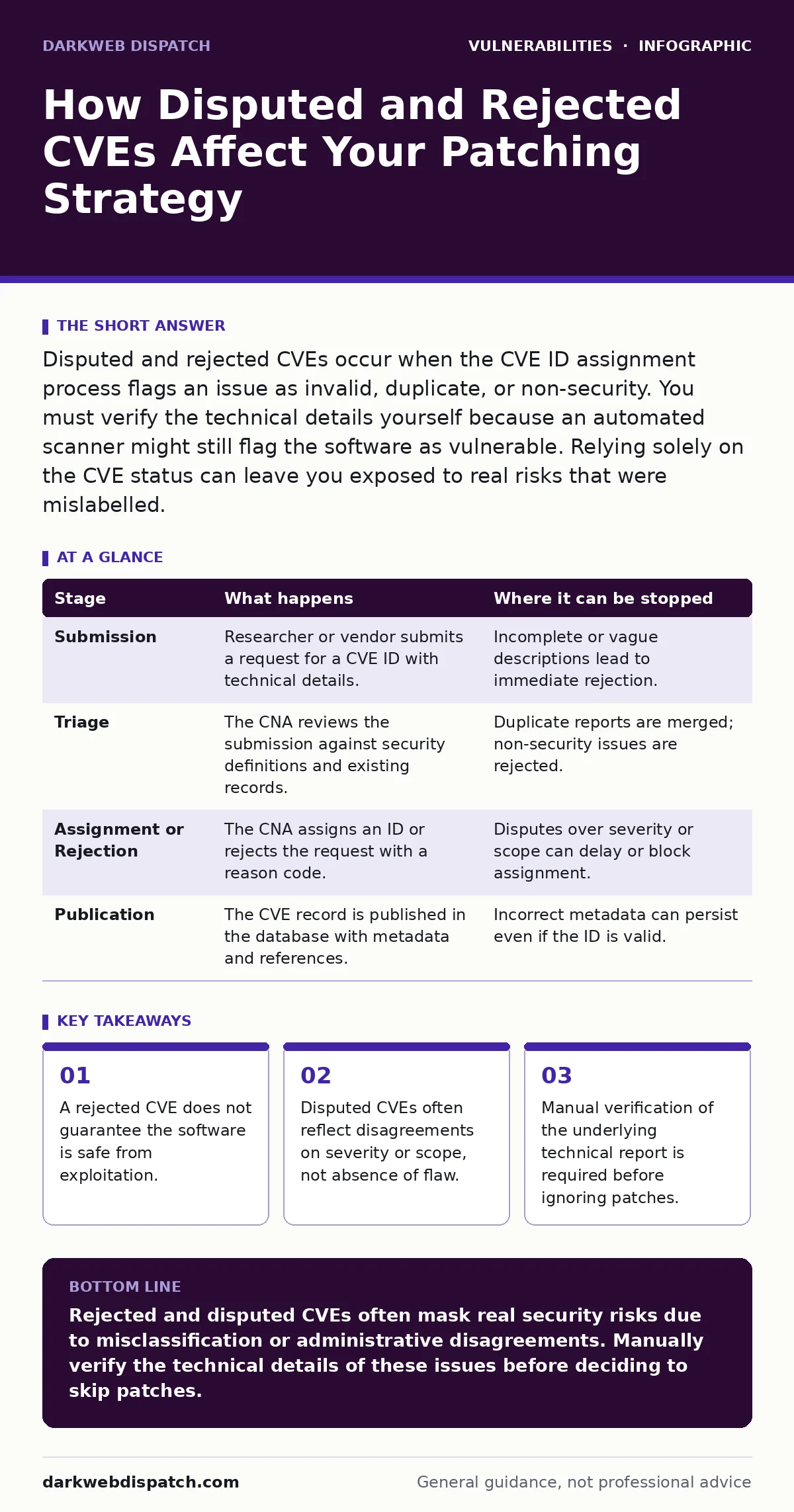
Disputed and rejected CVEs occur when the CVE ID assignment process flags an issue as invalid, duplicate, or non-security. You must verify the technical details yourself because an automated scanner might still flag the software as vulnerable. Relying solely on the CVE status can leave you exposed to real risks that were mislabelled.
The Mechanics of CVE Assignment and Rejection
The Common Vulnerabilities and Exposures (CVE) system provides a standard identifier for publicly disclosed cybersecurity vulnerabilities. A CVE ID is a unique string that allows researchers, vendors and security tools to reference a specific flaw without ambiguity. The process relies on CVE Numbering Authorities (CNAs) which are organisations authorised to assign these IDs. Vendors, independent researchers and bug bounty platforms submit requests for CVE IDs when they discover a vulnerability. The CNA reviews the submission against strict criteria to determine if the issue qualifies as a security vulnerability.
Not all submissions result in an active CVE ID. Some requests are rejected or disputed during this review phase. A rejection usually means the issue does not meet the definition of a vulnerability. This could be because the behaviour is intended, the impact is negligible, or the report contains insufficient technical detail. A dispute often arises when two parties disagree on the classification. For example, a vendor might argue a flaw is a configuration error rather than a code defect. These outcomes create noise in the vulnerability data that automated tools process.
| Stage | What happens | Where it can be stopped |
|---|---|---|
| Submission | Researcher or vendor submits a request for a CVE ID with technical details. | Incomplete or vague descriptions lead to immediate rejection. |
| Triage | The CNA reviews the submission against security definitions and existing records. | Duplicate reports are merged; non-security issues are rejected. |
| Assignment or Rejection | The CNA assigns an ID or rejects the request with a reason code. | Disputes over severity or scope can delay or block assignment. |
| Publication | The CVE record is published in the database with metadata and references. | Incorrect metadata can persist even if the ID is valid. |
Understanding Rejection Reasons and Their Implications
When a CVE request is rejected, the CNA assigns a specific reason code. Common reasons include "NOTVULN" which indicates the issue is not a vulnerability, or "NOTRESERVED" which means the ID was not reserved for the specific issue. Another frequent reason is "DUP" where the issue is already covered by an existing CVE. These codes provide a high-level status but lack technical nuance. A "NOTVULN" rejection might stem from a vendor arguing that the feature works as designed. This does not necessarily mean the design is secure or that it cannot be exploited in unexpected ways.
Imagine a researcher reports a logic error in an authentication module. The vendor rejects the request, claiming the error only affects internal testing environments. The CVE record shows a rejection. However, if an attacker finds a way to reach that testing environment, the flaw becomes a real security risk. The rejection status masks the underlying technical truth. Automated vulnerability scanners often rely on the CVE database to identify risks. If the scanner sees a rejected CVE, it may suppress the alert. This creates a false sense of security for the organisation managing the software.
The Complexity of Disputed CVE Records
Disputed CVEs represent a grey area in the vulnerability lifecycle. A dispute occurs when the submitter and the CNA or vendor cannot agree on the classification. This might involve disagreements over the severity score, the affected versions or the nature of the exploit. The CVE record may remain in a disputed state for an extended period. During this time, the status is ambiguous. Security teams must decide whether to treat the issue as a potential risk or ignore it based on the current metadata.
This ambiguity complicates patch management. Vendors may release updates that address the disputed issue, but the CVE record does not reflect the resolution. Alternatively, a vendor might refuse to patch, maintaining that the issue is not a vulnerability. The CVE record remains disputed, leaving the security community without a clear signal. This situation requires manual investigation. You must read the original technical report and any vendor advisories to understand the reality of the risk. Relying on the CVE status alone is insufficient in disputed cases.
Practical Steps for Verifying Disputed and Rejected Issues
You need a systematic approach to handle disputed and rejected CVEs. First, locate the original technical report or blog post that triggered the CVE request. These sources often contain proof-of-concept code or detailed descriptions that the CVE record lacks. Second, check for vendor advisories or patch notes. Even if the CVE is rejected, the vendor may have released an update that mitigates the issue. Third, consult community discussions on security forums or mailing lists. Other researchers may have analysed the dispute and provided additional context.
This process requires time and technical expertise. It is not scalable for large environments with thousands of assets. However, for critical systems, manual verification is necessary. Automated tools can flag the issue, but they cannot make the final judgment call. You must weigh the evidence. If the technical report demonstrates a clear exploit path, treat the issue as a vulnerability regardless of the CVE status. If the vendor has provided a compelling argument that the issue is benign, you may choose to accept the risk. Document your decision for audit purposes.
Integrating Verification into Patch Management Workflows
Integrating manual verification into your patch management workflow ensures that disputed and rejected CVEs do not slip through the cracks. Start by categorising your assets based on criticality. High-value assets require more rigorous verification. For these systems, assign a security engineer to review any disputed or rejected CVEs that affect the software stack. Create a ticket for each issue, attaching the technical report and vendor response. Use this ticket to track the verification process and the final decision.
For lower-priority assets, you can adopt a risk-based approach. If the disputed CVE affects a non-critical function, you might choose to monitor it rather than patch immediately. This balances security with operational efficiency. However, you must regularly review these deferred items. The context may change, or new information may emerge that alters the risk assessment. This dynamic approach ensures that you respond to evolving threats without overwhelming your team with every minor issue.
See also: Mitigations and Workarounds: How to Secure Systems When Patches Fail · WordPress Plugin Update Policy Mistakes and How to Fix Them
The Hidden Costs of Over-Reliance on CVE Data
Over-reliance on CVE data creates hidden costs for security teams. When tools automatically suppress alerts for rejected CVEs, they miss real risks that were misclassified. This leads to undetected vulnerabilities remaining in your environment. When an attacker eventually exploits such a flaw, the response is more costly and damaging. The time spent investigating the breach and remediating the damage far exceeds the time required for initial verification.
Additionally, disputed CVEs create uncertainty. Security teams may delay patching while waiting for clarification. This delay increases the window of exposure. Attackers do not wait for CVE records to be resolved. They exploit known weaknesses regardless of their official status. By waiting for official validation, you cede the initiative to the attacker. Proactive verification reduces this risk. It allows you to make informed decisions based on technical reality rather than administrative status.
Comparing CVE Status with Other Risk Indicators
CVE status is only one indicator of risk. You should combine it with other signals to form a complete picture. For instance, you might look at EPSS percentiles which estimate the probability of exploitation in the wild. A disputed CVE with a high EPSS score warrants immediate attention. Conversely, a rejected CVE with a low EPSS score might be safely deferred. This multi-factor approach reduces the noise and focuses your efforts on the most likely threats.
You can also consider the nature of the vulnerability. Some flaws, such as zero-day vulnerabilities, are unknown to the vendor and therefore lack a CVE ID entirely. Other issues, like server-side template injection, are well-known classes of vulnerability that may have many variants. Understanding the class of vulnerability helps you assess the risk even when the CVE status is ambiguous. Additionally, consider the context of the software. A flaw in a public-facing web server is more critical than the same flaw in an internal tool.
Building a Culture of Technical Verification
The most effective defence against the limitations of CVE data is a culture of technical verification. Encourage your security team to question automated alerts. Train them to read technical reports and understand the underlying mechanisms of vulnerabilities. This skill set is more valuable than memorising CVE IDs. When your team understands how wormable vulnerabilities propagate, they can better assess the risk of disputed issues that might exhibit similar characteristics.
Regularly review your patching processes. Identify areas where over-reliance on CVE status has led to gaps. Adjust your workflows to include manual verification for high-risk items. Engage with the security community. Participate in discussions about disputed CVEs and share your findings. This collective intelligence improves the accuracy of vulnerability data for everyone. By taking ownership of your risk assessment, you reduce dependence on imperfect external systems.
Key takeaways
- A rejected CVE does not guarantee the software is safe from exploitation.
- Disputed CVEs often reflect disagreements on severity or scope, not absence of flaw.
- Manual verification of the underlying technical report is required before ignoring patches.
Rejected and disputed CVEs often mask real security risks due to misclassification or administrative disagreements. Manually verify the technical details of these issues before deciding to skip patches.
Frequently asked questions
Does a rejected CVE mean the software is safe?
No, a rejected CVE only means the issue did not meet the specific criteria for a CVE ID. The underlying technical flaw may still exist and be exploitable.
How do I find the original report for a disputed CVE?
Search for the CVE ID in security blogs, GitHub repositories and vendor advisory pages. The original researcher often publishes detailed technical analysis independently of the CVE record.
Can automated tools handle disputed CVEs?
Automated tools can flag disputed CVEs, but they cannot assess the technical validity. You must manually review the context and technical details to make an informed decision.
How this guide was produced: written by the DarkWeb Dispatch editorial team with AI assistance, checked against the public references listed below, and reviewed when the facts change. See our editorial policy or report an error.