EPSS Percentiles: Prioritise Patching by Real-World Exploit Risk
EPSS percentiles reveal that most vulnerabilities never see wild exploitation, allowing teams to ignore low-risk CVEs and focus finite resources on genuine threats.

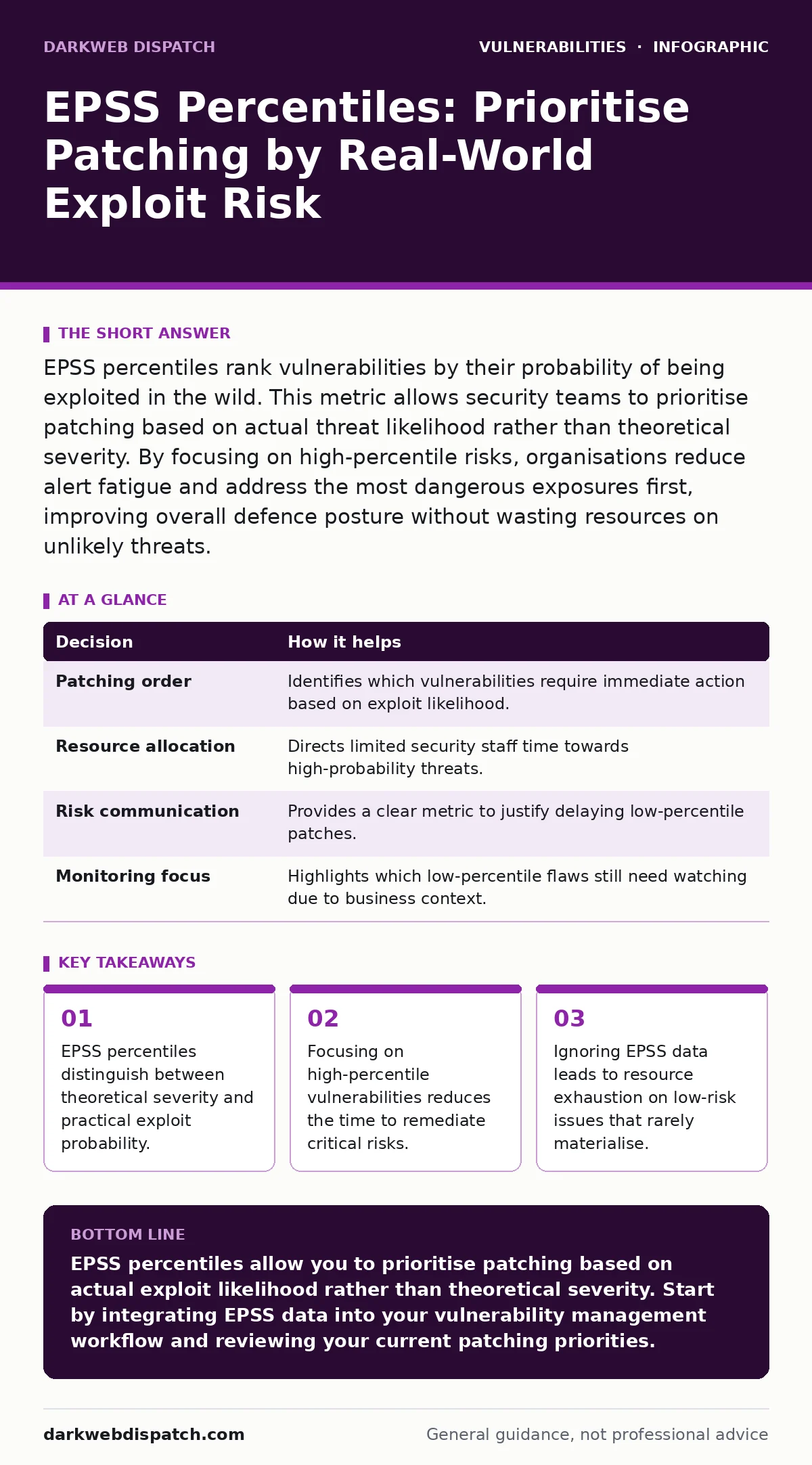
EPSS percentiles rank vulnerabilities by their probability of being exploited in the wild. This metric allows security teams to prioritise patching based on actual threat likelihood rather than theoretical severity. By focusing on high-percentile risks, organisations reduce alert fatigue and address the most dangerous exposures first, improving overall defence posture without wasting resources on unlikely threats.
Understanding EPSS Percentiles
EPSS stands for Exploit Prediction Scoring System. It assigns a daily probability that a vulnerability will be exploited in the wild. While traditional scores like CVSS measure technical severity, EPSS measures real-world behaviour. Percentiles convert these probabilities into a relative ranking. This distinction matters because severity does not equal risk. A flaw might be technically severe but difficult to exploit or irrelevant to your environment. EPSS percentiles provide a clearer picture of which flaws attackers are actually using. They help you separate noise from signal in your vulnerability management process.
The Decision Matrix
Security teams face constant pressure to patch everything. Resources are always limited. EPSS percentiles inform specific decisions about where to apply effort. They help you choose between immediate remediation and monitoring. They guide you in selecting which systems need urgent attention. They also assist in communicating risk to stakeholders who may not understand technical details. By using percentiles, you create a consistent framework for prioritisation. This framework reduces guesswork and emotional decision-making. It ensures that the most dangerous flaws receive attention first.
| Decision | How it helps |
|---|---|
| Patching order | Identifies which vulnerabilities require immediate action based on exploit likelihood. |
| Resource allocation | Directs limited security staff time towards high-probability threats. |
| Risk communication | Provides a clear metric to justify delaying low-percentile patches. |
| Monitoring focus | Highlights which low-percentile flaws still need watching due to business context. |
What Goes Wrong Without It
Imagine a team that patches every vulnerability as soon as it is disclosed. This approach seems thorough but often fails in practice. The team spends weeks fixing low-risk issues that attackers never touch. Meanwhile, a high-risk vulnerability emerges and remains unpatched because the team is busy with trivial flaws. This is the opposite of effective security.
Without EPSS percentiles, you lack a objective way to distinguish urgent threats from background noise. You may also suffer from alert fatigue. Security analysts become desensitised when every alert looks equally important. This fatigue increases the chance that a genuine threat is missed. The result is a false sense of security while real risks accumulate.
How Teams Use EPSS Data
Teams integrate EPSS percentiles into their vulnerability management workflows. They often combine EPSS with other data sources to refine their risk assessment. For example, a team might look at EPSS scores alongside asset criticality. A high-percentile vulnerability on a public-facing server demands immediate action. The same vulnerability on an isolated internal device might be deferred.
Teams also use EPSS to validate their patching cycles. If they consistently address vulnerabilities in the top 10th percentile, they are likely effective. Some teams set automated rules to escalate tickets for high-percentile issues. This automation ensures that urgent risks are never overlooked. Using EPSS data consistently improves the efficiency of your security operations.
The Hidden Costs of Ignoring Percentiles
Ignoring EPSS percentiles has hidden costs beyond wasted time. One cost is the delay in addressing genuine threats. When your team is busy fixing low-risk issues, high-risk issues wait. This delay increases your exposure window. Attackers often exploit known vulnerabilities quickly. If you are not prioritising based on exploit likelihood, you leave doors open.
Another hidden cost is the erosion of trust. Stakeholders lose confidence when security teams appear busy but risks remain high. They may question the value of the security function. This can lead to reduced budgets or support. Using EPSS percentiles helps maintain trust by demonstrating a focus on real threats. It shows that you understand the difference between theoretical and practical risk.
See also: Mitigations and Workarounds: How to Secure Systems When Patches Fail · WordPress Plugin Update Policy Mistakes and How to Fix Them
Integrating With Other Security Measures
EPSS percentiles work best when combined with other security measures. They complement mitigations and workarounds by helping you decide which mitigations to apply first. If a vulnerability has a high EPSS score, you might apply a workaround immediately while waiting for a patch. They also relate to out-of-band patches. These are emergency updates released outside regular cycles. EPSS data helps you identify which out-of-band patches are truly urgent.
Without this data, you might treat all emergency patches with equal panic. This can lead to chaotic deployment processes. By using EPSS, you can calm the process and focus on what matters. You also benefit from understanding zero-day vulnerabilities. While EPSS predicts exploitation of known flaws, zero-days are unknown. EPSS helps you manage the known risks so you have capacity to detect unknown ones.
Common Pitfalls to Avoid
One common pitfall is treating EPSS percentiles as absolute truth. They are predictions based on historical data. They do not guarantee that a low-percentile vulnerability will never be exploited. Context matters. A vulnerability that affects a core system in your organisation might be more risky than one affecting a peripheral system, even if the EPSS score is lower. Another pitfall is ignoring the trend.
EPSS scores can change as more information becomes available. A vulnerability might start with a low score but rise quickly as attackers develop exploits. Regularly reviewing your prioritisation list ensures you catch these changes. Do not set it and forget it. Finally, avoid using EPSS to justify ignoring all low-percentile flaws. Some may still require patching for compliance or internal policy reasons. Balance is key.
Moving Forward With Confidence
Adopting EPSS percentiles requires a shift in mindset. You must move from patching everything to patching what matters. This shift reduces stress and improves outcomes. Start by integrating EPSS data into your vulnerability management tool. Review your current patching priorities. Identify where you are spending time on low-risk issues. Adjust your processes to focus on high-percentile vulnerabilities. Communicate this change to your team and stakeholders. Explain how this approach reduces real-world risk. Over time, you will see a more efficient and effective security posture. You will also have more capacity to address emerging threats. This proactive approach keeps you ahead of attackers.
Key takeaways
- EPSS percentiles distinguish between theoretical severity and practical exploit probability.
- Focusing on high-percentile vulnerabilities reduces the time to remediate critical risks.
- Ignoring EPSS data leads to resource exhaustion on low-risk issues that rarely materialise.
EPSS percentiles allow you to prioritise patching based on actual exploit likelihood rather than theoretical severity. Start by integrating EPSS data into your vulnerability management workflow and reviewing your current patching priorities.
Frequently asked questions
How often should I review EPSS scores?
Review EPSS scores regularly, ideally as part of your weekly vulnerability management cycle. Scores can change as new exploit information becomes available, so frequent checks ensure your prioritisation remains accurate.
Can EPSS replace CVSS scores?
No, EPSS complements CVSS rather than replacing it. CVSS measures technical severity, while EPSS measures exploit probability. Use both metrics together to get a complete picture of risk, considering both the impact and the likelihood of exploitation.
What if my vulnerability management tool does not support EPSS?
You can manually integrate EPSS data by exporting vulnerability lists and cross-referencing them with public EPSS databases. Many tools allow custom fields or integrations that can be configured to import this data, enhancing your prioritisation capabilities.
Does EPSS account for my specific environment?
EPSS provides a general probability based on global data. It does not account for your specific environment. You must apply contextual factors, such as asset criticality and exposure, to tailor the EPSS data to your organisation's unique risk profile.
How this guide was produced: written by the DarkWeb Dispatch editorial team with AI assistance, checked against the public references listed below, and reviewed when the facts change. See our editorial policy or report an error.