SaaS Access Reviews: 6 Mistakes That Leave Accounts Exposed
Automated access reviews often confirm stale permissions rather than removing them, creating a false sense of security that increases your attack surface over time.

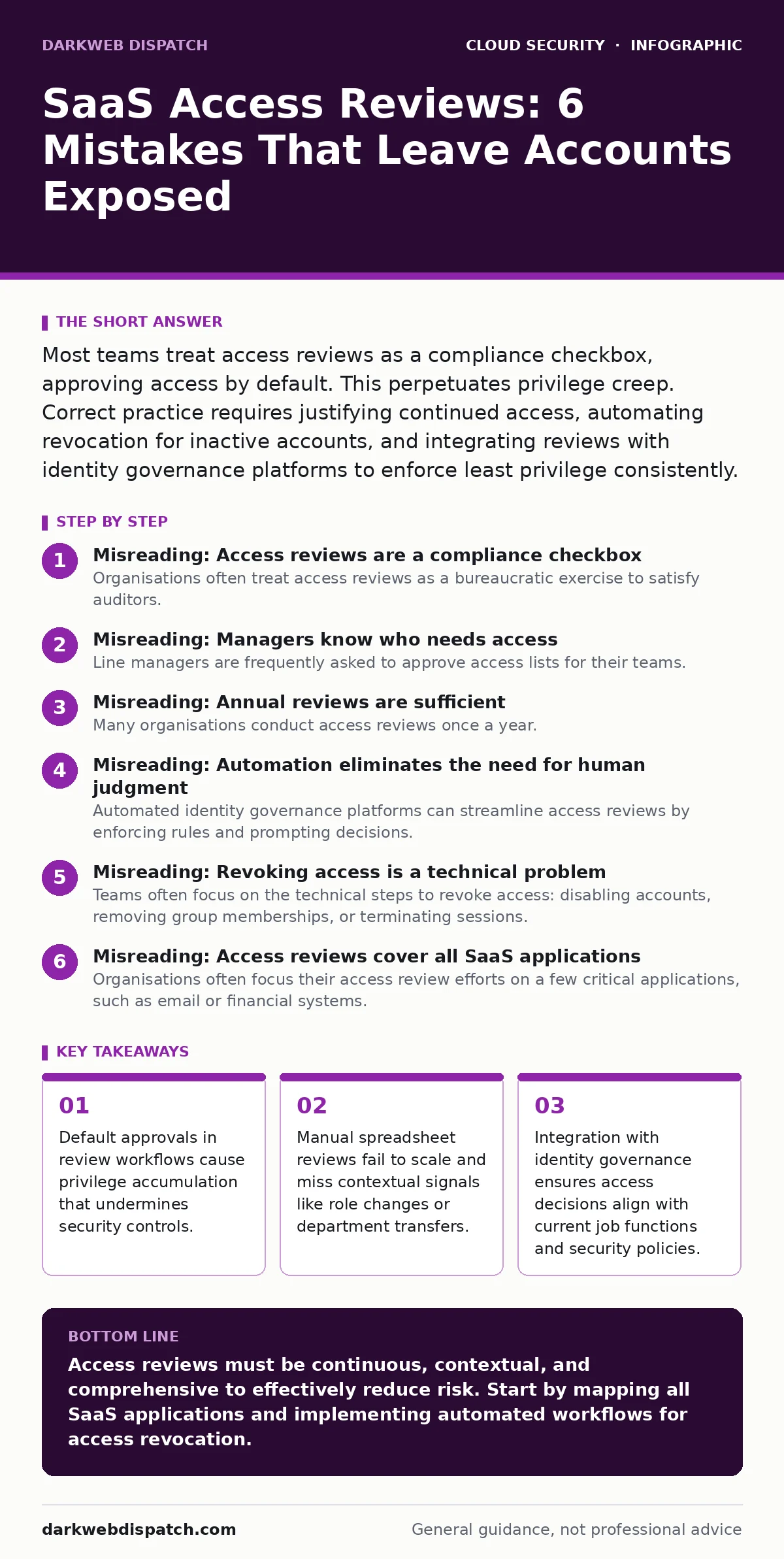
Most teams treat access reviews as a compliance checkbox, approving access by default. This perpetuates privilege creep. Correct practice requires justifying continued access, automating revocation for inactive accounts, and integrating reviews with identity governance platforms to enforce least privilege consistently.
Misreading: Access reviews are a compliance checkbox
Organisations often treat access reviews as a bureaucratic exercise to satisfy auditors. You schedule the review, send the notifications, and hope managers approve the requests quickly. This mindset prioritises speed over security. The process becomes a race to clear the queue rather than a genuine assessment of risk.
Correct reading: Access reviews are a risk reduction mechanism. Each review should challenge the necessity of existing permissions. If a user no longer needs access to a specific application or data set, that access must be revoked. The goal is to minimise the attack surface, not to produce a signed document for an auditor.
Misreading: Managers know who needs access
Line managers are frequently asked to approve access lists for their teams. The assumption is that they know exactly what their staff do and what tools they require. In reality, managers often lack visibility into technical roles or cross-functional projects. They may not know that a developer has access to production databases or that a contractor still has active credentials.
Correct reading: Managers are poor proxies for technical access requirements. You must provide them with context during the review process. Include the user’s current role, the last time they accessed the resource, and the sensitivity of the data. Without this context, managers will approve access by default to avoid blocking work, perpetuating privilege creep.
Misreading: Annual reviews are sufficient
Many organisations conduct access reviews once a year. This frequency aligns with typical audit cycles but ignores the dynamic nature of modern work. Employees change roles, leave projects, or depart the organisation between reviews. Waiting twelve months to remove unnecessary access leaves a significant window of exposure. A former employee with active credentials is a common entry point for attackers.
Correct reading: Access reviews should be continuous or triggered by events. Role changes, project completions, and employee departures should trigger immediate reviews. Automated systems can monitor activity and flag dormant accounts for revocation. Regular, smaller reviews are more effective than large, infrequent ones. This approach aligns with the principles of cloud identity governance, ensuring permissions reflect current reality.
Misreading: Automation eliminates the need for human judgment
Automated identity governance platforms can streamline access reviews by enforcing rules and prompting decisions. Some teams believe that once automation is in place, human involvement is unnecessary. They set rules to automatically approve access if certain conditions are met. This removes the critical step of human verification. Automation can enforce policy, but it cannot understand context or intent.
Correct reading: Automation supports human decision-making; it does not replace it. You must configure automation to escalate exceptions and require manual approval for high-risk access. Human reviewers must validate that automated decisions align with business needs. The combination of automated enforcement and human oversight ensures that access is both efficient and secure.
Misreading: Revoking access is a technical problem
Teams often focus on the technical steps to revoke access: disabling accounts, removing group memberships, or terminating sessions. They treat revocation as an IT task. This view ignores the business impact of removing access. Users may lose access to critical tools, disrupting their work. If the process is cumbersome, users may bypass security controls to regain access, creating shadow IT.
Correct reading: Revocation is a business process with technical execution. You must define clear procedures for requesting and approving access changes. Users should have a simple way to request access when needed, and a clear path to have it revoked when no longer required. Integrating access management with workflow tools reduces friction. This approach supports the shared responsibility model, where security and usability are balanced.
See also: Policy as Code: Definition, Purpose and Practical Cloud Security · What is Cloud Governance: Control Access Without Choking Innovation
Misreading: Access reviews cover all SaaS applications
Organisations often focus their access review efforts on a few critical applications, such as email or financial systems. They neglect smaller SaaS tools used by specific departments. These applications may contain sensitive data or provide access to broader networks. Attackers often target these overlooked applications to gain a foothold. Ignoring them creates blind spots in your security posture.
Correct reading: Access reviews must encompass all SaaS applications that store or process sensitive data. You should maintain an inventory of all SaaS tools in use. Regularly review access to each application, regardless of its size or perceived importance. This comprehensive approach prevents attackers from exploiting weak links. It also aligns with microsegmentation strategies, limiting lateral movement within the cloud environment.
Misreading: Static roles are secure enough
Many organisations assign users to static roles, such as "Manager" or "Developer," and grant access based on those roles. This method is simple to implement but fails to account for nuanced access requirements. A developer may need temporary access to a specific project that falls outside their standard role. Static roles cannot accommodate these temporary needs without granting excessive permanent permissions.
Correct reading: Use dynamic or just-in-time access controls where possible. Grant access for a specific duration or purpose, then automatically revoke it. This reduces the risk of long-term privilege accumulation. Identity governance platforms can manage these temporary assignments, ensuring that access is granted only when needed. This approach minimises the risk of cloud privilege escalation attacks.
Key takeaways
- Default approvals in review workflows cause privilege accumulation that undermines security controls.
- Manual spreadsheet reviews fail to scale and miss contextual signals like role changes or department transfers.
- Integration with identity governance ensures access decisions align with current job functions and security policies.
Access reviews must be continuous, contextual, and comprehensive to effectively reduce risk. Start by mapping all SaaS applications and implementing automated workflows for access revocation.
Frequently asked questions
How often should I conduct access reviews?
Conduct reviews continuously or trigger them by events like role changes or departures. Annual reviews are insufficient for dynamic environments.
What is the difference between access reviews and identity governance?
Access reviews are a process within identity governance. Identity governance encompasses the entire lifecycle of access management, including provisioning, deprovisioning, and continuous monitoring.
Can I automate access reviews completely?
No. Automation can enforce rules and prompt decisions, but human judgment is required to validate context and approve exceptions.
How do I handle access reviews for contractors?
Treat contractors with the same rigour as employees. Ensure their access is time-bound and revoked immediately upon contract completion.
How this guide was produced: written by the DarkWeb Dispatch editorial team with AI assistance, checked against the public references listed below, and reviewed when the facts change. See our editorial policy or report an error.