What is Cloud Governance: Control Access Without Choking Innovation
Cloud governance stops accidental data exposure by enforcing automated rules that revoke access when employees leave or change roles.

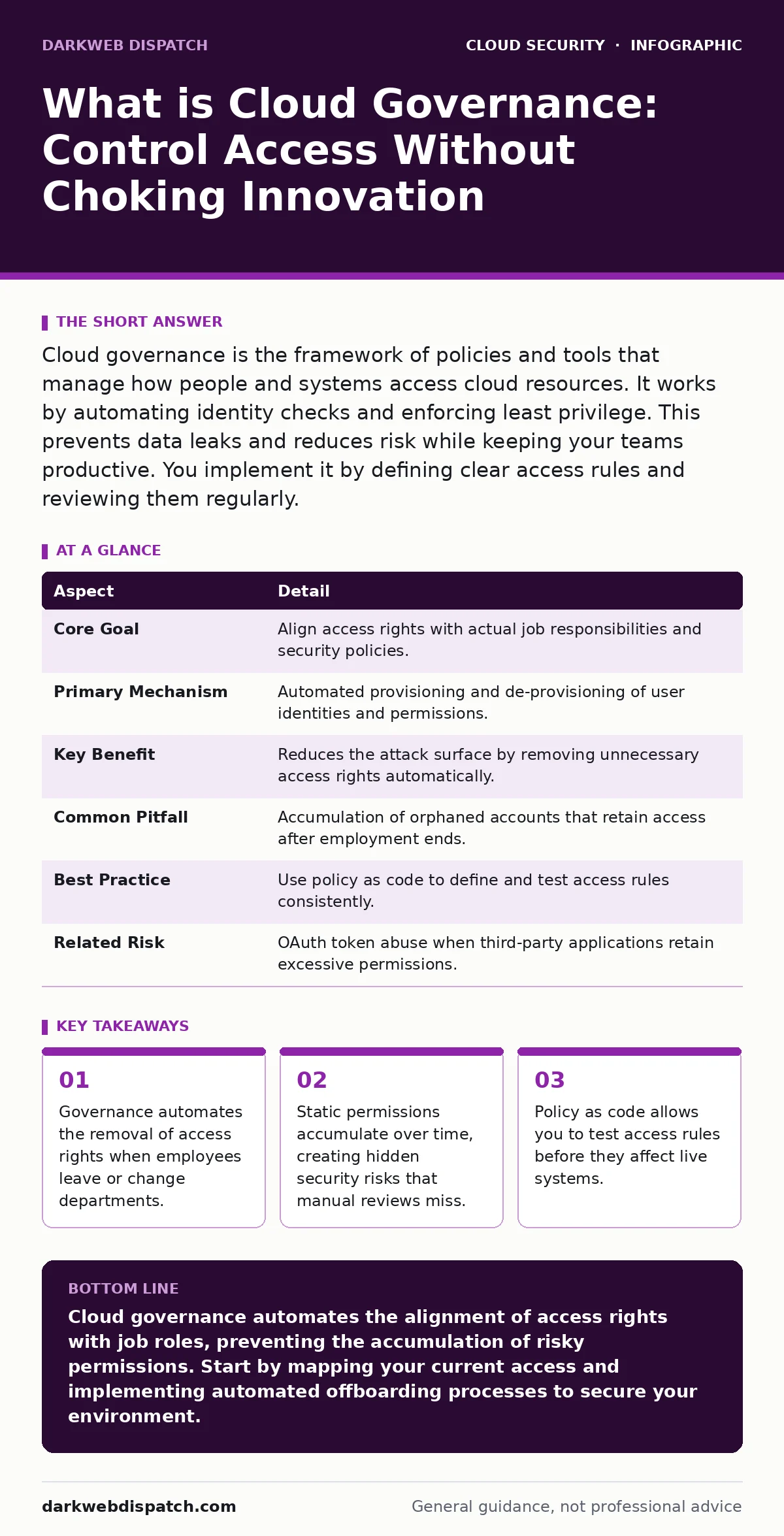
Cloud governance is the framework of policies and tools that manage how people and systems access cloud resources. It works by automating identity checks and enforcing least privilege. This prevents data leaks and reduces risk while keeping your teams productive. You implement it by defining clear access rules and reviewing them regularly.
The Library Card Analogy
Imagine a library that gives every visitor a master key upon entry. The key opens every book, every room, and the back door. Most visitors only need to read one section. They leave the key on their desk when they go home. The next day, a thief finds the key and empties the archive. Cloud identity governance is the system that issues temporary, specific passes instead of master keys. It ensures that access matches the actual job requirement. It also revokes the pass the moment the visitor leaves the building. This prevents unauthorized access without requiring constant manual supervision.
At a glance: Cloud Governance Essentials
| Aspect | Detail |
|---|---|
| Core Goal | Align access rights with actual job responsibilities and security policies. |
| Primary Mechanism | Automated provisioning and de-provisioning of user identities and permissions. |
| Key Benefit | Reduces the attack surface by removing unnecessary access rights automatically. |
| Common Pitfall | Accumulation of orphaned accounts that retain access after employment ends. |
| Best Practice | Use policy as code to define and test access rules consistently. |
| Related Risk | OAuth token abuse when third-party applications retain excessive permissions. |
What is cloud governance?
What is cloud governance? It is the set of processes and technologies that manage identity, access, and compliance in cloud environments. Unlike traditional on-premise security, cloud governance deals with dynamic resources that scale instantly. Users and applications request access on demand. Governance ensures these requests align with organisational rules.
It answers who can access what, when, and why. It also answers who can change those rules. Without it, permissions drift and accumulate. Users keep access they no longer need. This drift creates a large attack surface. Attackers exploit these excessive privileges to move laterally within your network. Governance stops this drift by enforcing continuous alignment with policy.
How Cloud Identity Governance Works
Governance relies on a central identity provider. This system authenticates users and authorises their access to resources. It connects to various cloud services and applications. When a user requests access, the system checks the request against defined policies. Policies might specify that finance staff can only access billing data. They cannot access engineering repositories. The system grants or denies access based on these rules.
It also logs every decision for audit purposes. Automated workflows handle the lifecycle of access. Onboarding scripts grant initial permissions. Role changes trigger permission updates. Offboarding scripts revoke all access immediately. This automation removes human error from the process. It ensures that access rights reflect current reality. Manual spreadsheets cannot keep pace with cloud dynamics. Automated governance can.
Who Identity Governance Affects
Identity governance affects every user with cloud access. Employees, contractors, and partners all require managed identities. Developers need access to code repositories and testing environments. Support staff need access to customer data. Each group has different risk profiles. Governance applies different rules to each group. It also affects third-party applications. These applications often use service accounts to access data.
Governance must manage these non-human identities too. Neglecting service accounts is a common oversight. Attackers frequently target these accounts because they often have higher privileges. They also lack the multi-factor authentication protections given to humans. Governance extends to all identities, human and machine. It ensures consistent protection across the entire ecosystem.
See also: Difference Between Authorized and Unauthorized Access: The Hidden Boundaries · Role-Based Access Control Example: How RBAC Limits Exposure
The Hidden Cost of Static Permissions
Suppose you hire a developer. You grant them access to the production database for testing. They finish the test in three days. You forget to remove the access. Six months later, they leave the company. The account remains active. An attacker compromises the developer's personal email. They use the credentials to access your production database. This scenario highlights the danger of static permissions. Access does not expire automatically.
It persists until someone remembers to remove it. This persistence creates orphaned accounts. These accounts are invisible to many security tools. They appear as legitimate users. Governance solves this by enforcing time-bound access. Access expires after a set period. Users must re-request access if they still need it. This re-verification step ensures ongoing necessity. It reduces the window of opportunity for attackers.
What People Usually Get Wrong
Many organisations confuse governance with monitoring. They install tools that log access but do not enforce rules. Logging is passive. Governance is active. It prevents violations before they occur. Another common mistake is treating governance as a one-time project. Cloud environments change daily. New services are added. Roles evolve. Governance must be continuous. It requires regular review of policies and permissions.
Static policies become obsolete quickly. They either block legitimate work or allow risky access. Organisations also neglect external identities. They focus on employees but ignore vendors and partners. External users often have broader access. They are harder to monitor. Governance must include all identity types. It must apply consistent rules regardless of employment status.
Implementing Effective Governance
Start by mapping your current access landscape. Identify who has access to what. Look for excessive privileges. Remove any access that is not justified by job role. This initial cleanup is tedious but necessary. It establishes a baseline. Next, define clear policies. Specify who can access which resources. Define the conditions for access. Use policy as code to manage these rules. This approach allows you to version control and test policies.
It ensures consistency across environments. Automate the enforcement of these policies. Integrate governance tools with your identity provider. Ensure that onboarding, role changes, and offboarding trigger automatic updates. Regularly review access rights. Conduct periodic access reviews. Ask managers to confirm that their teams still need their current access. This human review catches edge cases that automation might miss. Combine automation with human oversight for the best results.
Integrating With Broader Security
Governance does not work in isolation. It connects with other security practices. For example, secrets in source code can bypass governance controls. If credentials are hardcoded in an application, governance cannot revoke them. You must manage secrets separately. Use a dedicated secrets management tool. Rotate credentials regularly. Governance also supports least privilege in the cloud. It enforces the principle by automating permission grants.
It ensures users have only the access they need. It reduces the impact of OAuth token abuse. By limiting the scope of tokens, governance minimises damage if a token is stolen. It also helps prevent cloud metadata service attacks. By restricting access to metadata endpoints, governance reduces the risk of credential theft. A holistic security strategy integrates governance with these other controls. It creates a layered defence.
The Role of Policy as Code
Policy as code transforms governance from a manual process to an automated one. You write policies in a machine-readable format. These policies define access rules and compliance requirements. You store them in a version control system. This allows you to track changes and roll back errors. You can test policies in a development environment before deploying them. This reduces the risk of breaking production systems.
Policy as code also enables consistency. The same rules apply across all cloud accounts. It eliminates configuration drift. It ensures that every resource adheres to the same standards. This approach scales better than manual configuration. It handles thousands of resources with ease. It also provides an audit trail. You can see who changed a policy and why. This transparency supports compliance efforts.
Continuous Improvement and Review
Governance is not a set-and-forget solution. It requires continuous improvement. Cloud services evolve. New features introduce new risks. Policies must adapt to these changes. Regularly review your policies. Check for gaps or overly restrictive rules. Engage with business units to understand their needs. Balance security with usability. Overly strict policies lead to shadow IT. Users find ways to bypass controls if they hinder their work.
Collaborative governance is more effective. Involve stakeholders in the policy design process. Educate users on the importance of access management. Help them understand the risks of excessive permissions. Foster a culture of security awareness. Governance is a shared responsibility. It requires participation from everyone in the organisation. By integrating governance into daily workflows, you make it sustainable. It becomes a natural part of how you work.
Key takeaways
- Governance automates the removal of access rights when employees leave or change departments.
- Static permissions accumulate over time, creating hidden security risks that manual reviews miss.
- Policy as code allows you to test access rules before they affect live systems.
Cloud governance automates the alignment of access rights with job roles, preventing the accumulation of risky permissions. Start by mapping your current access and implementing automated offboarding processes to secure your environment.
Frequently asked questions
How does cloud governance differ from cloud security?
Cloud security protects the infrastructure and data from threats. Cloud governance manages who can access those resources and ensures compliance with internal policies. Governance is about identity and access control. Security is about defence against attacks. They work together to protect your cloud environment.
Do I need governance if I only use one cloud provider?
Yes, single-provider environments still face identity sprawl. Users accumulate permissions over time. Manual management becomes impossible at scale. Governance provides the automation needed to keep access rights accurate. It reduces risk regardless of the number of providers you use.
Can governance slow down my development team?
Poorly designed governance can hinder development. Overly strict policies cause delays. Good governance automates access requests. It grants permissions quickly based on predefined rules. This speeds up onboarding and reduces friction. The key is to design policies that balance security with developer needs.
How do I handle third-party vendor access?
Treat third-party vendors as external identities. Grant them temporary, limited access. Use just-in-time provisioning to give access only when needed. Revoke access immediately after the work is complete. Monitor their activity closely. Ensure your governance tools cover these external accounts.
How this guide was produced: written by the DarkWeb Dispatch editorial team with AI assistance, checked against the public references listed below, and reviewed when the facts change. See our editorial policy or report an error.