Unified Kill Chain: Why Fragmented Threat Models Fail Your Defences
Most teams miss attacks because they treat network traffic and endpoint behaviour as separate problems rather than a single continuous sequence.

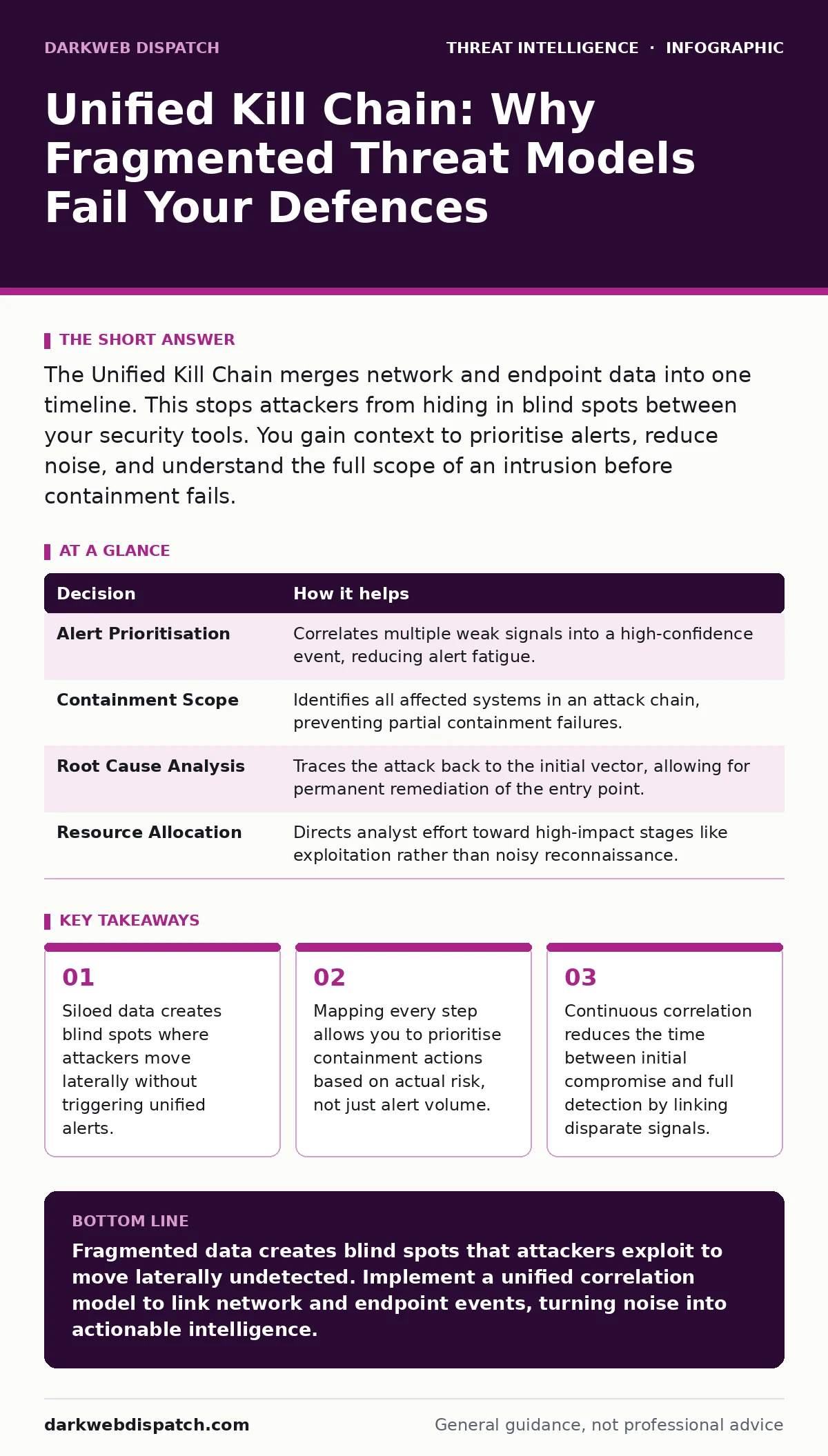
The Unified Kill Chain merges network and endpoint data into one timeline. This stops attackers from hiding in blind spots between your security tools. You gain context to prioritise alerts, reduce noise, and understand the full scope of an intrusion before containment fails.
The Problem With Isolated Defences
Security tools rarely speak the same language. Your network firewall logs connection attempts. Your endpoint detection software records process executions. Your identity provider tracks login events. Each system generates alerts based on its own limited view. When an attacker moves from network reconnaissance to privilege escalation, these events appear as unrelated noise. You see a failed login here and a strange process there. Without a connecting thread, you treat them as separate incidents. This fragmentation is the primary reason breaches persist long after initial detection.
The Unified Kill Chain addresses this by creating a single narrative. It does not replace your tools. It sits above them, correlating data points into a coherent sequence of actions. This model forces you to view an attack as a journey rather than a series of isolated events. By mapping network activity to endpoint behaviour, you close the gaps where adversaries typically hide.
Bridging The Network And Endpoint Gap
Traditional threat models often stop at the perimeter. They focus on blocking inbound traffic or scanning for malware signatures. Modern adversaries rarely rely on a single vector. They combine phishing, credential theft, and legitimate administrative tools to move through your environment. A network alert might show unusual outbound traffic. An endpoint alert might show a new script running. Alone, neither is conclusive. Together, they tell a story of data exfiltration.
This correlation is the core benefit of the Unified Kill Chain. It links the "what" from your network with the "how" from your endpoints. For instance, a DNS query to a suspicious domain might seem harmless. But if that query occurs seconds before a PowerShell script executes on a server, the risk profile changes drastically. You are no longer guessing at intent. You are observing a tactical sequence. This visibility allows you to detect low-and-slow attacks that evade single-point detection.
Decisions Informed By Unified Context
When you lack context, you react to symptoms rather than causes. You block an IP address that was already compromised. You disable a user account that was acting normally. These actions create friction for your users and offer little protection against determined adversaries. The Unified Kill Chain shifts your focus from reactive blocking to proactive containment. It helps you decide which alerts warrant immediate action and which are false positives.
Consider the decision to isolate a host. Without unified data, you might isolate a machine because of a single anomalous login. With unified data, you see that login is part of a broader pattern of lateral movement. You isolate not just the entry point, but the entire segment where the attacker is operating. This precision minimises business disruption while maximising security.
| Decision | How it helps |
|---|---|
| Alert Prioritisation | Correlates multiple weak signals into a high-confidence event, reducing alert fatigue. |
| Containment Scope | Identifies all affected systems in an attack chain, preventing partial containment failures. |
| Root Cause Analysis | Traces the attack back to the initial vector, allowing for permanent remediation of the entry point. |
| Resource Allocation | Directs analyst effort toward high-impact stages like exploitation rather than noisy reconnaissance. |
What Goes Wrong Without It
Without a unified view, your security team operates in the dark. You may detect the initial intrusion but miss the lateral movement. The attacker has already copied credentials and moved to a critical database. You think you have contained the issue because you blocked the initial phishing email. In reality, you have only addressed the tip of the iceberg. This false sense of security is dangerous. It leads to delayed responses and larger breaches.
False positives in threat detection become unmanageable without correlation. If every failed login triggers an alert, your team will ignore them entirely. This is known as alert fatigue. When a real attack occurs, it gets lost in the noise. The Unified Kill Chain filters this noise by requiring multiple correlated events to trigger a high-priority alert. A single failed login is ignored. A failed login followed by a successful login from a new location and a privilege escalation attempt is flagged. This distinction is vital for maintaining operational efficiency.
How Teams Use The Framework
Implementation starts with data integration. You must feed logs from your SIEM, endpoint agents, and network devices into a common platform. This platform must be able to parse and normalise these diverse data formats. Once integrated, you define rules that map to the stages of the kill chain. These rules are not static. They evolve as attackers change their tactics.
Teams use this framework for continuous monitoring and investigation. When an alert fires, analysts follow the chain. They look for the preceding steps to understand the scope. They look for the subsequent steps to predict the attacker's next move. This proactive stance allows for purple teaming exercises that test the effectiveness of your correlations. By simulating attacks that span multiple stages, you verify that your unified model catches the full sequence.
See also: Network Traffic Analysis: Fixing 6 Common Misconceptions · Blue Team Myths: Correcting Common Misunderstandings
Handling Edge Cases And Complexity
Not every event fits neatly into a linear chain. Some attacks are chaotic. Some defenders introduce noise through legitimate administrative tasks. The Unified Kill Chain must account for this variability. It should allow for non-linear progression. An attacker might jump from exploitation directly to impact, skipping lateral movement. Your model must detect this shortcut.
Additionally, consider the impact of scheduled task abuse. Attackers often use legitimate scheduling tools to maintain persistence. These actions look like normal administrative behaviour. However, when correlated with prior exploitation events, they reveal their malicious intent. The unified model connects the exploit to the persistence mechanism. Without this link, the scheduled task appears benign. This is a common blind spot in fragmented defences.
Integrating With Broader Intelligence
The Unified Kill Chain does not exist in a vacuum. It benefits from external context. Threat intelligence reports provide indicators of compromise that can enrich your internal data. If you see an IP address in your logs that matches a known threat actor, your unified model can elevate the priority of related events. This external data helps you identify advanced persistent threats that may not trigger internal behavioural alerts.
However, rely on your own data for confirmation. External indicators can be noisy or outdated. The strength of the Unified Kill Chain lies in your internal behavioural analysis. Use external intelligence to hypothesise. Use internal correlation to confirm. This balanced approach ensures you are not chasing ghosts while missing real threats. For deeper context on external data sources, see our guide on ISACs. For understanding the human element behind these attacks, review threat actor profiling.
Moving Beyond Detection
Detection is only the first step. The Unified Kill Chain informs your response strategy. By understanding the full sequence of the attack, you can tailor your containment measures. You know exactly which systems are compromised. You know how the attacker moved. This knowledge allows for precise eradication. You remove the backdoors, reset the compromised credentials, and patch the vulnerability.
This approach also improves your resilience. By analysing past attacks through this unified lens, you identify weaknesses in your defence strategy. You might find that your network segmentation is insufficient. You might discover that your identity controls are too permissive. These insights drive architectural changes that make future attacks harder. The Unified Kill Chain is not just a detection tool. It is a framework for continuous improvement. For more on testing your defences, see our guide on purple teaming. For understanding specific credential theft techniques, refer to golden ticket attacks.
Key takeaways
- Siloed data creates blind spots where attackers move laterally without triggering unified alerts.
- Mapping every step allows you to prioritise containment actions based on actual risk, not just alert volume.
- Continuous correlation reduces the time between initial compromise and full detection by linking disparate signals.
Fragmented data creates blind spots that attackers exploit to move laterally undetected. Implement a unified correlation model to link network and endpoint events, turning noise into actionable intelligence.
Frequently asked questions
Does the Unified Kill Chain replace my SIEM?
No, it uses data from your SIEM and other sources. It adds a layer of correlation and context that most standard SIEM configurations lack by default.
How long does it take to implement?
Implementation varies based on your data maturity. Basic correlation can start quickly, but full integration across all data sources takes time and careful tuning.
Can this model detect insider threats?
Yes. By correlating legitimate user behaviour with anomalous access patterns, it can flag insiders who are acting outside their normal baseline.
Is this only for large enterprises?
No. Small teams benefit most from reducing noise. A unified model helps limited staff focus on real threats rather than chasing false positives.
How this guide was produced: written by the DarkWeb Dispatch editorial team with AI assistance, checked against the public references listed below, and reviewed when the facts change. See our editorial policy or report an error.