PCI DSS: Why Payment Security Standards Dictate Your Architecture
PCI DSS forces organisations to treat payment data as a distinct security domain, preventing card details from bleeding into general logging systems.

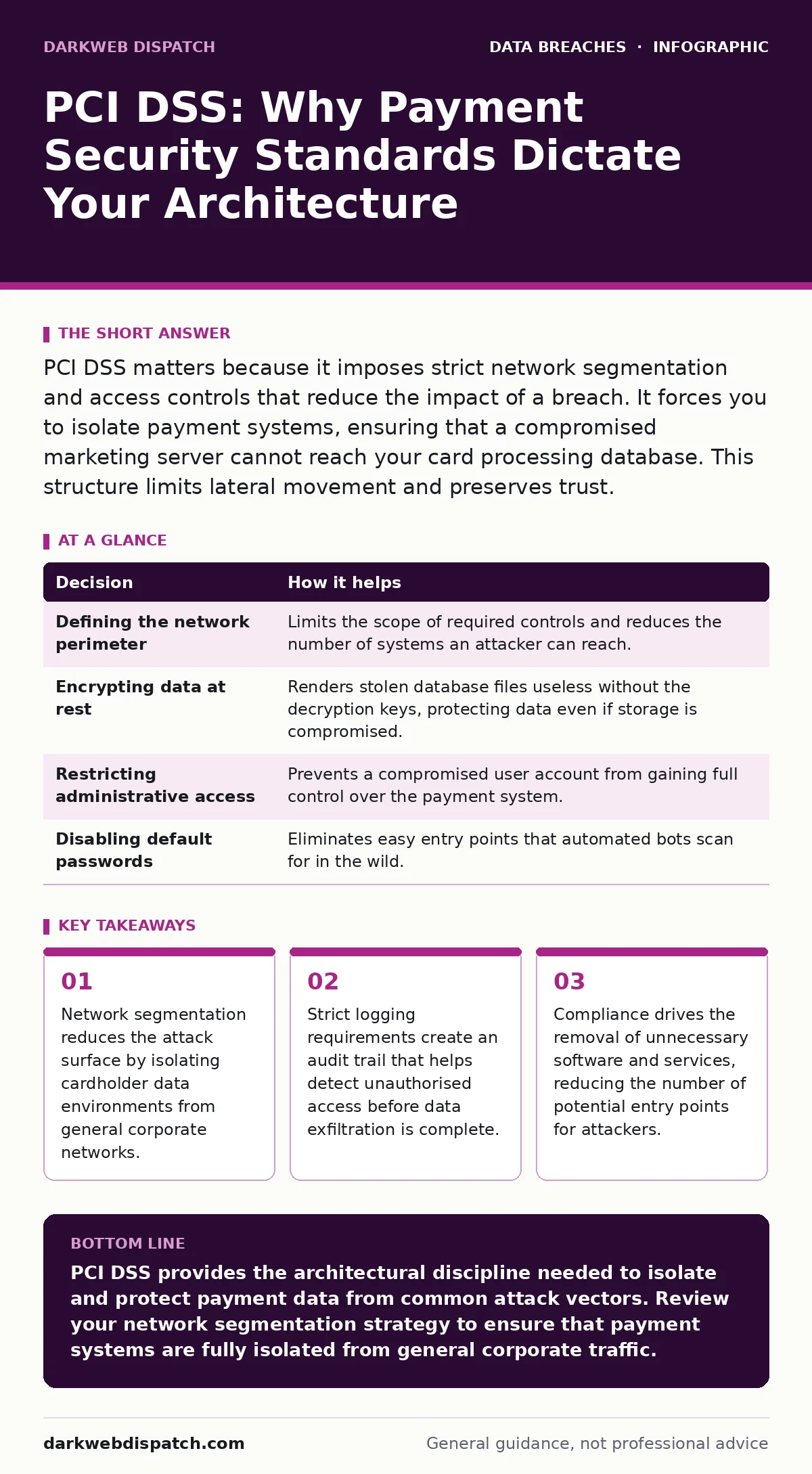
PCI DSS matters because it imposes strict network segmentation and access controls that reduce the impact of a breach. It forces you to isolate payment systems, ensuring that a compromised marketing server cannot reach your card processing database. This structure limits lateral movement and preserves trust.
The Architecture of Isolation
Payment card industry standards are not merely a checklist for auditors. They are a structural mandate that forces you to rethink how data moves through your organisation. When you handle payment information, you accept a liability that extends beyond your own infrastructure. The standard requires you to build walls around the systems that process, store or transmit this data. These walls are not metaphorical. They are firewall rules, access controls and encrypted channels that separate sensitive workloads from the rest of your environment.
Most organisations start with a flat network where every server can talk to every other server. This convenience becomes a security disaster when a low-value target, such as a public-facing web server, is compromised. Without segmentation, an attacker can pivot from that entry point to your database containing customer records. The standard mandates that you break these default connections. You must define exactly which systems need to communicate and block everything else. This process, known as network segmentation, is the cornerstone of defensible design.
Decisions Driven by Compliance
Implementing these standards requires difficult architectural choices. You cannot simply install a plugin and claim safety. You must decide where the boundary of your cardholder data environment lies. This boundary determines which systems fall under the strictest scrutiny. Every decision you make within this boundary has a cost in terms of complexity and operational overhead.
| Decision | How it helps |
|---|---|
| Defining the network perimeter | Limits the scope of required controls and reduces the number of systems an attacker can reach. |
| Encrypting data at rest | Renders stolen database files useless without the decryption keys, protecting data even if storage is compromised. |
| Restricting administrative access | Prevents a compromised user account from gaining full control over the payment system. |
| Disabling default passwords | Eliminates easy entry points that automated bots scan for in the wild. |
The Cost of Neglect
Imagine a team that ignores these structural requirements. They store credit card numbers in a plain-text file on a shared drive to speed up customer service refunds. They believe their internal network is safe because it is behind a firewall. This assumption fails when an employee receives a phishing email. The attacker gains access to the internal network and moves laterally to the shared drive. Because there is no segmentation, the attacker does not need to bypass additional defences. The data is exposed immediately.
This scenario highlights a hidden cost of non-compliance: the loss of forensic clarity. When a breach occurs in an unstructured environment, it is difficult to determine what was taken and when. Without mandatory logging and monitoring, you may not know you have been breached until customers report fraudulent charges. By then, the damage is done. The standard requires you to log access to sensitive data, creating a timeline that helps you respond quickly and accurately.
How Teams Operationalise Standards
Security teams use these standards as a baseline for their engineering practices. They do not view compliance as a separate project but as a continuous state of their infrastructure. Development teams integrate security checks into their code pipelines to ensure that new features do not introduce vulnerabilities. Operations teams configure servers to remove unnecessary services, reducing the attack surface. This discipline prevents technical debt from accumulating in the form of insecure configurations.
The standard also influences how teams manage third-party risk. You cannot outsource your liability. If a vendor has access to your payment systems, they must adhere to the same security controls. This requirement forces you to perform rigorous due diligence on your partners. You must verify that their security posture matches your own expectations. This process often reveals weaknesses in the supply chain that would otherwise remain hidden.
Beyond the Checkboxes
Many organisations treat compliance as a goal rather than a starting point. They build the minimum required controls to pass an audit and then ignore them. This approach leaves them vulnerable to sophisticated attacks that exploit gaps in their implementation. For instance, an organisation might encrypt data at rest but fail to protect the keys used for decryption. If an attacker steals the keys, the encryption provides no protection.
This is why understanding the mechanism is more valuable than ticking boxes. You must ensure that your encryption keys are stored separately from the encrypted data. You must rotate keys regularly to limit the value of a stolen key. You must monitor for unusual access patterns that might indicate an insider threat. These practices go beyond the basic requirements and provide genuine resilience.
See also: Wormable Vulnerabilities: What Small Businesses Need to Know · Zero-Day Vulnerabilities: Risks and Protection for Small Businesses
Integrating with Broader Security
Payment security does not exist in a vacuum. It intersects with other regulatory frameworks and security domains. For example, if you handle health data, you must align your controls with the HIPAA Security Rule. Both frameworks emphasise access control and audit trails, allowing you to build a unified security programme. Similarly, protecting payment systems requires robust secrets management to handle the keys and passwords that protect your data.
You must also consider the risk of shadow IT data exposure. Employees may use unapproved tools to process payments, bypassing your security controls. Regular audits help identify these rogue systems and bring them under governance. Furthermore, you must protect against email account compromise, which is often the first step in a social engineering attack targeting financial systems. By securing your email infrastructure, you reduce the likelihood of an attacker gaining initial access.
The Human Element
Technology alone cannot secure your payment systems. You must train your staff to recognise social engineering attempts. Phishing emails remain a primary vector for initial access. Employees who click on malicious links can hand over credentials to attackers. Training programmes must be regular and relevant, using realistic scenarios to prepare staff for real-world threats.
You must also enforce the principle of least privilege. Users should only have access to the systems they need to perform their jobs. This limits the damage if credentials are stolen. Regular reviews of access rights ensure that employees who change roles or leave the organisation do not retain unnecessary privileges. This discipline reduces the risk of insider threats and accidental data exposure.
Key takeaways
- Network segmentation reduces the attack surface by isolating cardholder data environments from general corporate networks.
- Strict logging requirements create an audit trail that helps detect unauthorised access before data exfiltration is complete.
- Compliance drives the removal of unnecessary software and services, reducing the number of potential entry points for attackers.
PCI DSS provides the architectural discipline needed to isolate and protect payment data from common attack vectors. Review your network segmentation strategy to ensure that payment systems are fully isolated from general corporate traffic.
Frequently asked questions
Does compliance guarantee that my payment data is safe?
No, compliance reduces risk by enforcing best practices, but it does not eliminate all threats. You must continue to monitor for new vulnerabilities and update your defences accordingly.
How often should I review my security controls?
You should review controls continuously, with formal assessments at least annually. Regular testing ensures that your defences remain effective against evolving threats.
Can I outsource compliance responsibilities to a vendor?
You can outsource tasks, but you remain responsible for ensuring that your vendors meet the required standards. You must verify their security posture through regular assessments.
What is the first step in achieving compliance?
Define the scope of your cardholder data environment. Identify all systems that process, store or transmit payment data and ensure they are properly segmented.
How this guide was produced: written by the DarkWeb Dispatch editorial team with AI assistance, checked against the public references listed below, and reviewed when the facts change. See our editorial policy or report an error.