CEO Fraud Prevention Checklist: Stop Impersonation Attacks
Financial controls fail when verification relies on digital channels alone, allowing attackers to bypass standard authentication through social engineering.

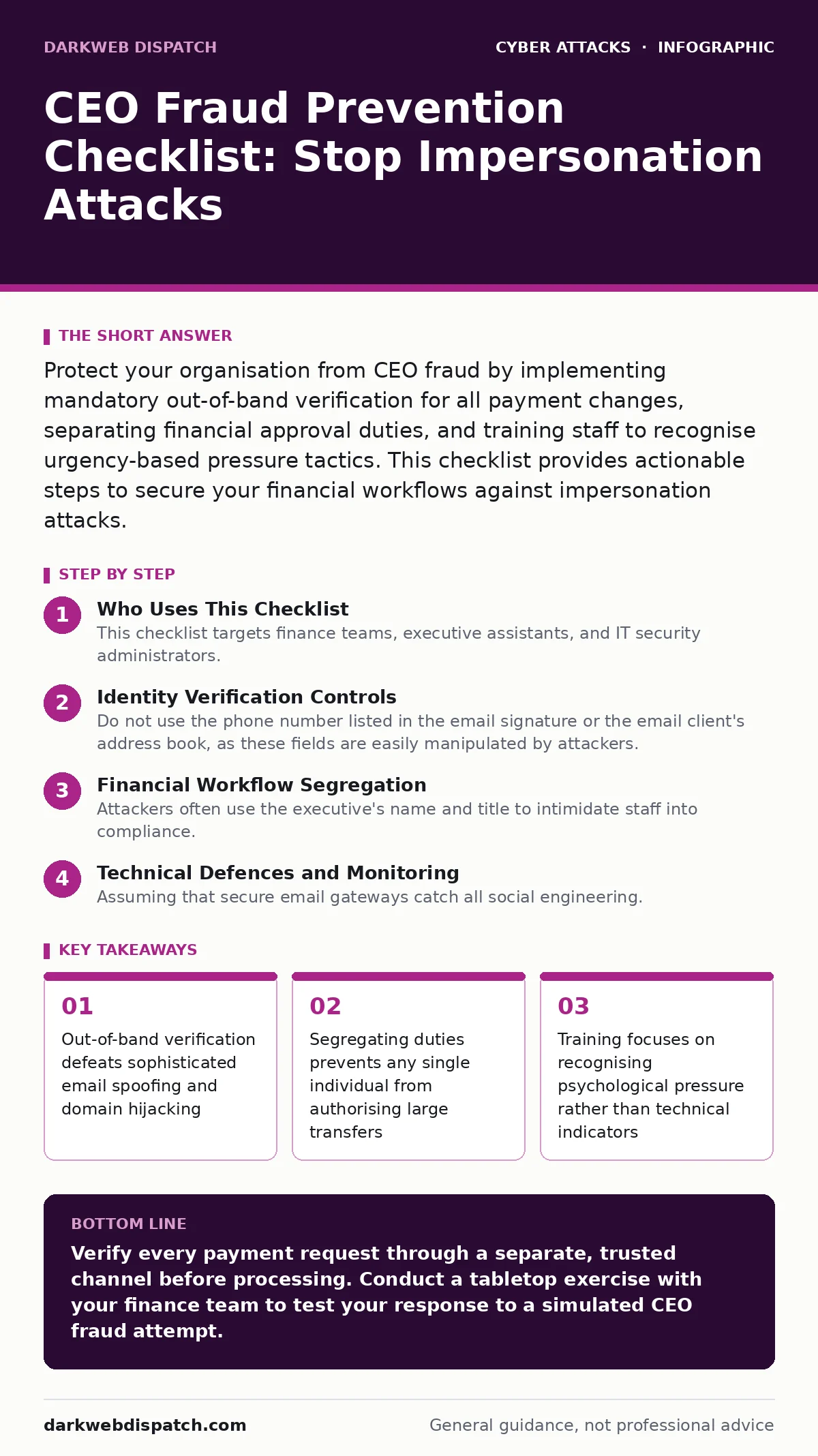
Protect your organisation from CEO fraud by implementing mandatory out-of-band verification for all payment changes, separating financial approval duties, and training staff to recognise urgency-based pressure tactics. This checklist provides actionable steps to secure your financial workflows against impersonation attacks.
Who Uses This Checklist
This checklist targets finance teams, executive assistants, and IT security administrators. You use it to audit your current payment workflows and identify gaps where an attacker could intercept or mimic instructions. The goal is to slow down urgent requests. Speed is the attacker’s primary weapon. Slowing the process allows time for verification. Review these items quarterly. Update procedures when staff change roles. Treat every payment request as potentially compromised until verified through a secondary channel.
Identity Verification Controls
- Mandate out-of-band verification for all new bank details: Digital communications can be spoofed or compromised, so verifying via a separate, pre-established phone line ensures the request originates from the genuine executive.
- Maintain a verified contact directory for key personnel: Attackers often pose as familiar colleagues, so having a trusted list of direct numbers prevents reliance on email signatures or forwarded messages that may be falsified.
- Implement multi-factor authentication for email accounts: Standard passwords are easily stolen or guessed, so adding a second factor ensures that even if credentials are compromised, the attacker cannot access the inbox to stage an attack.
- Review related guidance on email spoofing: Understanding how attackers forge sender addresses helps you appreciate why visual inspection of an email header is insufficient for verifying identity.
Financial Workflow Segregation
- Require dual approval for transfers above a set threshold: Single points of failure allow an attacker who compromises one account to execute a transfer, so requiring two distinct approvals breaks the chain of command.
- Separate the requestor from the approver in payment systems: If the same person can create and approve a payment, they can bypass internal controls, so splitting these duties ensures independent scrutiny of every transaction.
- Limit access to banking portals by role: Broad access increases the risk surface, so restricting login rights to only those who need them reduces the chance of credential theft leading to financial loss.
- Audit access logs regularly for unusual activity: Monitoring who accesses financial systems and when helps detect compromised accounts early, allowing you to intervene before a fraudulent transfer is initiated.
- Consider network segmentation to isolate financial systems: Keeping finance servers on a separate network segment limits lateral movement if an attacker gains access to the general corporate network.
Psychological Pressure Recognition
- Train staff to identify urgency cues in communications: Attackers create false deadlines to bypass rational thought, so recognising phrases like "urgent" or "confidential" as potential red flags allows for a pause and verification.
- Establish a "cooling off" period for high-value requests: Immediate action is rarely required for legitimate business, so enforcing a mandatory wait time for large transactions allows time to verify the sender's identity through trusted channels.
- Encourage a culture where questioning authority is safe: Fear of offending senior management silences caution, so fostering an environment where employees feel comfortable challenging unusual requests prevents social engineering from succeeding.
- Simulate phishing and fraud scenarios regularly: Realistic practice helps staff recognise the subtle signs of impersonation, turning theoretical knowledge into instinctive defensive behaviour during an actual attack.
Technical Defences and Monitoring
- Deploy secure email gateways to filter malicious content: These systems scan incoming mail for known threats and suspicious patterns, reducing the likelihood that a fraudulent email reaches the user's inbox in the first place.
- Implement intrusion detection systems to monitor for anomalies: These tools analyse network traffic for unusual behaviour, such as a login from a new location, providing an early warning sign of a compromised account.
- Keep software and operating systems updated: Unpatched vulnerabilities provide entry points for attackers, so regular updates ensure that known security holes are closed, reducing the risk of initial compromise.
- Use password managers to enforce strong, unique credentials: Reusing passwords across services allows attackers to pivot between accounts, so unique, complex passwords managed by a dedicated tool prevent credential stuffing attacks.
- Review cyber hygiene practices across the organisation: Basic security habits, such as locking screens and avoiding suspicious links, form the foundation of a secure environment, reducing the overall risk of initial access.
Incident Response and Recovery
- Define clear procedures for suspected fraud: Knowing exactly who to contact and what steps to take when an attack is suspected reduces panic and ensures a swift, coordinated response to mitigate damage.
- Maintain relationships with your bank's fraud department: Banks can reverse transactions if alerted quickly, so having a direct line to their fraud team ensures you can act within the critical window for recovery.
- Document and analyse every incident: Learning from past attempts helps refine your defences, so keeping detailed records of how attacks were executed allows you to update your checklist and training materials accordingly.
- Communicate lessons learned to all staff: Transparency about recent attempts reinforces the importance of vigilance, showing employees that the threat is real and their role in prevention is valued.
- Review insurance coverage for cyber incidents: Financial losses from fraud can be devastating, so ensuring your insurance policy covers social engineering attacks provides a financial safety net if prevention fails.
Key takeaways
- Out-of-band verification defeats sophisticated email spoofing and domain hijacking
- Segregating duties prevents any single individual from authorising large transfers
- Training focuses on recognising psychological pressure rather than technical indicators
Verify every payment request through a separate, trusted channel before processing. Conduct a tabletop exercise with your finance team to test your response to a simulated CEO fraud attempt.
Frequently asked questions
What is out-of-band verification?
Out-of-band verification means confirming a request through a different communication channel than the one used to make the request. For example, if you receive an email asking for a payment, you call the sender on a known, trusted phone number to confirm the instruction.
Can secure email gateways prevent CEO fraud?
Secure email gateways can block emails with known malicious links or attachments, but they often cannot detect social engineering. A CEO fraud email typically contains no malware, just a persuasive message, so the gateway may allow it through.
Why is urgency used in these attacks?
Urgency triggers a stress response that bypasses rational thinking. When people feel pressured to act quickly, they are less likely to follow standard verification procedures or question the legitimacy of the request, making them easier to manipulate.
How often should I update my contact directory?
You should update your verified contact directory whenever staff change roles, leave the company, or change their contact details. Regular reviews, such as quarterly checks, ensure that the information remains accurate and that no outdated or false numbers are present.
How this guide was produced: written by the DarkWeb Dispatch editorial team with AI assistance, checked against the public references listed below, and reviewed when the facts change. See our editorial policy or report an error.