Third-party risk assessments: how to spot supply chain blind spots
Your vendors hold keys to your digital doors, and standard contracts rarely cover what happens when their security fails or their data is scraped.

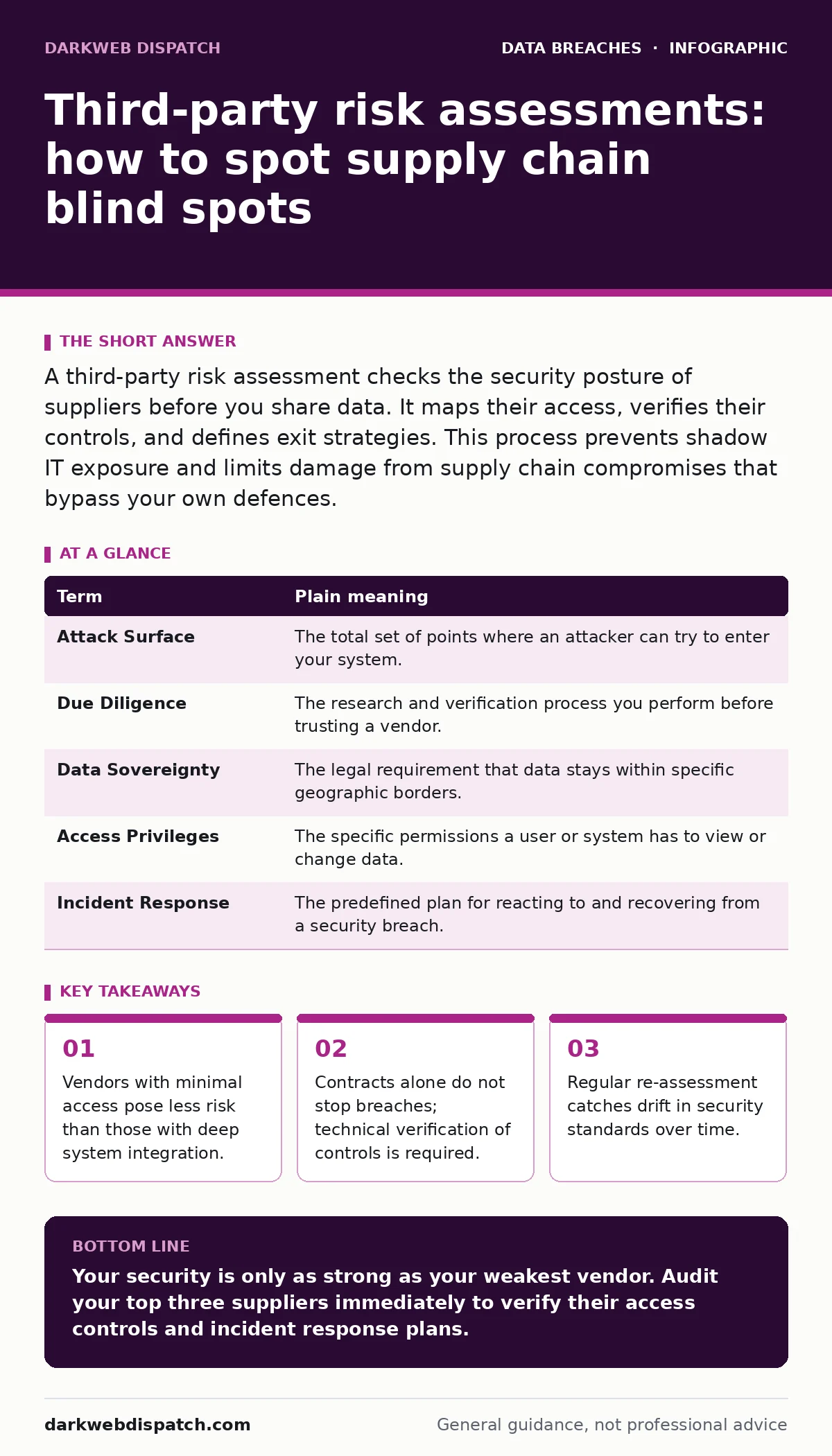
A third-party risk assessment checks the security posture of suppliers before you share data. It maps their access, verifies their controls, and defines exit strategies. This process prevents shadow IT exposure and limits damage from supply chain compromises that bypass your own defences.
The borrowed tool analogy
Imagine you are running a high-security archive. You do not build every lock yourself. Instead, you hire a specialist to maintain the climate control system. You trust them with a key to the server room. If their own office is burgled, and the thief copies that key, your archive is compromised. This is third-party risk. You are responsible for the breach, even though you did not hand the thief the key directly. The vulnerability existed in the chain of trust, not in your own walls.
Defining the exposure scope
You must identify which vendors have access to your data or systems. Not every supplier poses the same threat. A catering company poses negligible risk. A cloud provider hosting your customer database poses extreme risk. Map these connections clearly. This mapping reveals shadow IT data exposure where employees use unsanctioned tools that bypass your security checks. You cannot protect what you have not inventoried. Hidden integrations are the most common failure point.
The assessment checklist
An assessment is not a one-time event. It is a continuous verification of controls. You need to understand their incident response plans. You need to know how they handle employee offboarding. You need to verify their patch management cycles. If a vendor cannot answer these questions, they are a liability. This process aligns with frameworks like the HIPAA Security Rule for health data or PCI DSS for payment cards. These standards require you to prove due diligence regarding your partners.
| Term | Plain meaning |
|---|---|
| Attack Surface | The total set of points where an attacker can try to enter your system. |
| Due Diligence | The research and verification process you perform before trusting a vendor. |
| Data Sovereignty | The legal requirement that data stays within specific geographic borders. |
| Access Privileges | The specific permissions a user or system has to view or change data. |
| Incident Response | The predefined plan for reacting to and recovering from a security breach. |
The hidden cost of trust
Many organisations assume that signing a contract transfers risk. It does not. Legal liability remains with you. If a vendor suffers an email account compromise, attackers may use that access to pivot into your network. This is a supply chain attack. The vendor becomes a bridge for the attacker. You must verify that they use secrets management practices that rotate credentials regularly. Static passwords are a open door. Assume that shared credentials will be leaked eventually.
Practical verification steps
Do not rely on self-reported questionnaires. They are often outdated or inaccurate. Request proof of configuration. Ask for evidence of regular penetration testing. Check if they have been audited by independent third parties. If they refuse, treat this as a red flag. Transparency is a proxy for security maturity. Organisations with nothing to hide will share their security posture. Those who hesitate are likely hiding weaknesses.
Managing the lifecycle
Risk changes over time. A vendor that is secure today may be negligent tomorrow. They may merge with a less secure company. They may cut corners to save costs. You must schedule regular re-assessments. Annual reviews are a minimum. Critical vendors need quarterly checks. Monitor for news regarding their security incidents. If a vendor fails an assessment, you must have an exit strategy. Moving data away from a compromised partner is difficult if you have not planned for it.
The human element
Technology is only part of the equation. People make mistakes. Vendors may train staff poorly. They may ignore phishing attempts. You must assess their security culture. Do they conduct regular training? Do they have a clear reporting channel for suspicious activity? A strong technical defence is useless if an employee willingly hands over credentials. Human error is the weakest link in the chain. Address it by requiring proof of ongoing staff education.
Taking the first step
Start with your most critical data. Identify who touches it. Map the flow from entry to storage. Contact those vendors. Request their latest security documentation. Compare it against your own requirements. Note the gaps. Prioritise remediation for the highest risks. This process reduces the likelihood of data breach costs skyrocketing due to negligence. It builds a defensible position. You are not just checking boxes; you are hardening your supply chain.
Key takeaways
- Vendors with minimal access pose less risk than those with deep system integration.
- Contracts alone do not stop breaches; technical verification of controls is required.
- Regular re-assessment catches drift in security standards over time.
Your security is only as strong as your weakest vendor. Audit your top three suppliers immediately to verify their access controls and incident response plans.
Frequently asked questions
How often should I reassess third-party risks?
At least annually for standard vendors, and quarterly for those with access to sensitive data or critical infrastructure.
Do I need to assess every single supplier?
No. Focus on those with access to your network, data, or sensitive operational systems. Low-risk suppliers require minimal due diligence.
What if a vendor refuses to share security details?
Treat this as a significant risk. Consider finding an alternative vendor. Lack of transparency usually indicates poor security hygiene.
Can I automate third-party risk assessments?
You can automate data collection and scoring, but human review is necessary to interpret context and verify the validity of the controls.
How this guide was produced: written by the DarkWeb Dispatch editorial team with AI assistance, checked against the public references listed below, and reviewed when the facts change. See our editorial policy or report an error.