Blue Team Myths: Correcting Common Misunderstandings
Blue teams do not hunt threats in real time; they manage detection logic and respond to alerts generated by automated systems.

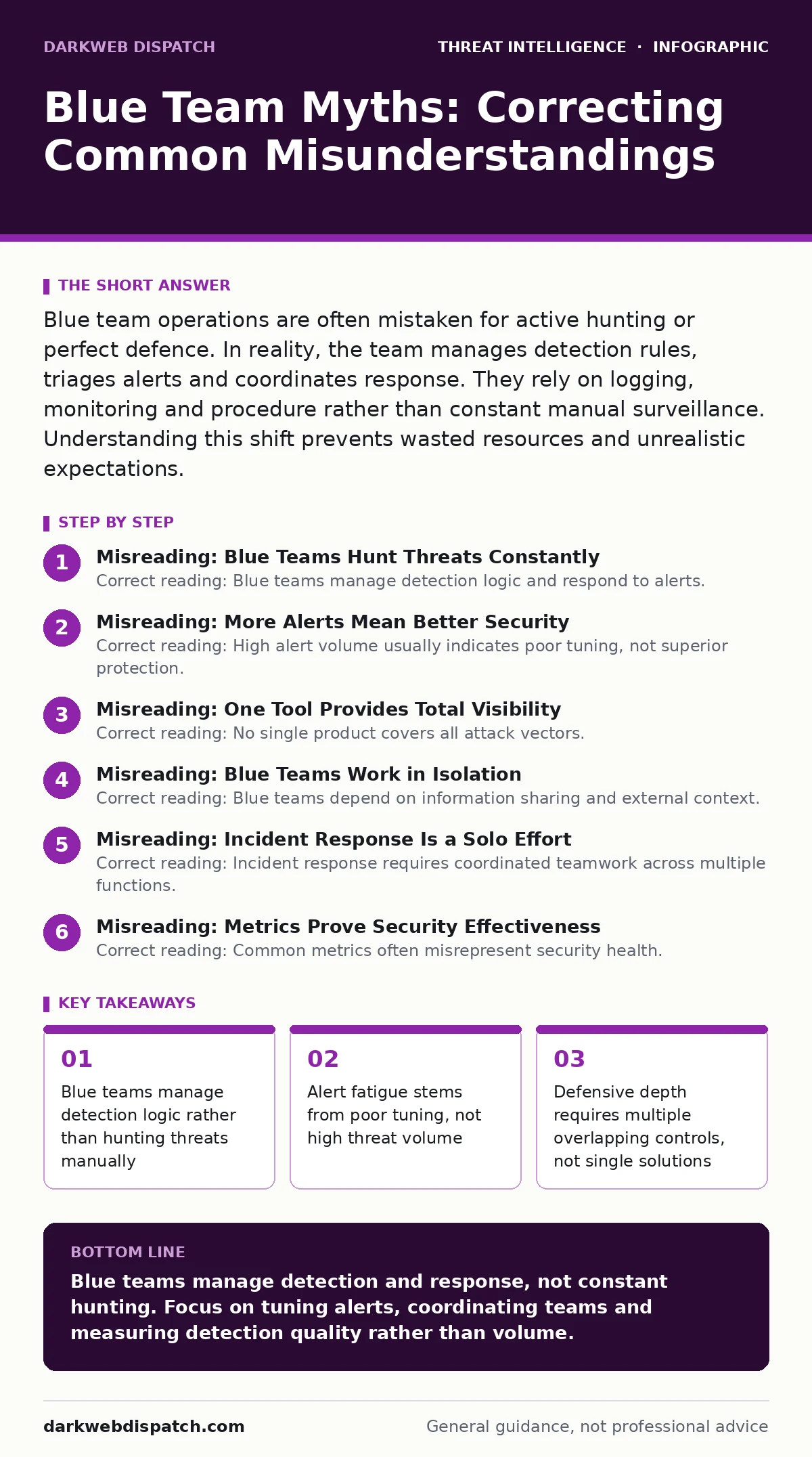
Blue team operations are often mistaken for active hunting or perfect defence. In reality, the team manages detection rules, triages alerts and coordinates response. They rely on logging, monitoring and procedure rather than constant manual surveillance. Understanding this shift prevents wasted resources and unrealistic expectations.
Misreading: Blue Teams Hunt Threats Constantly
Correct reading: Blue teams manage detection logic and respond to alerts. They do not sit watching network traffic for anomalies in real time. Modern environments generate too much data for human eyes to scan effectively. The team’s primary job is to configure sensors, tune detection rules and triage the output.
They react to what the system flags, rather than proactively searching for hidden adversaries across the entire infrastructure. This distinction matters because it changes how you allocate staff. You need analysts who can interpret alerts, not just watch screens. Expecting constant hunting leads to burnout and missed signals. The system does the watching; the team does the judging.
Misreading: More Alerts Mean Better Security
Correct reading: High alert volume usually indicates poor tuning, not superior protection. A well-configured system suppresses noise and highlights genuine anomalies. When you receive hundreds of alerts daily, your team suffers from alert fatigue. They begin to ignore warnings, assuming most are false positives.
This blindness creates gaps that attackers exploit. The goal is precision, not quantity. You should aim for a manageable number of high-fidelity alerts. Each alert must contain enough context for an analyst to decide on action. Reducing noise improves response speed and accuracy. Quality of detection matters more than the sheer volume of warnings generated by your security tools.
Misreading: One Tool Provides Total Visibility
Correct reading: No single product covers all attack vectors. Attackers use multiple techniques, from network exploits to social engineering. Relying on one solution leaves blind spots. You need a layered approach that combines different data sources. Endpoint detection monitors device activity. Network sensors watch traffic patterns. Identity logs track user behaviour.
Each layer catches different threats. For example, a firewall might stop external intrusion but miss insider misuse. Combining these views gives a clearer picture. This concept aligns with the Unified Kill Chain, which emphasises disrupting attacks at multiple stages. You must integrate data from various sources to detect complex threats.
Misreading: Blue Teams Work in Isolation
Correct reading: Blue teams depend on information sharing and external context. They do not operate in a vacuum. Threat actors change tactics rapidly. Local teams cannot track every new technique alone. Sharing anonymised data with peers helps everyone adapt faster. Participation in ISACs allows organisations to exchange indicators of compromise and tactical advice.
This collective defence strengthens individual security postures. It also provides context for local alerts. An alert that seems minor might be part of a broader campaign. External intelligence helps prioritise response efforts. Collaboration turns isolated data points into actionable intelligence. You gain insights that your own logs cannot provide.
Misreading: Incident Response Is a Solo Effort
Correct reading: Incident response requires coordinated teamwork across multiple functions. A single analyst cannot handle containment, eradication and recovery alone. You need legal, communications, human resources and IT operations involved. Each group plays a specific role. Legal ensures compliance and evidence preservation. Communications manage external messaging.
HR handles insider threats. IT operations assists with containment actions. The blue team leads the technical response but relies on others for success. Clear roles and procedures prevent chaos during a crisis. Practice these interactions regularly. Without coordination, technical fixes fail due to procedural gaps. Response is a organisational capability, not just a technical one.
See also: Network Traffic Analysis: Fixing 6 Common Misconceptions · Unified Kill Chain: Why Fragmented Threat Models Fail Your Defences
Misreading: Metrics Prove Security Effectiveness
Correct reading: Common metrics often misrepresent security health. Counting blocked attacks sounds impressive but ignores what went undetected. This creates a false sense of security. Better metrics measure detection time and response quality. How long did it take to identify an intruder? How effectively was the threat contained? These measures reflect actual capability. You should also track false positive rates. High rates waste resources and reduce trust in the system. Focus on outcomes, not inputs. Measuring the effectiveness of your detection logic provides a truer picture than counting blocked events.
Misreading: Blue Teams Prevent All Breaches
Correct reading: Blue teams reduce risk and limit damage, but they cannot stop every attack. Attackers find ways around controls. The goal is to detect and respond quickly enough to minimise impact. This mindset shift is critical. You accept that breaches may occur. You prepare for them. This approach is known as defence in depth. It involves multiple layers of control. If one layer fails, another catches the threat. For instance, if an attacker uses pass-the-hash attacks to move laterally, endpoint detection might still flag unusual process behaviour. You cannot prevent all entry, but you can limit movement. Focus on resilience and recovery.
Misreading: Automation Replaces Human Analysts
Correct reading: Automation handles routine tasks, but humans make complex decisions. Scripts can block known bad IPs or reset passwords. They cannot judge context or intent. An alert might look malicious but stem from a legitimate administrative action. Humans interpret nuance. They investigate edge cases that automation misses. For example, LSASS credential theft might trigger alerts that require manual analysis to confirm. Automation speeds up response to known patterns. It frees analysts to focus on sophisticated threats. You need both. Automation without human oversight leads to errors. Humans without automation face overload. Balance is key.
Misreading: Blue Teams Only Focus on External Threats
Correct reading: Insider threats and accidental errors pose significant risks. Blue teams monitor internal activity as closely as external traffic. Employees might accidentally expose data or fall for phishing. Malicious insiders can steal information or sabotage systems. Detection logic must cover both scenarios.
You need to monitor privileged account usage, data access patterns and unusual file transfers. Internal threats are harder to detect because they have legitimate access. They do not trigger perimeter alerts. You must establish baselines for normal behaviour. Deviations from these baselines signal potential issues. Internal monitoring is as important as external defence.
Misreading: Blue Teams Do Not Need Threat Intelligence
Correct reading: Threat intelligence informs detection and response. It provides context about attacker tactics, techniques and procedures. You use this information to update your detection rules. For example, threat intelligence reports might highlight a new malware variant. You can then create a signature to detect it. Intelligence helps you prioritise alerts. It tells you which threats are most relevant to your industry. It also helps you understand the broader landscape. You are not just reacting to alerts; you are anticipating attacks. This proactive stance improves your defensive posture. Intelligence turns raw data into actionable insights.
Key takeaways
- Blue teams manage detection logic rather than hunting threats manually
- Alert fatigue stems from poor tuning, not high threat volume
- Defensive depth requires multiple overlapping controls, not single solutions
- Incident response is a coordinated process, not a solo hero effort
Blue teams manage detection and response, not constant hunting. Focus on tuning alerts, coordinating teams and measuring detection quality rather than volume.
Frequently asked questions
How do I know if my blue team is effective?
Measure detection time and response accuracy. Look at how quickly they identify and contain threats. Check if false positives are decreasing over time.
What is the role of threat intelligence in blue team operations?
It provides context on attacker tactics. You use this information to update detection rules and prioritise alerts. It helps anticipate attacks rather than just reacting.
Should I automate all incident response tasks?
No. Automate routine tasks like blocking known bad IPs. Keep human analysts for complex decisions and context interpretation. Balance automation with human judgment.
How does blue team differ from red team?
Blue teams defend and respond to attacks. Red teams simulate attacks to test defences. Both roles improve security by identifying weaknesses and validating controls.
How this guide was produced: written by the DarkWeb Dispatch editorial team with AI assistance, checked against the public references listed below, and reviewed when the facts change. See our editorial policy or report an error.