How Citrix NetScaler Flaws Work: The Attack Chain Explained
NetScaler breaches often bypass perimeter defences by exploiting how the application delivery controller processes untrusted input before authentication occurs.

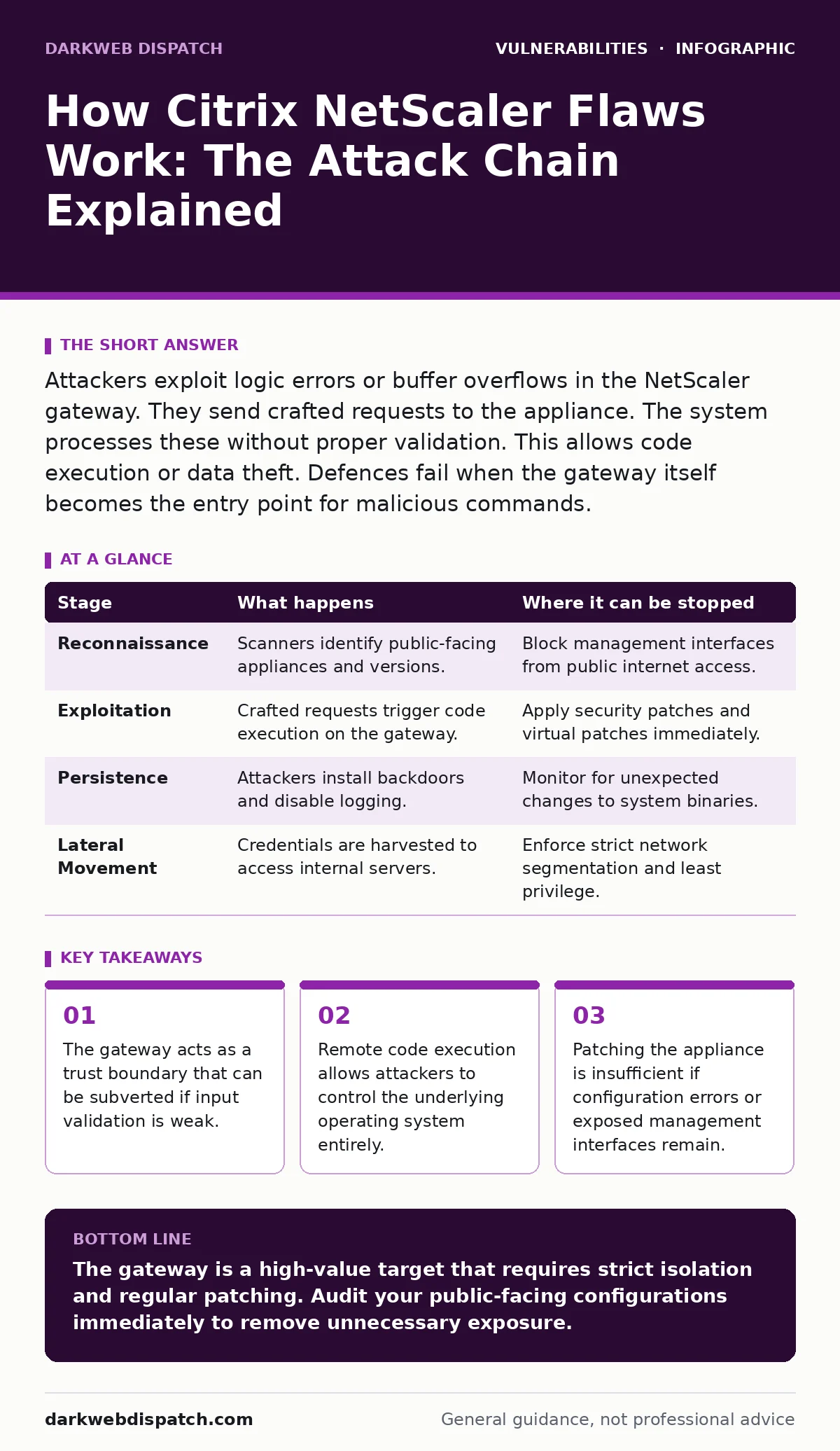
Attackers exploit logic errors or buffer overflows in the NetScaler gateway. They send crafted requests to the appliance. The system processes these without proper validation. This allows code execution or data theft. Defences fail when the gateway itself becomes the entry point for malicious commands.
The Gateway Trust Model
Citrix NetScaler functions as an application delivery controller. It sits between external users and internal corporate resources. You rely on it to authenticate users and encrypt traffic. The device terminates SSL connections and forwards requests to backend servers. This architecture creates a specific trust model. The gateway assumes authority over the traffic it processes. It decides which requests are valid and which should be blocked.
This centralised control point is powerful for administration. It also creates a single point of failure for security. If the gateway software contains a flaw, the entire perimeter is compromised. The device processes packets before the backend applications see them. This means vulnerabilities in the gateway can bypass application-level security controls entirely. You must treat the gateway as untrusted code that executes on your behalf.
Stage 1: Reconnaissance and Target Identification
Attackers begin by scanning the internet for exposed NetScaler appliances. They look for specific server headers or default login pages. Many organisations leave the management interface accessible to the public internet. This is a common configuration error. Attackers use automated tools to identify the version of the software running. Knowing the version allows them to select known exploits. They do not need to guess. Public databases list vulnerabilities for each release.
This stage is passive and leaves little trace. You might see increased traffic from unknown IP addresses. These scans are routine and often ignored by standard monitoring. The attacker maps the network topology by observing how the gateway responds to different requests. They identify whether multi-factor authentication is enforced. They check if the management port is open on the external interface. This information shapes the next phase of the attack.
Stage 2: Initial Exploitation
The attacker sends a carefully crafted request to the identified vulnerability. This request might contain malicious code or malformed data. The flaw could be a buffer overflow or an injection error. The gateway attempts to process this input. The software fails to validate the data correctly. This failure allows the attacker to execute arbitrary commands. The execution happens on the gateway operating system. This is remote code execution. The attacker gains a shell or a command prompt on the device.
They now have the same privileges as the system administrator. This step relies on the software trusting the input format. It does not require credentials. The vulnerability exists in the code that handles the connection. It triggers before the user is authenticated. This is why patching is critical. Unpatched versions remain vulnerable to these specific payloads. The attacker may use a script to automate this step. They send the payload and wait for a response. If the gateway crashes or responds unexpectedly, the exploit worked.
| Stage | What happens | Where it can be stopped |
|---|---|---|
| Reconnaissance | Scanners identify public-facing appliances and versions. | Block management interfaces from public internet access. |
| Exploitation | Crafted requests trigger code execution on the gateway. | Apply security patches and virtual patches immediately. |
| Persistence | Attackers install backdoors and disable logging. | Monitor for unexpected changes to system binaries. |
| Lateral Movement | Credentials are harvested to access internal servers. | Enforce strict network segmentation and least privilege. |
Stage 3: Establishing Persistence
Once inside, the attacker wants to stay. They modify system files to maintain access. They may create new user accounts with administrative rights. They disable security logging to hide their activity. This makes detection difficult. The attacker installs a backdoor. This could be a hidden web shell or a reverse tunnel. They ensure that even if you patch the original vulnerability, they can still enter. This stage exploits the administrative access gained earlier.
The attacker has full control over the file system. They can replace legitimate binaries with malicious versions. This is known as binary substitution. It undermines the integrity of the system. You cannot trust the output of a compromised gateway. Any traffic passing through it is subject to interception. The attacker may also harvest credentials stored in memory. These credentials allow access to other systems. The gateway often holds session tokens for many users.
Stage 4: Credential Harvesting
The gateway handles authentication for many services. It stores session tokens and sometimes cached credentials. Attackers target this data. They dump memory to find plaintext passwords or tokens. They extract configuration files that contain secrets. This information is valuable for further attacks. The attacker uses these credentials to move laterally. They access internal servers that the gateway protects. This breaks the perimeter model.
The internal network is no longer safe. The attacker assumes the identity of legitimate users. They bypass internal security controls that trust the gateway. This is why segmentation is vital. The gateway should not have direct access to sensitive databases. It should only forward authenticated requests. If the gateway is compromised, the attacker inherits its trust. They can access any backend resource the gateway can reach. This amplifies the impact of the initial breach.
Stage 5: Lateral Movement and Data Exfiltration
With credentials and internal access, the attacker expands their reach. They move from the gateway to other servers. They look for sensitive data or high-value assets. They may install additional malware on internal systems. The goal is often data theft or ransomware deployment. The attacker uses the compromised gateway as a pivot point. They tunnel traffic through it to avoid detection. This makes the internal attack look like legitimate web traffic.
Defences that monitor internal traffic may miss this activity. The gateway is trusted, so its traffic is often allowed. The attacker exfiltrates data slowly to avoid alerts. They compress and encrypt the stolen data. This hides the content from inspection tools. The breach is now deep inside the network. Containing it requires isolating the compromised systems. You must revoke all credentials issued by the gateway. This disrupts legitimate users but stops the attack.
Interrupting the Attack Chain
You can stop this process at multiple points. Blocking public access to the management interface prevents the initial scan. This is a simple configuration change. It removes the target from the attacker's view. Applying patches closes the known vulnerabilities. This stops the exploitation stage. You must update the firmware regularly. Delaying updates leaves the system exposed. Monitoring for unexpected changes helps detect persistence. Look for new user accounts or modified binaries.
Network segmentation limits lateral movement. The gateway should not connect directly to critical databases. Use a jump server or bastion host for management. This adds an extra layer of authentication. Reviewing access logs can reveal reconnaissance activity. Look for repeated failed login attempts. These are signs of scanning. Implementing out-of-band patches can help when immediate updates are not possible. This provides a temporary mitigation. It filters malicious requests before they reach the vulnerable code.
Beyond the Gateway
Securing the gateway is only part of the solution. You must consider the broader ecosystem. Browser extension vulnerabilities can be used to steal session cookies. These cookies allow attackers to bypass the gateway authentication. Directory listing exposure on backend servers can reveal sensitive files. If the attacker gains access, they can exploit these weaknesses. Web cache poisoning can be used to serve malicious content to other users. This amplifies the impact of the breach.
Disputed and rejected CVEs may still pose a risk if the vendor ignores them. You must assess these risks independently. EPSS percentiles help prioritise which vulnerabilities to patch first. Focus on those with high exploitability scores. WordPress plugin update policies are irrelevant here, but the concept of regular updates applies. Broken object level authorization (BOLA) is a common web flaw. It is different from gateway flaws but often co-exists. Ensure your backend applications are secure too. A strong gateway cannot protect a weak application.
Key takeaways
- The gateway acts as a trust boundary that can be subverted if input validation is weak.
- Remote code execution allows attackers to control the underlying operating system entirely.
- Patching the appliance is insufficient if configuration errors or exposed management interfaces remain.
The gateway is a high-value target that requires strict isolation and regular patching. Audit your public-facing configurations immediately to remove unnecessary exposure.
Frequently asked questions
Can a firewall stop a NetScaler exploit?
No, because the traffic appears as legitimate web requests. Firewalls inspect ports and protocols, not application logic errors.
How do I know if my gateway is compromised?
Look for unexpected changes to system files, new user accounts, or unusual outbound traffic patterns.
Is disabling the management interface enough?
It reduces risk significantly but does not protect against vulnerabilities in the data processing path.
How often should I patch the gateway?
Apply critical security patches as soon as they are available. Delay increases the window of exposure.
How this guide was produced: written by the DarkWeb Dispatch editorial team with AI assistance, checked against the public references listed below, and reviewed when the facts change. See our editorial policy or report an error.