IoT Vulnerability Lifecycle: From Physical Access to Data Theft
Most IoT compromises bypass network defences entirely by exploiting weak physical interfaces and unpatched firmware stored in non-volatile memory chips.

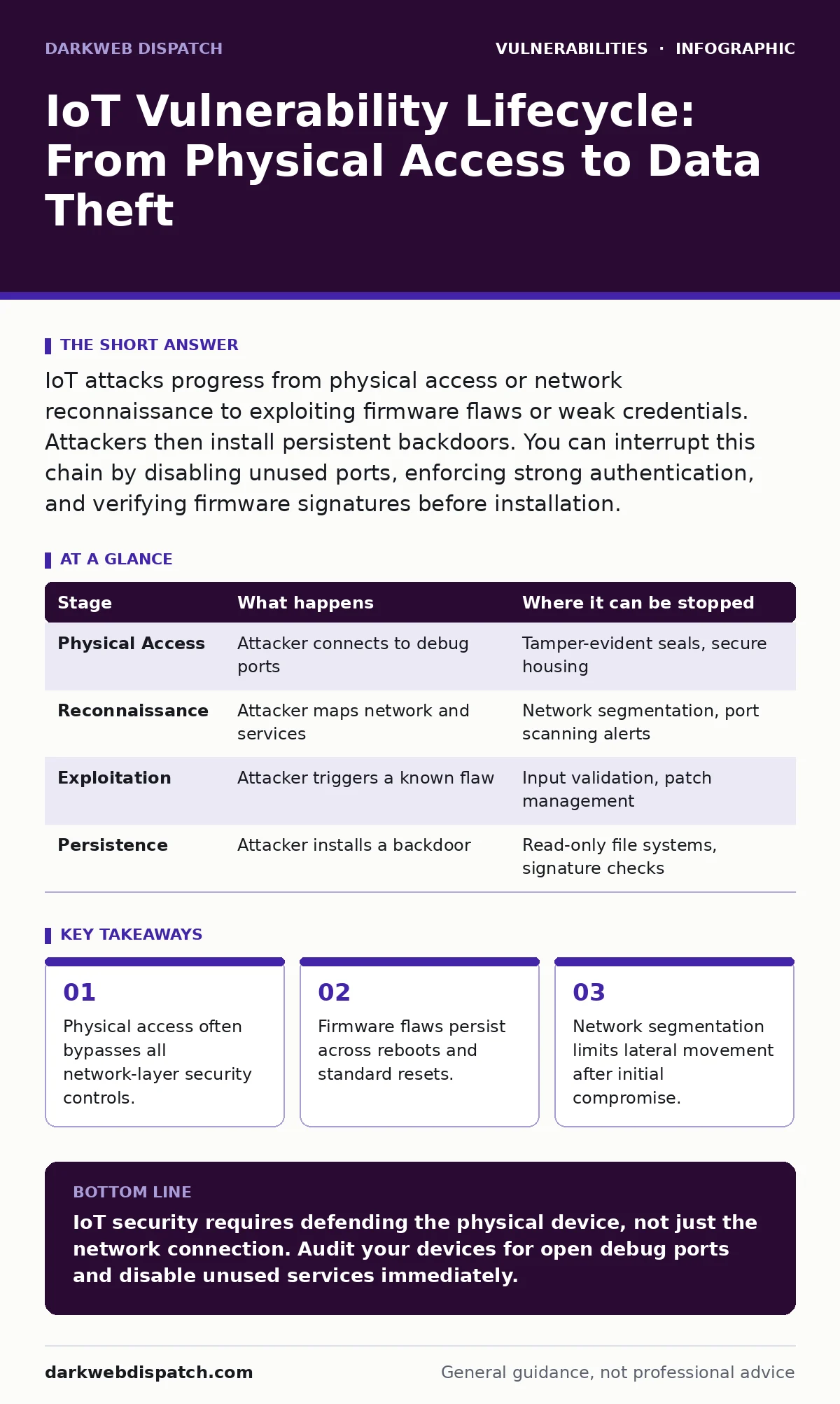
IoT attacks progress from physical access or network reconnaissance to exploiting firmware flaws or weak credentials. Attackers then install persistent backdoors. You can interrupt this chain by disabling unused ports, enforcing strong authentication, and verifying firmware signatures before installation.
The Physical Attack Vector
Many users assume that if a device is behind a firewall, it is safe. This assumption fails when an attacker can touch the device. Smart cameras, doorbells and industrial sensors often expose debugging interfaces for manufacturing convenience. These ports remain active in the final product.
Imagine a technician gains access to a server room or a thief steals a smart lock. They connect a cable directly to the device’s serial debug port. This port often grants root-level access to the operating system. No password is required because the manufacturer removed the authentication step to speed up production testing.
| Stage | What happens | Where it can be stopped |
|---|---|---|
| Physical Access | Attacker connects to debug ports | Tamper-evident seals, secure housing |
| Reconnaissance | Attacker maps network and services | Network segmentation, port scanning alerts |
| Exploitation | Attacker triggers a known flaw | Input validation, patch management |
| Persistence | Attacker installs a backdoor | Read-only file systems, signature checks |
Network Reconnaissance and Enumeration
If physical access is impossible, the attacker turns to the network. They scan your local subnet for open ports and running services. IoT devices often run unnecessary services like Telnet, FTP or UPnP to simplify setup. Each open port is a potential entry point.
The attacker identifies the device model and firmware version by reading the banner information sent during the handshake. This information allows them to look up known vulnerabilities for that specific version. They do not need to guess; they simply match the version to a database of public exploits.
You can interrupt this stage by hiding unnecessary services. Disable any protocol you do not actively use. Change default ports if the application allows it, as this stops automated scanners from immediately identifying the software.
Exploiting Firmware and Memory Flaws
Once a target is identified, the attacker sends a specially crafted packet to trigger a flaw. Common issues include buffer overflows, where input exceeds the allocated memory space, or use-after-free vulnerabilities, where code accesses memory that has already been released.
These flaws allow the attacker to execute arbitrary code on the device. The device’s processor follows the attacker’s instructions instead of its intended program logic. This often happens in the network stack or the web interface handling routine.
Credential Harvesting and Weak Auth
Many IoT devices rely on weak authentication mechanisms. Default credentials like "admin/admin" are still common because users rarely change them. Even when passwords are changed, many devices use weak hashing algorithms that can be cracked offline.
The attacker captures the login traffic or extracts the password hash from the device’s memory. They then use brute-force tools to guess the password. If the device lacks rate limiting, they can try thousands of combinations per second without being locked out.
To stop this, enforce strong, unique passwords and disable default accounts. Implement account lockout policies after failed attempts. Use multi-factor authentication where supported, as this adds a layer that cannot be bypassed by stealing a password hash.
Establishing Persistence and Backdoors
After gaining control, the attacker ensures they can return even if you reboot the device. They modify the startup scripts or install a rootkit, which hides their presence from standard system tools. The device now reports normal status while secretly sending data.
This persistence is often stored in the firmware flash memory. Standard reboots do not clear it. Only a full firmware reflash or a factory reset might remove the backdoor, depending on how deeply the attacker has embedded their code.
See also: Zero-Day Vulnerabilities: Risks and Protection for Small Businesses · Network Segmentation for Small Business: Stop Lateral Movement
Lateral Movement and Data Exfiltration
The compromised device is now a foothold inside your network. The attacker uses it to scan for other devices, such as computers or servers. They move laterally, exploiting trust relationships between devices to gain higher privileges.
Data is exfiltrated in small, steady streams to avoid detection. This might include passwords, personal documents or industrial control signals. The traffic often looks like normal web browsing or DNS queries, making it hard to spot.
Segment your network to limit this movement. Place IoT devices on a separate VLAN that cannot initiate connections to your main computer network. This containment strategy stops the attacker from reaching critical assets.
Mitigation and Long-Term Resilience
There is no single fix for IoT vulnerabilities. You must combine physical security, network segmentation and strict update policies. Regularly check for firmware updates, but verify their integrity first.
Consider the lifecycle of the device. When the manufacturer stops providing security patches, the device becomes a permanent risk. Plan to replace devices that no longer receive updates.
For deeper technical context, see our guides on firmware vulnerabilities and out-of-band patches. Understanding how input validation fails helps you appreciate why simple text fields can crash complex systems.
Key takeaways
- Physical access often bypasses all network-layer security controls.
- Firmware flaws persist across reboots and standard resets.
- Network segmentation limits lateral movement after initial compromise.
IoT security requires defending the physical device, not just the network connection. Audit your devices for open debug ports and disable unused services immediately.
Frequently asked questions
Can resetting an IoT device remove a malware infection?
A factory reset may remove software-based malware, but it often fails to clear rootkits stored in the firmware partition. A full reflash from a trusted source is safer.
Is Wi-Fi isolation enough to protect IoT devices?
Wi-Fi isolation prevents devices from talking to each other, but it does not stop them from communicating with the internet or the router. You still need to secure the router itself.
How do I know if my IoT device has been compromised?
Look for unusual network traffic, unexpected reboots or changes in device behaviour. Monitor DNS queries for connections to unknown domains.
Are smart home hubs more secure than individual devices?
Hubs can centralise security controls, but they also become a single point of failure. If the hub is compromised, all connected devices may be at risk.
How this guide was produced: written by the DarkWeb Dispatch editorial team with AI assistance, checked against the public references listed below, and reviewed when the facts change. See our editorial policy or report an error.