Use-After-Free Vulnerabilities: Step-by-Step Mechanism and Defences
Use-after-free flaws allow attackers to repurpose discarded memory, turning routine program operations into vectors for remote code execution without external exploits.
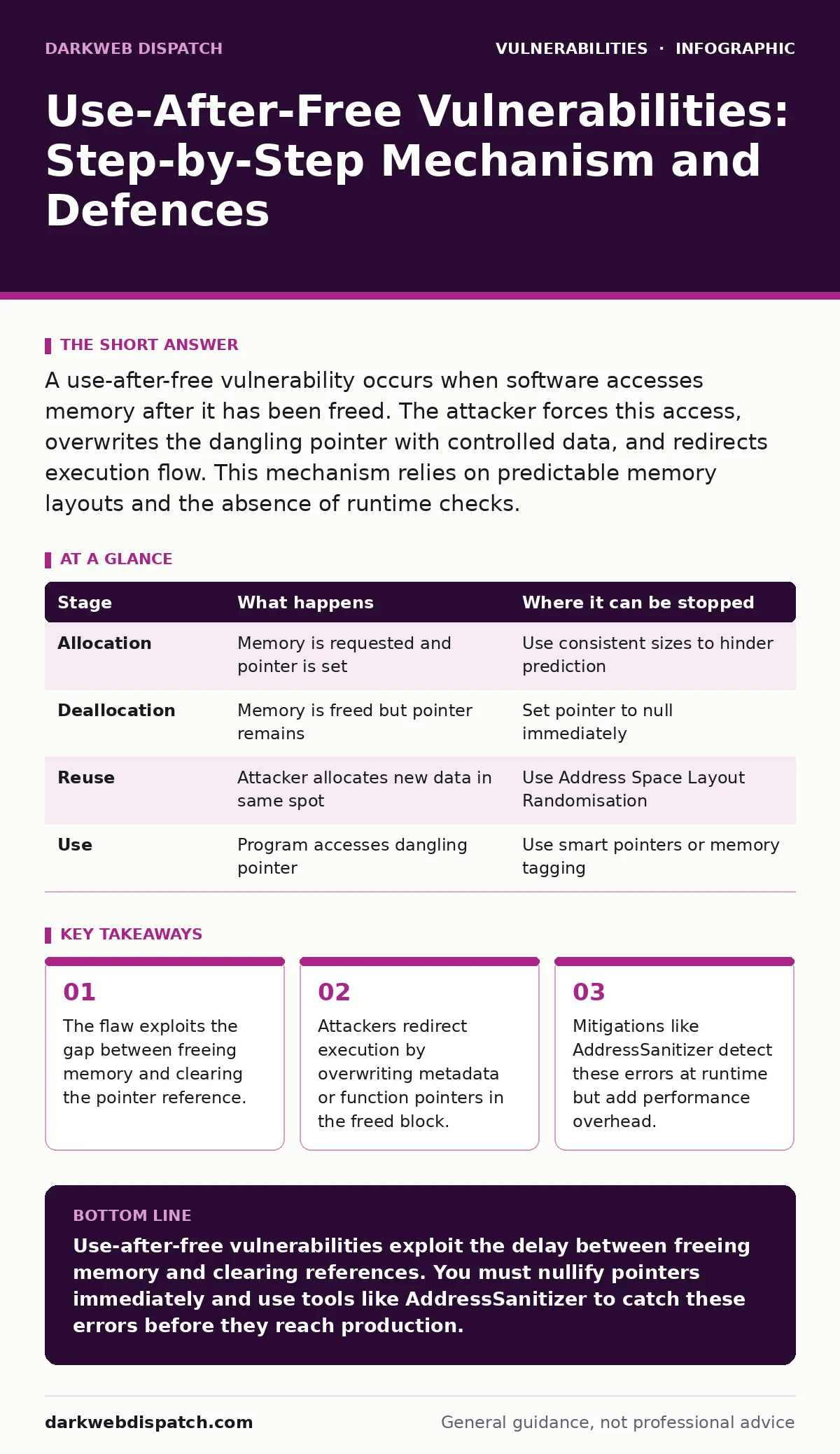
A use-after-free vulnerability occurs when software accesses memory after it has been freed. The attacker forces this access, overwrites the dangling pointer with controlled data, and redirects execution flow. This mechanism relies on predictable memory layouts and the absence of runtime checks.
The Mechanics of Memory Management
Modern operating systems manage memory dynamically. When a program needs space, it requests a block from the heap. The heap is a region of memory used for dynamic allocation during execution. When the program no longer needs that block, it returns it to the system. This process is called freeing.
The system marks the block as available for future use. It does not erase the data inside. The data remains there until new information overwrites it. The pointer variable that previously held the address of this block still exists. Unless the programmer explicitly sets this pointer to null, it continues to point to the same address. This creates a dangling pointer.
Imagine a library that returns a book to the shelf but keeps the checkout card in your pocket. The card still says the book is at aisle four. If you go to aisle four, you expect the book to be there. But the library has already given that space to a different patron. You are now interacting with the wrong book.
Stage One: Allocation and Usage
The cycle begins with allocation. The program requests a specific size of memory. The operating system allocates a contiguous block and returns its starting address. The program stores this address in a pointer variable. It then writes data into this block.
This stage is routine. Most programs perform thousands of allocations and deallocations per second. The flaw does not exist here. The vulnerability lies in the lifecycle management of this block. The program assumes that the relationship between the pointer and the data is stable. It assumes that freeing the memory will automatically invalidate the pointer. This assumption is false in many programming languages like C and C++.
Stage Two: Premature Deallocation
The program decides the memory is no longer needed. It calls the free function. The operating system marks the block as free. The heap manager adds this block to a list of available chunks. The data inside remains unchanged for a moment.
The critical error occurs here. The pointer variable is not updated. It still holds the address of the freed block. The program has lost track of the fact that the memory is no longer logically owned by it. This is the use-after-free condition. The pointer is now dangling.
If the program accesses this pointer immediately, it might read garbage data. It might crash. But if the program does not access it immediately, the window of opportunity opens. The attacker needs the program to use this dangling pointer later.
Stage Three: Memory Reuse and Corruption
The heap manager allocates the freed block to a new request. This new request could be from the same program or a different one. The new data is written into the block. This overwrites the old data.
The attacker’s goal is to control what gets written into this block. They need to trigger a new allocation that matches the size of the freed block. They need to ensure their controlled data is placed exactly where the old data was. This is known as heap spraying or heap Feng Shui. It involves manipulating the allocation pattern to predict where data lands.
Suppose the freed block was twenty bytes. The attacker forces the program to allocate another twenty-byte block. They fill this new block with a fake structure. This fake structure contains a pointer to malicious code. The old pointer, which points to this block, now points to the attacker’s fake structure.
Stage Four: The Use and Exploitation
The program uses the dangling pointer. It follows the address to the reused memory. It expects to find valid data or a valid function pointer. Instead, it finds the attacker’s fake structure.
If the program tries to call a function through this pointer, it executes the attacker’s code. This is remote code execution. The attacker has taken control of the program’s execution flow. They can now perform any action the program is permitted to do. This might include reading files, stealing credentials, or installing malware.
The exploitation relies on the program trusting the pointer. It assumes the pointer is valid because it was valid when it was created. It does not check if the memory has been reused. This trust is the core of the vulnerability.
See also: How to Spot JWT Vulnerabilities Before They Breach Your System · Prevent Microsoft Exchange Vulnerabilities: Priority Measures
Interrupting the Attack Chain
Each stage offers a point of interruption. The attack chain is fragile. It requires precise timing and memory layout. Disrupting any link breaks the exploit.
Allocation is hard to control. You cannot change how the OS allocates memory. But you can influence how your program requests it. Using consistent sizes reduces fragmentation. It makes heap spraying harder.
Deallocation is where you have the most control. Always set pointers to null after freeing. This turns a dangling pointer into a null pointer. Dereferencing a null pointer causes a crash. A crash is safer than code execution.
Reuse is the hardest to prevent. You cannot stop the OS from reusing memory. But you can add randomness. Address Space Layout Randomisation changes where memory blocks are located. It makes prediction difficult.
Mitigation Strategies and Trade-offs
Preventing use-after-free requires discipline. Manual memory management is error-prone. Many developers use smart pointers in C++. These automatically manage the lifecycle. They free memory when no references remain. This eliminates dangling pointers.
For C programs, tools like AddressSanitizer help. This tool instruments the code to detect invalid accesses. It stops the program when a use-after-free occurs. It adds significant overhead. It is not suitable for production servers but is vital for testing.
Memory tagging is a newer approach. The processor tags each memory block with a type. Accessing a block with the wrong tag causes a fault. This prevents reuse before the tag is updated. This hardware support is becoming more common.
The Hidden Cost of Safety
Safety measures have costs. AddressSanitizer slows down execution. It increases memory usage. Memory tagging requires specific hardware. Smart pointers add complexity to code. They can introduce subtle bugs if misused.
You must balance security with performance. In high-frequency trading, microseconds matter. Sanitizers are too slow. In a web server, reliability matters more. You can afford the overhead.
The biggest cost is cognitive. Developers must think about memory lifecycles. They must reason about who owns the memory. They must ensure that ownership is clear. This mental load leads to mistakes.
Related Vulnerability Context
Use-after-free is often found in complex systems. It is common in IoT device vulnerabilities where resources are limited and memory management is manual. These devices often run outdated firmware with known flaws.
It also appears in firmware vulnerabilities where the code runs at a low level. Bugs here are hard to patch. They require full firmware updates. This connects to the challenges of emergency patching for embedded systems.
While distinct from web cache poisoning, which exploits caching layers, use-after-free affects the application logic itself. It is a deeper flaw. It is not about input validation of data content, but about the structure of memory. Unlike zero-day vulnerabilities which are unknown, use-after-free is a known class of bug. Yet it remains prevalent due to the difficulty of manual memory management. Directory listing exposure is a configuration error, not a memory bug. But both can lead to data leakage. Input validation helps prevent buffer overflows but does not stop use-after-free. The latter is a logic error in memory lifecycle.
| Stage | What happens | Where it can be stopped |
|---|---|---|
| Allocation | Memory is requested and pointer is set | Use consistent sizes to hinder prediction |
| Deallocation | Memory is freed but pointer remains | Set pointer to null immediately |
| Reuse | Attacker allocates new data in same spot | Use Address Space Layout Randomisation |
| Use | Program accesses dangling pointer | Use smart pointers or memory tagging |
Key takeaways
- The flaw exploits the gap between freeing memory and clearing the pointer reference.
- Attackers redirect execution by overwriting metadata or function pointers in the freed block.
- Mitigations like AddressSanitizer detect these errors at runtime but add performance overhead.
Use-after-free vulnerabilities exploit the delay between freeing memory and clearing references. You must nullify pointers immediately and use tools like AddressSanitizer to catch these errors before they reach production.
Frequently asked questions
Can use-after-free occur in managed languages like Java or Python?
No, these languages use garbage collection. The runtime automatically frees memory and clears references. It prevents dangling pointers. However, unsafe code blocks can introduce similar risks.
Does setting a pointer to null always prevent exploitation?
It prevents access through that specific pointer. If other pointers or structures reference the same memory, the risk remains. You must clear all references to the freed block.
How do attackers predict where new memory will be allocated?
They manipulate the allocation pattern. By requesting and freeing blocks of specific sizes, they influence the heap layout. This is known as heap Feng Shui. It requires trial and error.
Is Address Space Layout Randomisation enough to stop these attacks?
No, it makes prediction harder. It does not prevent the logical error. The attacker can still trigger the use-after-free. They just have less certainty about the memory layout.
How this guide was produced: written by the DarkWeb Dispatch editorial team with AI assistance, checked against the public references listed below, and reviewed when the facts change. See our editorial policy or report an error.