Server-Side Template Injection Explained: How Code Becomes Dangerous
Server-side template injection turns user input into executable commands, bypassing standard security checks by tricking the server into running unintended code.

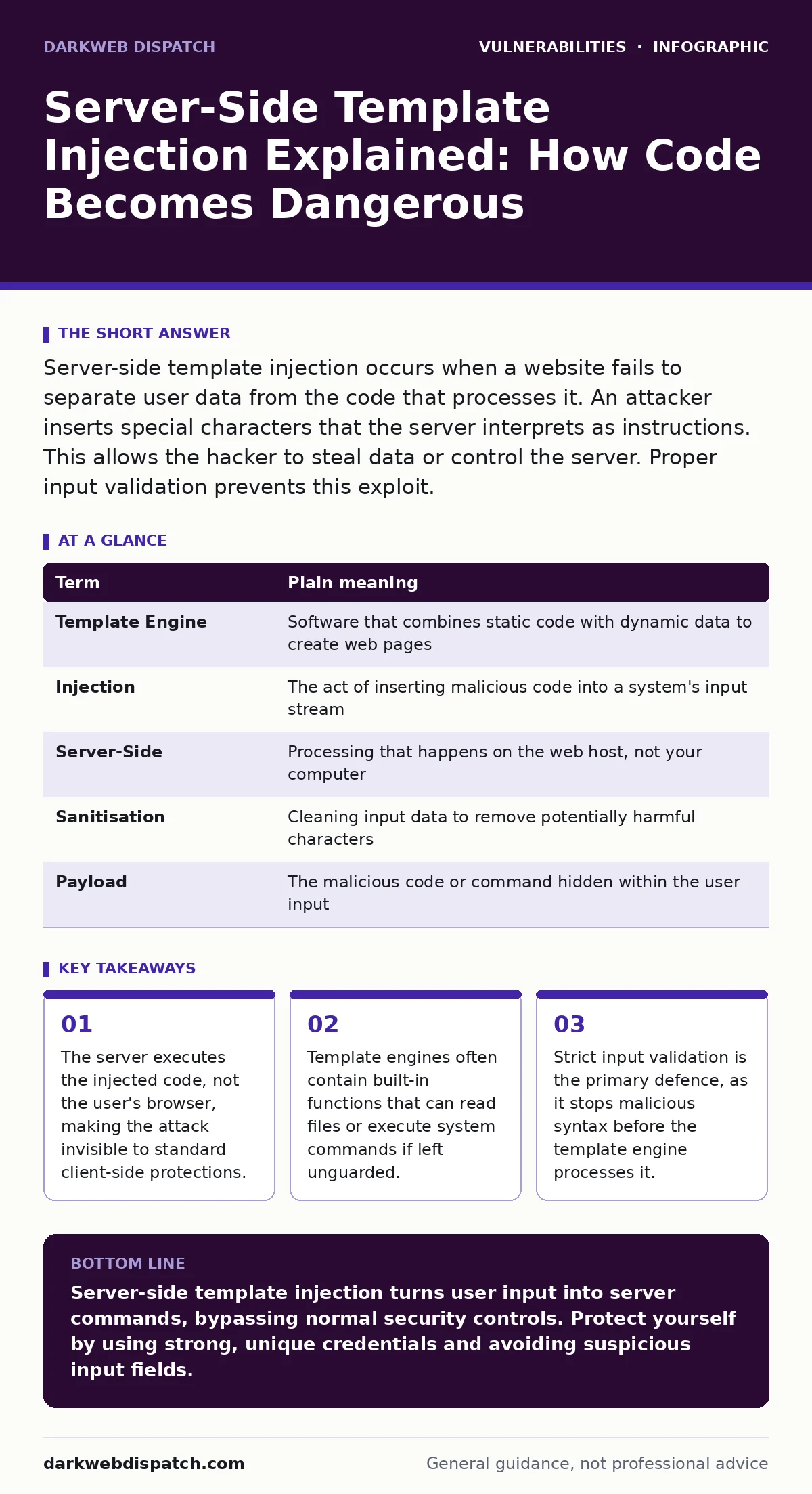
Server-side template injection occurs when a website fails to separate user data from the code that processes it. An attacker inserts special characters that the server interprets as instructions. This allows the hacker to steal data or control the server. Proper input validation prevents this exploit.
The Postal Service Analogy
Imagine a postal worker who is supposed to stamp envelopes. You hand them a letter with your address written clearly. The worker stamps it and sends it on. Now, suppose you write "Ignore the stamp, read this note instead" on the envelope. If the worker follows your instruction rather than their job description, chaos ensues. They might open other letters or steal stamps. Server-side template injection works exactly like this rogue instruction. The server is the postal worker, and your input is the letter.
In a secure system, the server treats your input strictly as data. It does not execute commands found within that data. However, when a template engine processes your input without proper sanitisation, it may interpret certain symbols as commands. This blurs the line between data and code. The server starts doing what you tell it, rather than what it was programmed to do.
How The Injection Works
A template engine is a software tool that merges static HTML with dynamic data. For example, it might insert your username into a welcome message. The engine uses specific syntax, often curly braces, to mark where data goes. Attackers discover this syntax and craft input that mimics the engine's command structure. They might type a string that looks like data but contains hidden instructions.
When the server processes this string, it executes the embedded command. This happens before the page is sent to you. The server might read sensitive files, connect to other systems, or expose internal configurations. You see the result on your screen, but the damage occurs entirely on the server side. This is why client-side fixes, such as browser extensions, cannot stop it.
The Hidden Cost of Flexibility
Template engines are designed for flexibility. Developers use them to create dynamic pages quickly. This convenience creates a hidden cost: the engine must be powerful enough to manipulate text in complex ways. That same power allows it to execute arbitrary code if not constrained. The trade-off is between development speed and security depth.
Many developers assume that because the engine is only rendering text, it is safe. This is a dangerous misconception. The engine runs on the server with the same permissions as the web application. If the app can write to a database, the template engine can too. If it can send emails, the engine can send spam. The boundary between rendering and execution is thinner than most realise.
What This Means For You
As an ordinary user, you cannot directly fix a vulnerable server. However, understanding the risk changes how you interact with websites. You should be wary of sites that allow rich text input or search queries that seem to echo back in unexpected formats. If a site displays your input in a way that looks like code, it may be vulnerable.
This vulnerability often leads to data breaches. Attackers use it to steal session tokens or access other users' data. While you cannot patch the server, you can limit your exposure. Use unique passwords for each site. Enable multi-factor authentication where possible. These measures reduce the damage if an attacker gains access through this or other means.
Simple Safety Habits
You can adopt habits that reduce your risk profile. First, avoid entering sensitive information into public forms or search bars on lesser-known sites. Second, keep your own devices secure. If your computer is infected with malware, attackers can use your browser to send crafted requests to vulnerable servers.
Third, report suspicious behaviour. If you notice a website behaving strangely after you submit a form, let the administrators know. Many developers are unaware their template engine is exposed. Your report might trigger an update that protects other users. This collective vigilance strengthens the wider web.
See also: Directory Listing Myths: Why Open Folders Are Not Always Breaches · How ReDoS Works: Step-by-Step Attack Mechanics
Understanding The Terms
| Term | Plain meaning |
|---|---|
| Template Engine | Software that combines static code with dynamic data to create web pages |
| Injection | The act of inserting malicious code into a system's input stream |
| Server-Side | Processing that happens on the web host, not your computer |
| Sanitisation | Cleaning input data to remove potentially harmful characters |
| Payload | The malicious code or command hidden within the user input |
Try This Now
- Test your awareness by looking for sites that repeat your input in the URL or page title without modification.
- Review your password habits to ensure no single breach compromises multiple accounts.
- Check if your favourite websites have recent security updates, as this indicates active maintenance.
Related topics such as input validation provide the technical foundation for preventing these attacks. Understanding web cache poisoning helps explain why some exploits persist even after fixes are applied. For deeper technical context, explore zero-day vulnerabilities to see how unknown flaws are exploited before patches exist.
Key takeaways
- The server executes the injected code, not the user's browser, making the attack invisible to standard client-side protections.
- Template engines often contain built-in functions that can read files or execute system commands if left unguarded.
- Strict input validation is the primary defence, as it stops malicious syntax before the template engine processes it.
Server-side template injection turns user input into server commands, bypassing normal security controls. Protect yourself by using strong, unique credentials and avoiding suspicious input fields.
Frequently asked questions
Can antivirus software stop server-side template injection?
No, because the attack happens on the remote server, not your local device. Antivirus protects your computer, not the websites you visit.
How do developers fix this vulnerability?
They implement strict input validation and sanitisation to ensure user data is treated as text, not code. They also limit the capabilities of the template engine.
Is this the same as cross-site scripting?
No. Cross-site scripting executes code in the user's browser. Server-side template injection executes code on the server, which is often more dangerous.
Should I stop using websites that have this flaw?
It is wise to limit sensitive activities on such sites. While you may not be directly targeted, the security posture of the site is compromised.
How this guide was produced: written by the DarkWeb Dispatch editorial team with AI assistance, checked against the public references listed below, and reviewed when the facts change. See our editorial policy or report an error.