Adversary-in-the-Middle Phishing: Step-by-Step Breakdown
This attack intercepts live traffic to bypass multi-factor authentication by reflecting credentials in real time between the victim and the legitimate service.

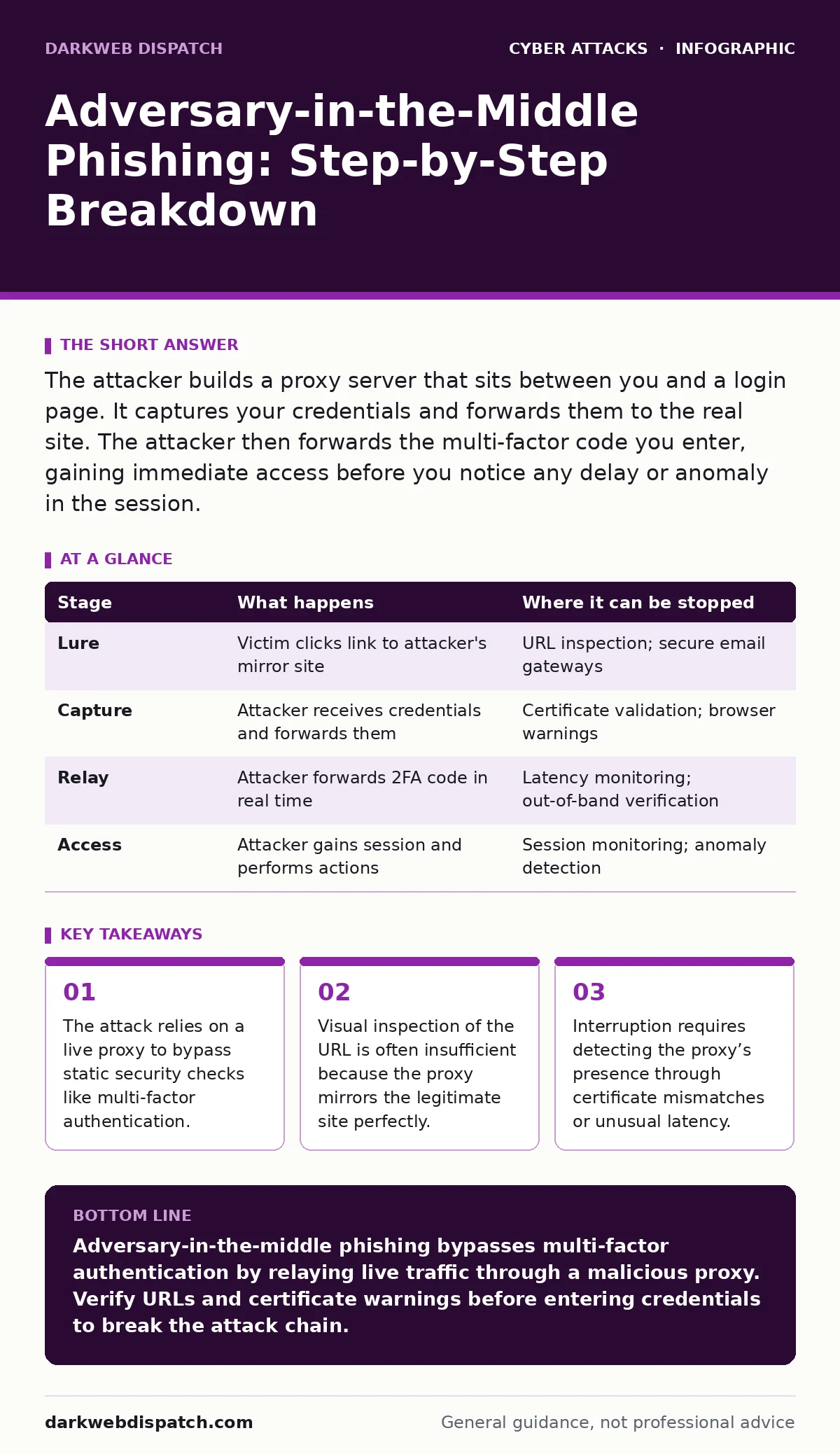
The attacker builds a proxy server that sits between you and a login page. It captures your credentials and forwards them to the real site. The attacker then forwards the multi-factor code you enter, gaining immediate access before you notice any delay or anomaly in the session.
The Mechanics of Live Interception
Adversary-in-the-middle phishing differs from traditional phishing because it does not rely on static fake pages. Traditional attacks present a static replica that fails when you submit credentials. This method creates a dynamic bridge. The attacker establishes a server that acts as a relay. You believe you are talking to the legitimate service. The attacker listens to every byte of data. They forward your input to the real server. They capture the response. They modify or record it. They send it back to you. The session remains active throughout the process.
This technique exploits the trust you place in the visual interface. The browser renders the login page exactly as it should appear. The security indicators, such as padlock icons, may even appear valid if the attacker uses valid certificates for their own domain. The deception lies in the network path, not the visual content. You are communicating with a hostile intermediary who controls the flow of information.
Stage 1: The Initial Lure
The attack begins with a delivery mechanism that directs you to the attacker’s infrastructure. This is often an email containing a link. The link appears legitimate. It may use a domain that looks similar to the target service. The attacker relies on your urgency or curiosity. You click the link. Your browser navigates to the attacker’s server. This server hosts a mirror of the legitimate login page. The mirror is not a static image. It is a functional application that generates the same HTML, CSS, and JavaScript as the real site.
The attacker must ensure the mirror is indistinguishable from the original. Any visual discrepancy raises suspicion. The page loads quickly. The branding is correct. The layout matches the current version of the service. The attacker updates the mirror if the legitimate service changes its design. This maintenance requires technical effort. It ensures the illusion holds. You proceed to enter your username and password.
Stage 2: Credential Capture and Relay
You submit your credentials. The attacker’s server receives them. It does not store them for later use. It immediately forwards them to the legitimate service. This is the critical step. The attacker acts as a transparent proxy. They send your username and password to the real login endpoint. The legitimate service processes the request. It validates the credentials. If they are correct, the service expects a second factor. It sends a request for a code or a push notification. The attacker intercepts this request. They forward it to you. You see the prompt for the second factor.
This stage relies on speed. The attacker must forward data quickly enough that you do not notice a delay. Network latency is normal. A slight increase in load time is often attributed to internet conditions. The attacker hides their involvement behind the noise of normal network behaviour. They capture the credentials in memory. They do not need to save them to a database. The goal is immediate access. The session is now active on the legitimate service. The attacker holds the session token.
Stage 3: Second Factor Bypass
You enter the multi-factor authentication code. This could be a one-time password from an app. It could be a code sent via SMS. It could be a push notification approval. The attacker’s server receives this code. They immediately forward it to the legitimate service. The service validates the code. It grants access. The attacker now has a valid session. They can read emails, view documents, or transfer funds. You also have a valid session. You see the same dashboard. You believe you have logged in successfully. The attack is complete.
The attacker often logs out of their session after a short period. This prevents detection through concurrent session alerts. They may perform specific actions, such as exporting data or changing settings. They then terminate their connection. You remain logged in. The session appears normal. The attacker has achieved their goal without triggering immediate alarms. The multi-factor authentication was defeated because it was verified in real time. The code was valid when you entered it. The attacker used it before it expired.
Stage 4: Post-Exploitation and Persistence
The attacker may not stop at initial access. They look for ways to maintain control. They might install malware on your device. They might change your password. They might add their own email address to your account for recovery. They might disable security settings. These actions occur while you are still logged in. You may not notice subtle changes. The attacker exploits the trust established during the login process. They use the session to perform administrative tasks. The damage is done while you are distracted by other work.
The attacker may also harvest additional data. They look for sensitive documents. They search for contacts. They map your network connections. This information is valuable for future attacks. It allows the attacker to target your colleagues or partners. The initial compromise becomes a foothold for broader infiltration. The attacker moves laterally through the organisation. The adversary-in-the-middle technique provided the entry point. The subsequent actions amplify the impact.
Where the Chain Breaks
You can interrupt this attack at several points. The first opportunity is during the initial navigation. If you notice the URL is slightly different, you should stop. Check the domain name carefully. Look for misspellings. Look for unexpected subdomains. The second opportunity is during the login process. If the page loads slowly, pause. If the certificate warning appears, do not ignore it. Modern browsers warn you if the certificate does not match the domain. These warnings are critical. They indicate a potential interception.
The third opportunity is after login. Monitor your session for anomalies. If you see unexpected activity, log out immediately. Change your password. Enable additional security measures. The attacker relies on your assumption that the interface is safe. Question that assumption. Verify the connection details. Use security tools that inspect traffic. These tools can detect proxy behaviour. They can identify mismatched certificates. They can alert you to suspicious redirects.
Table: Attack Stages and Interruption Points
| Stage | What happens | Where it can be stopped |
|---|---|---|
| Lure | Victim clicks link to attacker's mirror site | URL inspection; secure email gateways |
| Capture | Attacker receives credentials and forwards them | Certificate validation; browser warnings |
| Relay | Attacker forwards 2FA code in real time | Latency monitoring; out-of-band verification |
| Access | Attacker gains session and performs actions | Session monitoring; anomaly detection |
Technical Defences and Trade-offs
Technical defences add friction to the user experience. Certificate pinning ensures the browser only accepts specific certificates. This prevents attackers from using valid but wrong certificates. However, certificate pinning can break if the legitimate service updates its certificates. It requires careful management. It is not a solution for every application. Multi-factor authentication is still necessary. It is not sufficient on its own. You need layers of defence.
Network segmentation limits the damage if an account is compromised. It prevents lateral movement. It isolates critical systems. This reduces the impact of a successful attack. It does not prevent the initial compromise. You must still detect the interception. Security awareness training helps users recognise suspicious links. It reinforces the habit of checking URLs. It builds a culture of scepticism. Users become the first line of defence. They are also the weakest link. Training must be continuous and practical.
Related Threat Vectors
This attack shares characteristics with other threats. It relies on trust in the interface. It exploits human behaviour. It is different from email spoofing, which fakes the sender address. It is different from DNS amplification attacks, which overwhelm servers with traffic. It is different from SYN flood attacks, which exhaust connection resources. It is similar to evil twin Wi-Fi attacks, which create fake access points. Both intercept traffic. Both rely on the user connecting to a hostile node. Understanding these similarities helps you build better defences.
You should review your cyber hygiene practices. Regular updates patch vulnerabilities. Strong authentication reduces risk. Monitoring detects anomalies. These practices complement each other. They create a defence in depth. No single measure is enough. You need a combination of technical and human controls. The adversary-in-the-middle technique is sophisticated. It requires a sophisticated response. Stay alert. Verify your connections. Protect your sessions.
Final Considerations
The adversary-in-the-middle phishing attack is a serious threat. It bypasses traditional security controls. It exploits the trust you place in visual interfaces. It requires vigilance and technical defences. You must check URLs carefully. You must validate certificates. You must monitor your sessions. You must update your software. You must train your staff. These measures reduce the risk. They do not eliminate it. The attacker adapts. You must adapt too. Stay informed. Stay prepared. Protect your data.
The attack relies on speed and deception. It hides behind legitimate traffic. It uses your credentials against you. It defeats multi-factor authentication. It requires a multi-layered defence. Technical controls are necessary. Human awareness is equally important. Combine both. Build resilience. Detect the attack early. Respond quickly. Minimise the damage. Learn from the incident. Improve your defences. The cycle of attack and defence continues. You must keep pace.
Key takeaways
- The attack relies on a live proxy to bypass static security checks like multi-factor authentication.
- Visual inspection of the URL is often insufficient because the proxy mirrors the legitimate site perfectly.
- Interruption requires detecting the proxy’s presence through certificate mismatches or unusual latency.
Adversary-in-the-middle phishing bypasses multi-factor authentication by relaying live traffic through a malicious proxy. Verify URLs and certificate warnings before entering credentials to break the attack chain.
Frequently asked questions
Can a VPN stop adversary-in-the-middle phishing?
A VPN encrypts traffic between you and the VPN server. It does not stop the attacker from intercepting traffic after it leaves the VPN. The attacker still sits between the VPN exit and the target.
Does multi-factor authentication protect against this attack?
Standard time-based codes do not protect against this attack if the attacker forwards them in real time. Possession-based factors are verified live. The attacker gains access during the active session.
How do I know if my certificate is valid?
Your browser displays a padlock icon. Click it to view certificate details. Ensure the issuer is trusted and the domain matches exactly. Warnings indicate a mismatch or invalid certificate.
Should I use SMS for multi-factor authentication?
SMS is less secure than app-based codes. It is vulnerable to interception and SIM swapping. App-based codes are preferred. They are generated locally and do not traverse the mobile network.
How this guide was produced: written by the DarkWeb Dispatch editorial team with AI assistance, checked against the public references listed below, and reviewed when the facts change. See our editorial policy or report an error.