What is data mapping: the hidden blueprint for breach defence
Most organisations lose control of their data not through theft, but because they cannot prove where sensitive information resides during an incident.

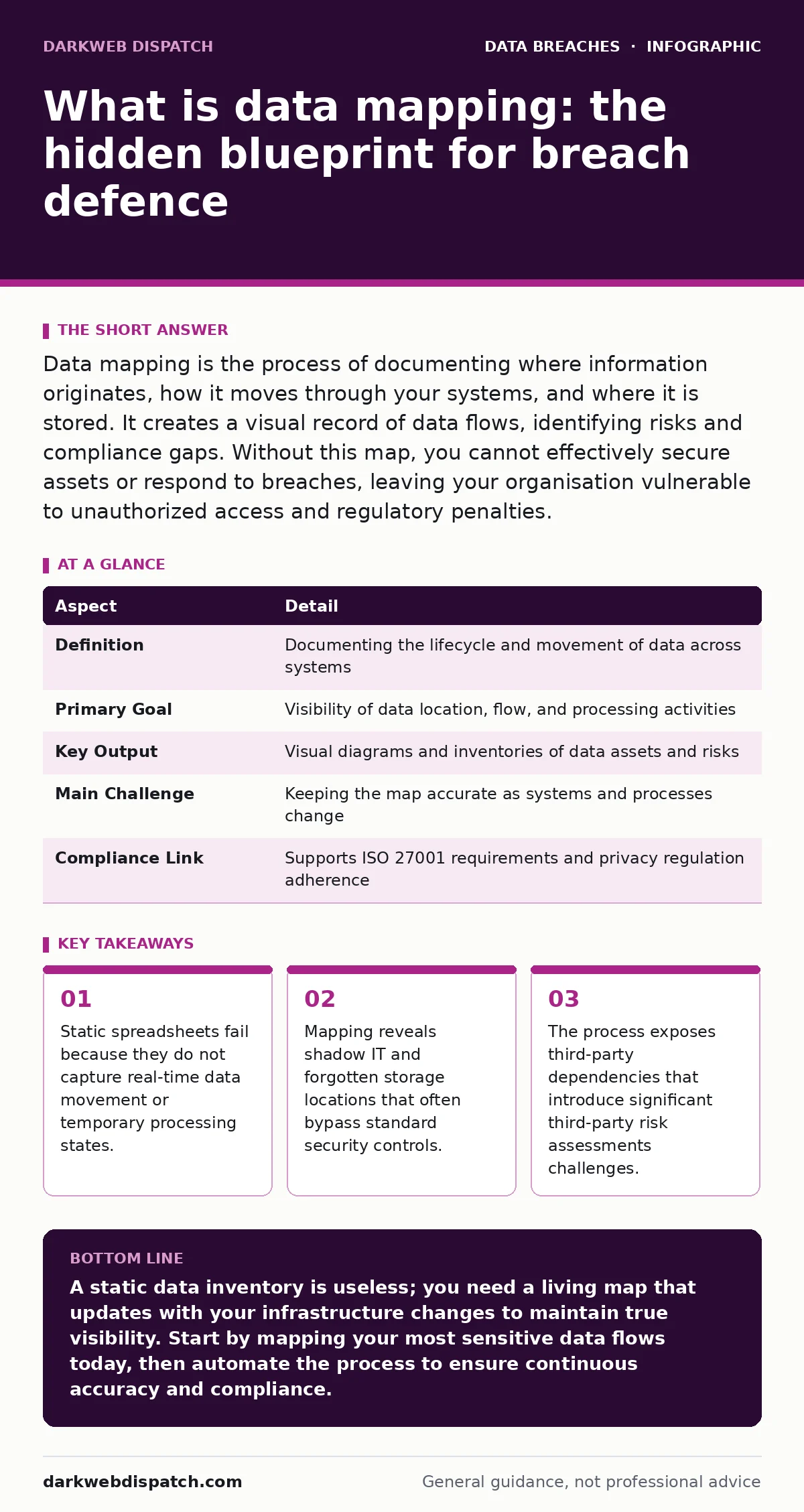
Data mapping is the process of documenting where information originates, how it moves through your systems, and where it is stored. It creates a visual record of data flows, identifying risks and compliance gaps. Without this map, you cannot effectively secure assets or respond to breaches, leaving your organisation vulnerable to unauthorized access and regulatory penalties.
The postal service analogy
Imagine a postal service that delivers letters but never records which postbox holds which address. When a letter goes missing, staff cannot trace its route or identify the responsible handler. Data mapping works the same way for your digital information. It tracks every piece of sensitive data from creation to deletion. You identify the source, the path, and the final destination. This visibility turns a chaotic flow of bytes into a structured, auditable journey.
At a glance
| Aspect | Detail |
|---|---|
| Definition | Documenting the lifecycle and movement of data across systems |
| Primary Goal | Visibility of data location, flow, and processing activities |
| Key Output | Visual diagrams and inventories of data assets and risks |
| Main Challenge | Keeping the map accurate as systems and processes change |
| Compliance Link | Supports ISO 27001 requirements and privacy regulation adherence |
What is data mapping
Data mapping is the systematic documentation of how information flows through your organisation. It answers three fundamental questions. Where does the data come from? How is it processed or transformed? Where does it end up? This is not merely a list of files. It is a dynamic record of relationships between systems, users, and data elements. You map the journey of a single data point, such as a customer email address, from the moment it is entered into a form until it is archived or deleted. This clarity is the foundation of any effective security strategy.
How the process works
The mapping process begins with discovery. You identify all systems that collect, store, or process data. This includes servers, cloud applications, and even personal devices used for work. Next, you trace the flow. You determine how data moves between these systems. Does it pass through a third-party processor? Is it encrypted in transit? You document each step. This creates a lineage chart. You then classify the data. You label information based on sensitivity. Finally, you identify risks at each node. You note where access controls are weak or where logging is absent. This structured approach reveals blind spots that manual checks miss.
Who it affects
Data mapping affects every department that handles information. Engineering teams need to understand where their code accesses sensitive databases. Legal teams require accurate records to prove compliance with privacy laws. Security teams rely on the map to prioritise protection efforts. Executive leadership uses it to assess overall risk posture.
It also impacts external partners. When you share data with vendors, you must know what you are sending. This transparency improves the quality of your third-party risk assessments. You cannot manage what you do not see. The map forces accountability across the entire organisation, breaking down silos that often hide data hoarding or insecure practices.
Common mistakes in mapping
Many organisations treat data mapping as a one-time project. They create a static spreadsheet and file it away. This approach fails because systems change constantly. New applications are deployed, APIs are updated, and storage needs grow. A static map becomes obsolete within months. Another common error is focusing only on storage. You might map where data rests, but ignore how it moves. Transient data in memory or during processing is often overlooked. This gap leaves your organisation vulnerable to interception or unauthorized access during transmission. You must map the motion, not just the destination. Ignoring the flow is like knowing where a car is parked but not where it drives.
The hidden cost of inaccuracy
An inaccurate map creates a false sense of security. You believe you have controlled data, but gaps remain. These gaps are where breaches occur. When an incident happens, responders waste precious time trying to locate affected records. This delay increases data breach costs significantly. You cannot isolate the problem if you do not know the scope.
Furthermore, inaccurate maps lead to poor compliance decisions. You might delete data that is still needed for legal holds, or retain data that should have been purged. This increases liability. The cost of maintaining an accurate map is low compared to the expense of a major data leaks event. Accuracy is not optional; it is a financial imperative.
Maintaining the living map
Data mapping is a continuous discipline, not a project. You must automate discovery where possible. Manual updates are prone to error and fatigue. Integrate mapping tools with your infrastructure management systems. When a new server is provisioned, the map should update automatically. Regular audits are still necessary. You must verify that the automated records match reality. Train staff to report changes. When a new application is integrated, the mapping process should be part of the approval workflow. This ensures that no data flow goes undocumented. Consistency is key. A living map requires cultural commitment. Everyone must understand that data visibility is a shared responsibility.
Integration with security frameworks
Data mapping supports broader security standards. It provides the evidence base for ISO 27001 certification. Auditors need to see that you understand your information assets. The map demonstrates due diligence. It also helps prevent synthetic identity fraud by ensuring that identity data is handled consistently across systems. When you know where identity verification data resides, you can apply stricter controls. This reduces the risk of bad actors manipulating records. The map connects technical controls to business risk. It bridges the gap between IT operations and strategic security goals. Without this link, security measures remain isolated and ineffective.
Key takeaways
- Static spreadsheets fail because they do not capture real-time data movement or temporary processing states.
- Mapping reveals shadow IT and forgotten storage locations that often bypass standard security controls.
- The process exposes third-party dependencies that introduce significant third-party risk assessments challenges.
A static data inventory is useless; you need a living map that updates with your infrastructure changes to maintain true visibility. Start by mapping your most sensitive data flows today, then automate the process to ensure continuous accuracy and compliance.
Frequently asked questions
How often should I update my data map?
You should update your map whenever systems change, ideally in real-time through automation. Manual reviews should occur at least quarterly to catch discrepancies and verify automated records against actual usage patterns.
Do I need special software for data mapping?
While spreadsheets can work for very small environments, dedicated discovery tools are necessary for complex infrastructures. These tools automatically detect data flows and classify information, reducing human error and ensuring the map remains current.
Who is responsible for creating the data map?
Responsibility is shared. IT teams provide technical details on systems and flows. Legal and compliance teams define classification rules. Security teams validate risks. A central data governance group should oversee the process to ensure consistency and completeness.
Can data mapping help with cloud security?
Yes, mapping is critical for cloud environments. It identifies where data resides across public, private, or hybrid clouds. This visibility prevents misconfigured cloud storage leaks by ensuring that sensitive data does not end up in publicly accessible buckets or unmonitored services.
How this guide was produced: written by the DarkWeb Dispatch editorial team with AI assistance, checked against the public references listed below, and reviewed when the facts change. See our editorial policy or report an error.