Reduce False Positives: Practical Steps for Cleaner Threat Detection
High alert volumes mask real intrusions by exhausting analyst capacity, turning your security stack into a source of operational noise rather than protection.

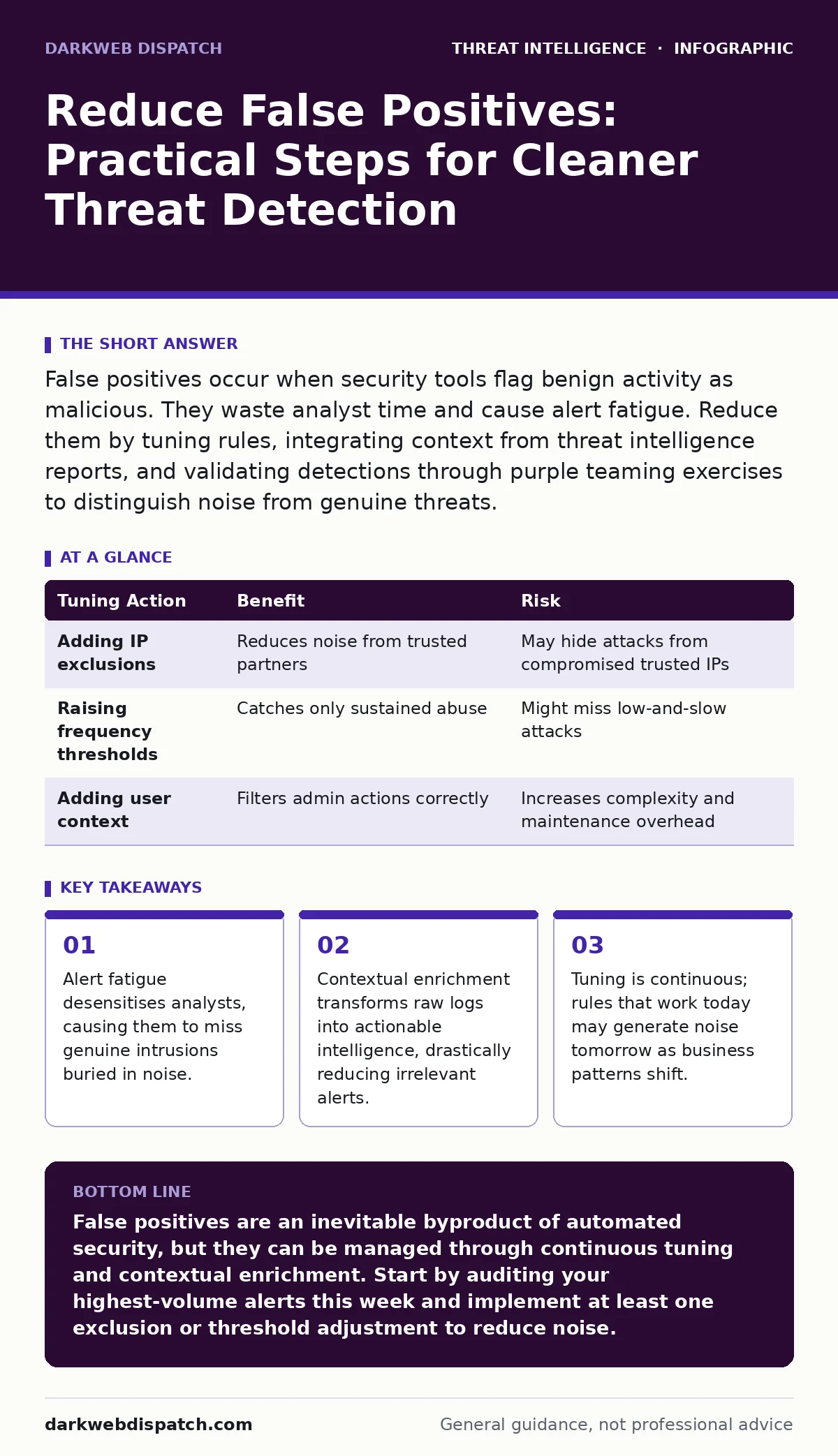
False positives occur when security tools flag benign activity as malicious. They waste analyst time and cause alert fatigue. Reduce them by tuning rules, integrating context from threat intelligence reports, and validating detections through purple teaming exercises to distinguish noise from genuine threats.
Why do false positives happen in security tools?
False positives arise when a detection rule matches benign behaviour that superficially resembles malicious activity. Most tools rely on pattern matching or heuristic analysis, which cannot always distinguish between a user performing an unusual but legitimate task and an attacker exploiting a vulnerability. For instance, a system administrator rebooting servers at 3 a.m. might trigger a rule designed to catch lateral movement during off-hours.
How does alert fatigue impact security operations?
When analysts receive hundreds of irrelevant alerts daily, their ability to prioritise genuine threats degrades significantly. This phenomenon, known as alert fatigue, leads to cognitive overload and decision paralysis. Over time, analysts may develop a subconscious bias to dismiss alerts, assuming they are likely false positives. This complacency creates blind spots where genuine intrusions, such as scheduled task abuse, can persist undetected for extended periods.
What is the cost of ignoring false positive reduction?
The primary cost is wasted human capital, but the secondary cost is increased dwell time for real attacks. Every minute spent investigating a benign alert is a minute not spent on a genuine incident. Furthermore, frequent false alarms erode trust in the security programme among leadership and other teams. If stakeholders perceive the security tooling as a nuisance, they may resist adopting more rigorous controls, weakening the overall defence posture.
How can you tune detection rules effectively?
Tuning involves refining the criteria used to trigger an alert, often by adding exclusions or raising thresholds. Start by analysing recent false positives to identify common characteristics, such as specific IP ranges, user groups, or application behaviours. Exclude these known benign sources from the rule logic. However, be cautious not to over-exclude, as this might hide genuine attacks that mimic legitimate traffic, a technique sometimes seen in domain fronting scenarios.
| Tuning Action | Benefit | Risk |
|---|---|---|
| Adding IP exclusions | Reduces noise from trusted partners | May hide attacks from compromised trusted IPs |
| Raising frequency thresholds | Catches only sustained abuse | Might miss low-and-slow attacks |
| Adding user context | Filters admin actions correctly | Increases complexity and maintenance overhead |
Why is context critical for accurate detection?
Raw log data lacks the narrative needed to determine intent. Context enrichment involves correlating alert data with external information, such as asset criticality, user role, or historical behaviour. A file download from a finance department is less suspicious than the same download from an engineering workstation. By integrating data sources, you transform a simple event into a meaningful indicator. This approach aligns with the Unified Kill Chain, helping you identify which stage of an attack the activity represents.
See also: Network Traffic Analysis: Fixing 6 Common Misconceptions · Blue Team Myths: Correcting Common Misunderstandings
How do you distinguish between noise and genuine anomalies?
Genuine anomalies often exhibit persistence, evasion techniques, or lateral movement that benign noise lacks. Noise is typically isolated, repetitive, and aligns with known business processes. Anomalies may involve unusual process trees, unexpected network connections, or privilege escalation attempts. For example, a sudden spike in DNS queries from a single host might be a software update (noise) or a command-and-control beacon (anomaly). Cross-referencing with threat intelligence reports helps clarify the nature of the domain being queried.
What role does purple teaming play in reducing false positives?
Purple teaming involves coordinated exercises between red teams (attackers) and blue teams (defenders) to test detection capabilities. By simulating realistic attacks, you can verify whether your tools generate alerts for genuine malicious activity. If an attack succeeds without triggering an alert, you have a false negative. If the simulation triggers excessive noise, you have a tuning opportunity. This feedback loop ensures your rules remain relevant and effective against current tactics, including sophisticated methods like golden ticket attacks.
How often should you review and update detection rules?
Detection rules require continuous review, ideally on a monthly basis or whenever significant infrastructure changes occur. Business processes evolve, new applications are deployed, and threat actors refine their techniques. Static rules become obsolete quickly, generating more noise over time. Regular reviews ensure that exclusions are still valid and that new threats are covered. This maintenance is as vital as the initial deployment of the security controls.
Can machine learning eliminate false positives entirely?
No, machine learning models can reduce false positives by learning normal behaviour patterns, but they introduce new challenges. Models require large volumes of clean data for training and can drift if the underlying data changes. They may also suffer from bias, ignoring rare but critical events. Furthermore, attackers can adapt their behaviour to mimic normal patterns, bypassing ML-based detections. Human oversight remains necessary to interpret model outputs and handle edge cases.
How do you measure the success of false positive reduction?
Success is measured by the signal-to-noise ratio, which compares the number of true positives to the total number of alerts generated. A lower volume of high-fidelity alerts is preferable to a high volume of low-fidelity ones. Regularly report these metrics to stakeholders to demonstrate the value of tuning efforts and justify resource allocation.
Key takeaways
- Alert fatigue desensitises analysts, causing them to miss genuine intrusions buried in noise.
- Contextual enrichment transforms raw logs into actionable intelligence, drastically reducing irrelevant alerts.
- Tuning is continuous; rules that work today may generate noise tomorrow as business patterns shift.
False positives are an inevitable byproduct of automated security, but they can be managed through continuous tuning and contextual enrichment. Start by auditing your highest-volume alerts this week and implement at least one exclusion or threshold adjustment to reduce noise.
Frequently asked questions
What is the difference between a false positive and a false negative?
A false positive is a benign event flagged as malicious, while a false negative is a malicious event that goes undetected. Both are errors, but false negatives are generally more dangerous as they allow attacks to proceed unnoticed.
How do I handle false positives from third-party security vendors?
Contact the vendor to report the false positive and request a rule update. In the meantime, adjust your local configuration to exclude the benign activity if possible, or suppress the alert in your SIEM until a fix is provided.
Should I disable detection rules that generate too many false positives?
Disabling a rule is a last resort. Instead, try to refine the rule by adding exclusions or adjusting thresholds. If the rule cannot be tuned effectively, consider replacing it with a more sophisticated detection method or a different tool.
What is the impact of false positives on incident response times?
High volumes of false positives increase the time analysts spend triaging alerts, delaying the response to genuine incidents. This can lead to increased dwell time for attackers and greater potential damage to the organisation.
How this guide was produced: written by the DarkWeb Dispatch editorial team with AI assistance, checked against the public references listed below, and reviewed when the facts change. See our editorial policy or report an error.