Purple Teaming Mistakes: Fix Common Errors for Better Security
Most purple teams fail because they simulate attacks rather than validating detection logic, leaving critical blind spots open to real adversaries.

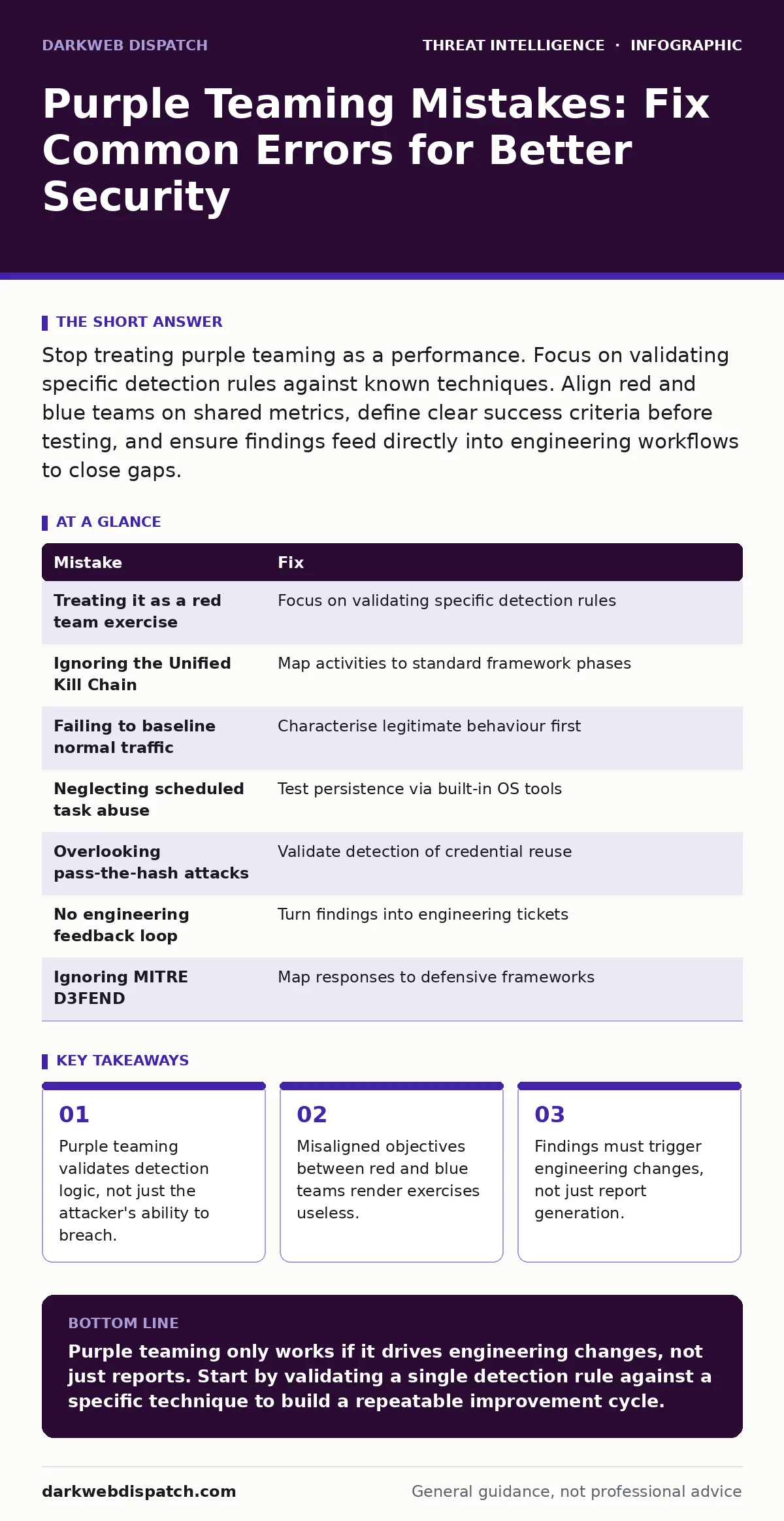
Stop treating purple teaming as a performance. Focus on validating specific detection rules against known techniques. Align red and blue teams on shared metrics, define clear success criteria before testing, and ensure findings feed directly into engineering workflows to close gaps.
Purple teaming combines offensive and defensive security efforts to improve detection and response capabilities. It differs from red teaming, which simulates a full adversary campaign to test overall security posture. The goal here is not to win a game, but to verify that your sensors catch specific malicious behaviours before they cause harm.
Mistake 1: Treating it as a red team exercise
Many organisations deploy an offensive team to break in, then ask defenders to find the breach. This approach misses the point of purple teaming. The objective is not to prove the attacker can succeed, but to prove the defender can see what is happening. If the red team succeeds without detection, the exercise has failed its primary purpose.
Why it hurts: You waste resources on elaborate attack scenarios that do not test your actual detection capabilities. Defenders learn nothing about improving their sensor coverage or alert tuning. The result is a false sense of security based on the difficulty of the attack, not the quality of the defence.
The fix: Start with a specific detection rule or gap. Ask the red team to execute only the techniques that trigger that rule. If the alert fires, analyse why. If it does not, work together to build a better signature. This iterative loop builds real capability rather than just generating a list of vulnerabilities.
Mistake 2: Ignoring the Unified Kill Chain
Teams often jump straight to exploitation without mapping activities to standard frameworks. Without a shared language, red and blue teams talk past each other. The attacker describes "hacking the box," while the defender looks for "network anomalies." This disconnect prevents meaningful analysis of what was missed.
Why it hurts: You cannot improve what you cannot measure. Without mapping actions to a framework like the Unified Kill Chain, you lack the structure to identify which phase of the attack failed detection. You might fix endpoint logging while the real blind spot was in initial access.
The fix: Define the kill chain phases you want to test before starting. Focus on one or two phases, such as lateral movement or persistence. Both teams must agree on the techniques used. This ensures the exercise tests specific defences rather than general security hygiene.
Mistake 3: Failing to baseline normal traffic
Defenders often struggle to distinguish malicious activity from legitimate noise. If the blue team does not understand what normal user behaviour looks like, every alert feels like a potential threat. This leads to alert fatigue and desensitisation to genuine warnings.
Why it hurts: You drown in false positives in threat detection. Analysts begin to ignore alerts because most are benign. When a real attack occurs, it gets lost in the noise. The purple team exercise then fails to improve signal-to-noise ratio, leaving the SOC overwhelmed.
The fix: Spend time characterising normal traffic before testing. Establish baselines for user logins, process executions, and network connections. This allows the blue team to spot deviations more easily. It also helps refine detection rules to reduce noise, making real threats stand out.
Mistake 4: Neglecting scheduled task abuse
Attackers frequently use legitimate system tools to maintain access. Many purple teams focus on exotic malware while ignoring built-in features. Scheduled tasks are a common vector for persistence that often flies under the radar because they are native to the operating system.
Why it hurts: You leave a wide-open door for persistence. Defenders may monitor for known malware hashes but ignore legitimate processes running at unusual times. An attacker using scheduled task abuse can remain undetected for weeks, moving laterally and exfiltrating data.
The fix: Include tests of built-in tools in your scenarios. Have the red team create scheduled tasks that mimic legitimate maintenance jobs. The blue team should monitor for task creation events and unusual execution patterns. This ensures you catch persistence mechanisms that do not require external binaries.
Mistake 5: Overlooking pass-the-hash attacks
Credential theft is a primary goal for adversaries. Many teams assume that strong passwords are enough to stop lateral movement. However, attackers can often reuse credential hashes without knowing the actual password, bypassing many standard authentication checks.
Why it hurts: You assume containment where none exists. A single compromised machine can lead to domain-wide access if pass-the-hash attacks are not detected. The purple team fails to validate whether your monitoring catches credential misuse, leaving the core network exposed.
The fix: Test detection of credential reuse specifically. The red team should attempt to move laterally using stolen hashes. The blue team must verify that their logs capture authentication attempts and flag those that do not present a password hash correctly. This validates your defence against one of the most common lateral movement techniques.
See also: Network Traffic Analysis: Fixing 6 Common Misconceptions · Blue Team Myths: Correcting Common Misunderstandings
Mistake 6: No engineering feedback loop
The most common failure is letting findings sit in a report. Purple teaming produces data, but if that data does not change the environment, it is wasted effort. Security is not about knowing you are vulnerable; it is about fixing the vulnerability.
Why it hurts: You create a cycle of repeated failures. The same gaps are identified in every exercise because nothing changes. Engineers remain unaware of detection gaps, and analysts continue to fight the same noise. The organisation stagnates despite spending money on testing.
The fix: Integrate findings directly into the development workflow. Treat detection gaps like software bugs. Assign tickets to engineering to update signatures, improve logging, or adjust configurations. Measure success by the number of gaps closed, not the number of attacks simulated.
Mistake 7: Ignoring MITRE D3FEND
Teams often focus solely on what the attacker does. They forget to consider what the defender can do in response. Without a framework for defensive actions, the blue team has no standard way to evaluate their options during an incident.
Why it hurts: You lack a structured response strategy. Defenders react ad-hoc, missing opportunities to block or mitigate attacks. The purple team exercise highlights detection but fails to improve response, leaving the organisation vulnerable even after an alert is raised.
The fix: Map defensive actions to MITRE D3FEND. This framework catalogues defensive techniques that counter specific adversary tactics. Use it to plan responses during the exercise. This ensures you not only see the attack but also have a validated method to stop it.
| Mistake | Fix |
|---|---|
| Treating it as a red team exercise | Focus on validating specific detection rules |
| Ignoring the Unified Kill Chain | Map activities to standard framework phases |
| Failing to baseline normal traffic | Characterise legitimate behaviour first |
| Neglecting scheduled task abuse | Test persistence via built-in OS tools |
| Overlooking pass-the-hash attacks | Validate detection of credential reuse |
| No engineering feedback loop | Turn findings into engineering tickets |
| Ignoring MITRE D3FEND | Map responses to defensive frameworks |
Key takeaways
- Purple teaming validates detection logic, not just the attacker's ability to breach.
- Misaligned objectives between red and blue teams render exercises useless.
- Findings must trigger engineering changes, not just report generation.
Purple teaming only works if it drives engineering changes, not just reports. Start by validating a single detection rule against a specific technique to build a repeatable improvement cycle.
Frequently asked questions
How is purple teaming different from red teaming?
Red teaming simulates a full adversary campaign to test overall security. Purple teaming is an iterative process where offensive and defensive teams collaborate to improve specific detection and response capabilities.
Do I need a dedicated purple team?
No. You can designate existing security staff to rotate through offensive and defensive roles. The key is collaboration and shared objectives, not separate headcount.
How often should we run purple team exercises?
Frequency depends on your environment's change rate. Regular, smaller exercises are more effective than rare, large campaigns. Aim for continuous validation of critical detection rules.
Can purple teaming replace penetration testing?
No. Penetration testing assesses exploitability of vulnerabilities. Purple teaming assesses the effectiveness of your detection and response. Both are necessary for a complete security posture.
How this guide was produced: written by the DarkWeb Dispatch editorial team with AI assistance, checked against the public references listed below, and reviewed when the facts change. See our editorial policy or report an error.