How to Spot JWT Vulnerabilities Before They Breach Your System
Weak signing algorithms and missing expiry times often hide in plain sight, allowing attackers to forge tokens without triggering standard security alerts.

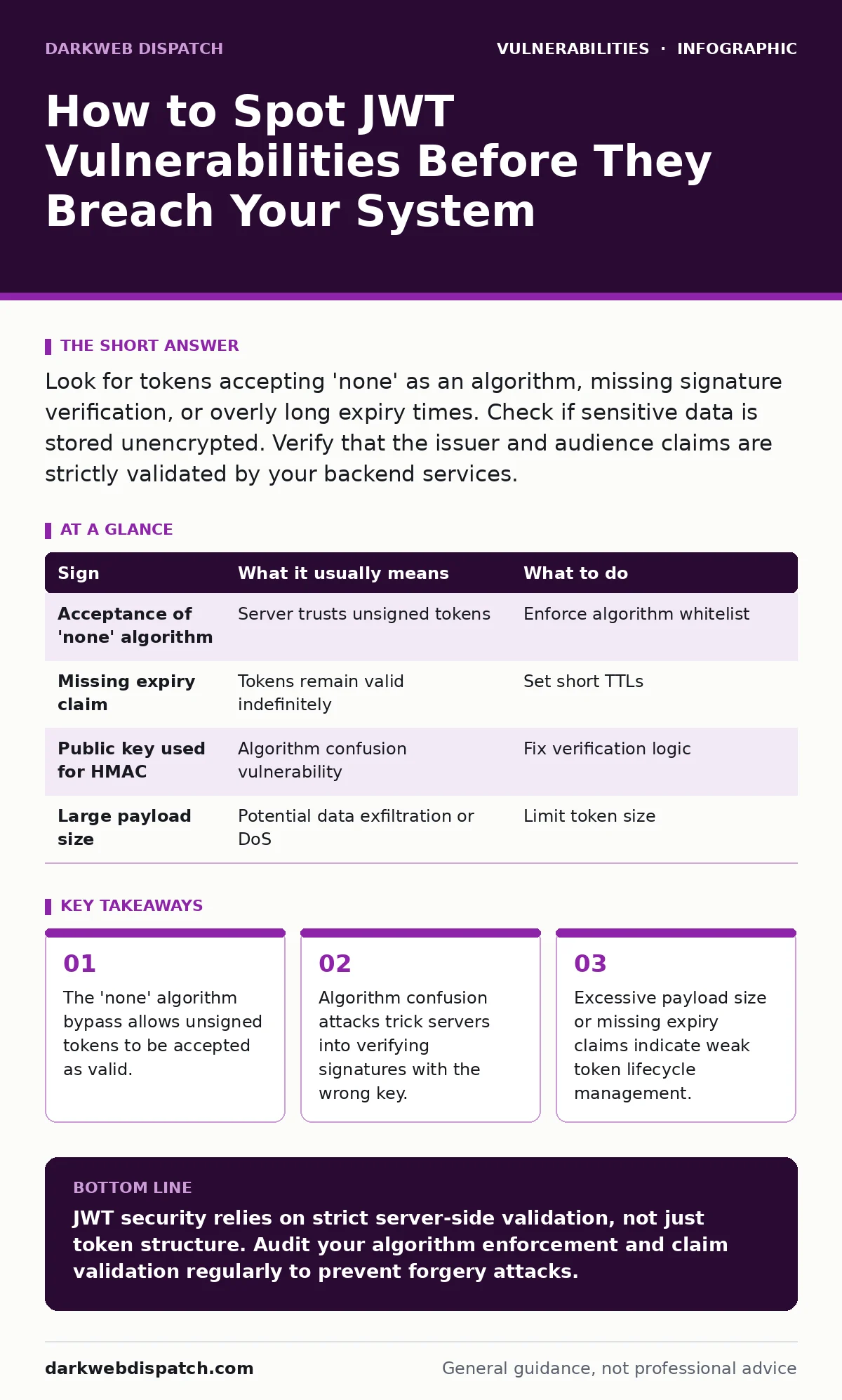
Look for tokens accepting 'none' as an algorithm, missing signature verification, or overly long expiry times. Check if sensitive data is stored unencrypted. Verify that the issuer and audience claims are strictly validated by your backend services.
Recognising immediate behavioural anomalies
You notice the first warning signs when application behaviour deviates from standard authentication flows. A user interface that accepts tokens with visibly altered claims without re-authentication suggests weak server-side validation. If an endpoint processes a token where the signature has been stripped or modified, the system lacks proper cryptographic verification. This failure often stems from misconfigured libraries that default to trusting the client-provided algorithm header.
Identifying silent configuration failures
Signs that are easy to miss involve the internal logic of token handling. Developers often forget to validate the issuer claim, allowing tokens from unrelated services to access your API. Audience validation failures permit cross-service token reuse, breaking the principle of least privilege. These issues do not crash the application, so they remain hidden until an attacker exploits the trust boundary. Reviewing access logs for unexpected service origins helps reveal these gaps.
The danger of algorithm confusion
Algorithm confusion attacks exploit the mismatch between how a token is signed and how it is verified. Suppose a server expects an asymmetric RSA signature but accepts a symmetric HMAC token. An attacker can then use the public key as the HMAC secret, forging valid tokens. This vulnerability persists because many libraries automatically switch algorithms based on the token header. You must enforce a single, expected algorithm on the server side to prevent this switch.
Practical response to suspected weakness
When you detect a potential vulnerability, isolate the affected endpoints immediately. Disable the acceptance of client-specified algorithms and force the server to use a predefined cryptographic method. Rotate your signing keys to invalidate any tokens forged using the previous configuration. Implement strict validation of the issuer and audience claims to ensure tokens are only accepted from trusted sources.
| Sign | What it usually means | What to do |
|---|---|---|
| Acceptance of 'none' algorithm | Server trusts unsigned tokens | Enforce algorithm whitelist |
| Missing expiry claim | Tokens remain valid indefinitely | Set short TTLs |
| Public key used for HMAC | Algorithm confusion vulnerability | Fix verification logic |
| Large payload size | Potential data exfiltration or DoS | Limit token size |
Managing token lifecycle risks
Long-lived tokens increase the window for exploitation. If a token is stolen, it remains useful until it expires. You should implement short time-to-live values and refresh mechanisms to limit exposure. This approach reduces the impact of credential theft. Combining this with server-side session tracking allows you to revoke access immediately if suspicious activity is detected. This strategy aligns with best practices for session fixation prevention.
See also: Prevent Microsoft Exchange Vulnerabilities: Priority Measures · Browser Extension Vulnerabilities: Risks and Protection for Small Businesses
Validating claims and scopes
JWTs often contain claims that dictate user permissions. If these claims are not validated against a central authority, attackers can modify them locally. Ensure that critical claims like role or group membership are verified against a trusted directory. Do not trust client-side modifications to these values. This validation step prevents privilege escalation attacks where users grant themselves admin rights by editing their own tokens.
Integrating with broader security hygiene
JWT vulnerabilities often intersect with other security weaknesses. For instance, a server-side template injection flaw might allow an attacker to extract signing keys. Understanding how these vulnerabilities interact helps you prioritise patches. You should also consider the risk of wormable vulnerabilities if the token handling logic is exposed to untrusted inputs. Regular audits of your authentication logic are necessary to maintain security.
Final verification steps
After implementing fixes, test your authentication flow with malformed tokens. Attempt to submit tokens with missing signatures, altered algorithms, and expired claims. Verify that the server rejects these tokens consistently. Monitor your logs for any attempts to exploit these weaknesses. This proactive testing ensures that your security measures are effective against common attack patterns.
Key takeaways
- The 'none' algorithm bypass allows unsigned tokens to be accepted as valid.
- Algorithm confusion attacks trick servers into verifying signatures with the wrong key.
- Excessive payload size or missing expiry claims indicate weak token lifecycle management.
JWT security relies on strict server-side validation, not just token structure. Audit your algorithm enforcement and claim validation regularly to prevent forgery attacks.
Frequently asked questions
Can JWTs be used for encryption?
Yes, JWE (JSON Web Encryption) allows you to encrypt the payload, ensuring confidentiality alongside integrity.
How do you prevent token theft?
Use HTTPS exclusively, store tokens securely in memory, and implement short expiry times to limit their usefulness if stolen.
Is the 'none' algorithm ever safe?
No, accepting 'none' in production environments disables signature verification, making token forgery trivial for any attacker.
What is the best way to revoke tokens?
Maintain a server-side blocklist or use short-lived tokens with refresh mechanisms to effectively manage token lifecycle.
How this guide was produced: written by the DarkWeb Dispatch editorial team with AI assistance, checked against the public references listed below, and reviewed when the facts change. See our editorial policy or report an error.